
Filial piety ceremony of the Thai people in western Nghe An
(baonghean.vn)This is an important ritual in the lives of the Thai clans in Nghe An. Children and grandchildren are only allowed to hold the Filial Piety Ceremony after they have started their own families. The Filial Piety Ceremony of the Thai people in Nghe An is different from the longevity celebration of the Vietnamese.
|
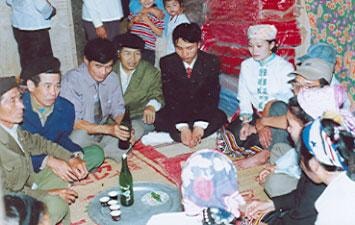
In some Thai ethnic groups in Nghe An, the Vu Lan festival is also celebrated on the 15th day of the seventh lunar month. It is usually a major annual festival for these clans. The offerings for the 15th day of the seventh lunar month in Nghe An are usually quite simple, consisting only of sticky rice with chicken and a dish called "mooc," made from minced meat or fish mixed with pounded rice, wrapped in banana leaves and boiled or steamed like sticky rice. However, the 15th day of the seventh lunar month in Nghe An is primarily a day for descendants to remember their ancestors and an occasion for relatives to gather, share a meal, and pass on life experiences, business knowledge, and interpersonal skills to their children. It is also a time for traditional singing contests between elders over jars of rice wine. This is usually the biggest festival of the year for the entire village; on other days, they still have to work hard in the forests, streams, and rivers to make a living.
Children and grandchildren are only allowed to hold a filial piety ceremony after they have started their own families. Usually, this is because the parents of the husband or wife are experiencing health problems or prolonged illnesses. At that time, they organize a ceremony to show filial piety to their parents, with the intention of encouraging them spiritually, praying for their parents' speedy recovery, and wishing them long life so that their children and grandchildren can live happily and stably.
However, in terms of meaning, the filial piety ceremony of the Thai people in Nghe An is different from the longevity celebration of the Vietnamese.
In the Thai ethnic group of Nghe An, the decision to perform a filial piety ceremony is usually made by shamans. When an elderly person in the family is ill for a long time without recovery, their children habitually bring a piece of the sick person's clothing along with 10 betel leaves and 10 areca nuts to ask those who can communicate with the sick person's spirit for help. In some cases, children must perform a filial piety ceremony because the spirit of their parents demands that their children repay the debt of gratitude for their parents' upbringing and care from birth to adulthood.
The date for the filial piety ceremony is not fixed. Families can hold it whenever circumstances permit, provided the parents are still alive. Sometimes, children must perform this ceremony for parents who are no longer alive. These cases often stem from financial difficulties, forcing them to make amends to their deceased parents when their family is more financially secure.
The person presiding over the ceremony is chosen from among the shamans in the village, usually the most respected person in that community. However, shamans in the Thai villages of Nghe An rarely make a living from performing rituals. They do these services mainly at the request of the host family, often because they have a close relationship with the host.
The offerings in the filial piety ceremony of the Thai people of Nghe An are quite elaborate because it is an important ritual expressing the respect and devotion of children to their parents. The offering tray must include a pig's head, a pair of chickens, and a pair of silver necklaces or bracelets. These offerings are mentioned by the shamans in their prayers, which guide the souls of the deceased to receive the offerings from their children and take them to heaven, thus receiving the sincere respect of their descendants so that from now on, the parents' bodies will be healthy and they will live long lives. In old age, Thai parents in Nghe An often "demand" that each child perform this filial piety ceremony at least once. If they do not receive this ceremony, their souls will feel sad and suffer from continuous illness and disease. This custom has become a duty of children towards their parents and ancestors.
A rather unique and interesting custom is that daughters, even after marrying and moving to their husband's home, still have to perform filial piety rituals for their parents. Sons-in-law are also well aware of this, and they often proactively choose an auspicious occasion to fulfill their filial duty to their wives' parents.
Ha Phuong -University of Culture, Hanoi


