
The naming ceremony of the Khmu people
(Baonghean) - Upon birth, a child is considered a new human being. The child needs a name that the community – especially Mrs. Cham Xuon, or the garden owner, can approve. This is the concept of the naming ceremony among the Khmu people in Keng Du commune (Ky Son district, Nghe An province)…
Naming Ceremony
Huoi Phuon 1 village is a purely Khmu community. One day at the end of the lunar year, we visited this small village, which also serves as the commune's headquarters. The journey from Vinh City to Ky Son district and then to Huoi Phuon is over 300km, further than the journey from Vinh to Hanoi. This is the most remote area of Ky Son district and also of Nghe An province. Despite its remoteness, this land of the Khmu people still holds many mysteries and interesting things. The naming ceremony is one such interesting event.
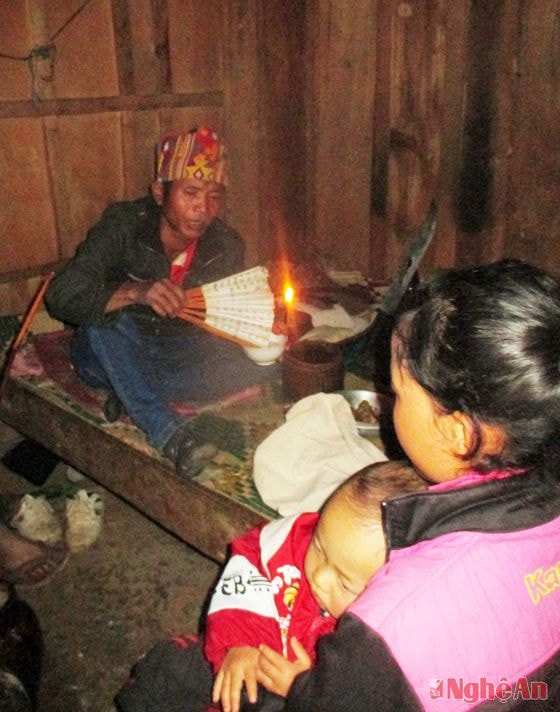 |
| The naming ceremony for a child among the Khmu people of Keng Du commune (Ky Son district). |
The birth of a child is a joyous event in the community. Families and relatives celebrate with drinking parties that last all night, especially when welcoming a baby boy. He will be the man of the family and lineage in the future. However, whether it's a boy or a girl, the birth of a child is still a joyous occasion.
Around seven days old, a Khmu child has their first naming ceremony. This is called the "mouse" naming ceremony. The name is usually used at home and may be taken from the name of a stream or a mountain. When a child reaches one month old, the Khmu people hold a naming ceremony. This name will be used on the birth certificate and will also be the child's name later in life.
Mr. Lo Pho Xieng, a retired Khmu teacher from Keng Du commune, has been retired for many years. Being knowledgeable in religious rituals, he was appointed as the shaman of Huoi Phuon village. Mr. Pho Xieng explained: "Like many other ceremonies, the naming ceremony is held in the kitchen, which is usually reserved for Khmu rituals, next to the kitchen used for daily cooking. This space is only for family members to sit during religious ceremonies. We have mentioned this in some previous articles. After the first drinking of rice wine, a chicken is slaughtered to offer to the ancestors, informing them about the new family member who doesn't yet have a name."
An important part of the ceremony is finding a suitable name for the child. It is believed that if the child "likes" the chosen name, they will live a long and healthy life within the community. The master of ceremonies will divine the child's name by picking a number of grains of rice from the offering tray. The master of ceremonies chooses a name and prays: "If the child likes this name, please give an even (or odd) number of grains of rice." After three divinations, if the number of grains of rice is always even or odd, it is considered that the child has accepted the chosen name. If the divinations yield different results, a different name must be chosen. Mr. Pho Xieng said that in some cases, only a few divinations are needed, while in other cases, it takes a whole day to find a name that the child "likes."
Choosing a name for the child is not the end of the ceremony; a ritual offering to Lady Cham Xuon must also be performed. This is a deity in the beliefs of the Thai and Khmu people, believed to bring life to the child and guide it from Po Then (King of Heaven) to the human realm. The offering to Lady Cham Xuon includes a tray of offerings with a boiled chicken, a small banana tree, and a sugarcane stalk to thank her for bringing life to the new person in the community, and to ask for her blessings so that the child will be healthy and free from illness, the son will be skilled in hunting, and the daughter will be capable in work.
The story of Mrs. Cham Xuon
Regarding the Chằm Xuốn festival, there's a folk tale. Once upon a time, a family had two daughters, the elder named Y and the younger Ay. The father loved Y dearly and gave her everything, while the mother favored Ay. The father, hating the mother, plotted to harm her by stabbing her in the head with a shovel while she was standing under the floorboards. The old woman didn't die, but was injured and fled. The father then sought to harm Ay. One day, he led the two sisters into a deep forest where there were no footprints or marks from tree-cutting knives, giving each of them a bamboo tube to carry water. He deliberately punctured Ay's tube. Y managed to get water, but Ay kept scooping until late at night without her tube filling. Meanwhile, the father took Y home, leaving Ay behind in the deep forest.
Ay was captured by an orangutan who wanted to eat her. She begged to be a servant, cooking, tending the fields, but the orangutan wouldn't listen. She then asked to catch lice and fleas, as long as it didn't eat her. The orangutan agreed. While catching lice on her head, Ay noticed a wound and, remembering her mother who had been harmed, wept bitterly. The orangutan inquired about her well-being, and she recounted her family story. It turned out that the orangutan was her mother, who had lived in the deep forest for a long time, transformed into a human. The two embraced joyfully and never left each other's side. They had a house and a lush garden full of bananas and sugarcane in the deep forest. When Ay grew up, her mother chose Tạo Quẻ as her husband. They had a baby boy named Tạo Quắc.
The older sister, hearing that her younger sister had become wealthy and married Tạo Quẻ, sought to visit. While staying at her sister's house, she plotted to kill Ay to steal her husband. Ay died and transformed into a bird to expose her crime. Ay killed the bird, ate its flesh, and burned its bones in the kitchen fire. Mrs. Chằm Xuốn, trying to save her daughter, pretended to ask for fire, but her real intention was to retrieve her daughter's bones. She placed them in a jar and performed a ritual to bring Ay back to life, making her even more beautiful than before. Mrs. Chằm Xuốn hid her daughter in a room. Thanks to her son, Tạo Quắc, Tạo Quẻ found his wife again. Mrs. Chằm Xuốn forced Tạo Quẻ to marry her a second time, demanding a dowry of enough silver ingots to stretch from Tạo Quẻ's house to Ay's house…
The story ends somewhat like the Vietnamese fairy tale of Tam Cam. Because she wanted to be as beautiful as her younger sister, Y ultimately died in a boiling water pit. This fairy tale is also passed down among the Thai community in many places. For the Khmu people, Lady Cham Xuon has the power to bring the dead back to life and is the one who created life for people. It is also she who led people from the heavenly realm back to the human realm, hence the custom of worshipping Lady Cham Xuon during the naming ceremony for children. The banana tree, sugarcane, and rice in the offering symbolize Lady Cham Xuon's once lush garden and also represent the community's dream of a prosperous life.
Text and photos:HỮU VI


