
Van-Cau Rao Temple Festival: Returning to the roots of history
(Baonghean) - The people of Tuong Duong are eagerly anticipating the Van-Cua Rao Temple Festival, a time to reconnect with their roots. This is an opportunity to immerse themselves in a solemn and sacred atmosphere, to express their hopes and aspirations...
The temple is located in Xa Luong commune (Tuong Duong district), situated at the confluence of the Nam Non and Nam Mo rivers. It is also an archaeological site (Temple Hill site), where researchers have excavated and discovered many valuable artifacts. The artifacts unearthed at Temple Hill are estimated to be nearly 4,000 years old, belonging to the Phung Nguyen culture.
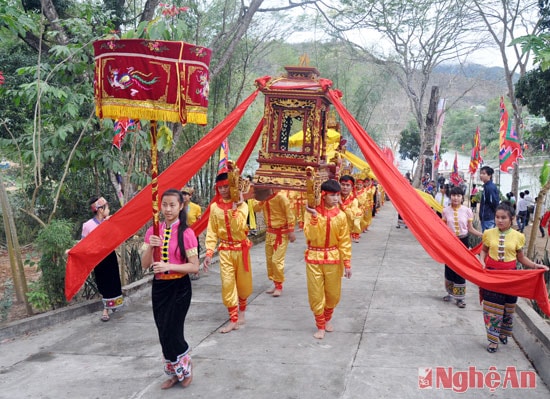 |
| The procession was solemn and respectful. |
The Van-Cua Rao Temple reflects its image onto the clear blue water, nestled beneath the canopy of ancient trees hundreds, even thousands of years old. The temple is closely associated with the career and merits of General Doan Nhu Hai, a renowned general of the Tran Dynasty who sacrificed himself on this borderland to protect the territory, the villages, and the lives of the people. Historical documents record this event.
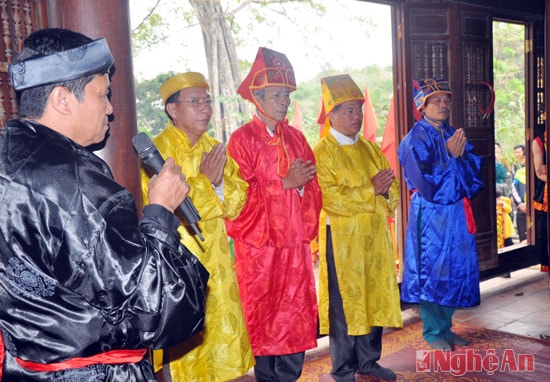 |
| The Grand Ceremony is held to pray for national peace and prosperity, favorable weather, and tranquility in the villages. |
Around 1335, the western border region of Nghe An province, then known as Nam Nhung (comprising the present-day districts of Ky Son, Tuong Duong, and Con Cuong), was invaded and harassed by Laotian forces, causing immense suffering. Despite his advanced age, Emperor Emeritus Tran Minh Tong decided to personally lead the army into Nam Nhung to suppress the invaders, punish the aggressors, and secure the borders.
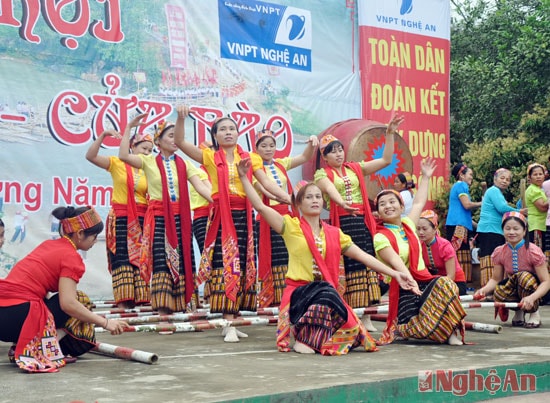 |
| The cultural exchange program was engaging and rich in national cultural identity. |
The Emperor appointed Doan Nhu Hai, who was then commanding the Than Vu and Than Sach armies and also holding the position of Governor-General of Nghe An, as the commander-in-chief to directly lead the troops. Due to the unclear balance of forces, terrain, and geographical features, in a battle that took place at the confluence of three rivers, shrouded in thick fog, the Tran Dynasty commander-in-chief and many of his soldiers perished in this area.
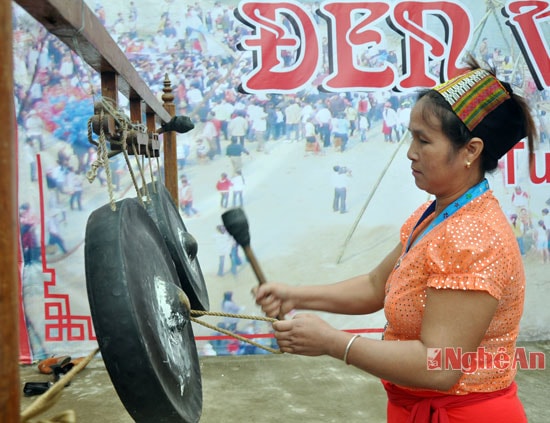 |
| Gong performance competition. |
Later, the imperial court continued to send reinforcements to drive the invaders back across the border, bringing peace to the people of the Southern Nhung region. To commemorate the General and soldiers of the Tran Dynasty who sacrificed their lives, the people erected a temple at the confluence of the rivers, where incense is burned year-round as people pray for blessings and protection, a place where they can entrust their spiritual beliefs. The Van - Cua Rao Temple also houses the altar of the Three Holy Mothers (one of the Four Immortals according to folk beliefs), a unique religious feature of Vietnamese culture.
This year's Van Temple - Cua Rao Festival program is condensed into 3 days (from February 27-29, 2016, or the 20th-22nd day of the first lunar month of the Year of the Monkey). The ceremonial part includes rituals such as: Opening Ceremony, Announcement, Procession of the Ancestral Tablets, Grand Sacrifice, and Thanksgiving. The festive part is lively with cultural and artistic exchanges between villages; competitions in furrow carving, gong playing, and bamboo pole dancing; and traditional folk games (throwing the ball, stick pushing, tug-of-war, spinning top, chess, swinging, and stilt walking).
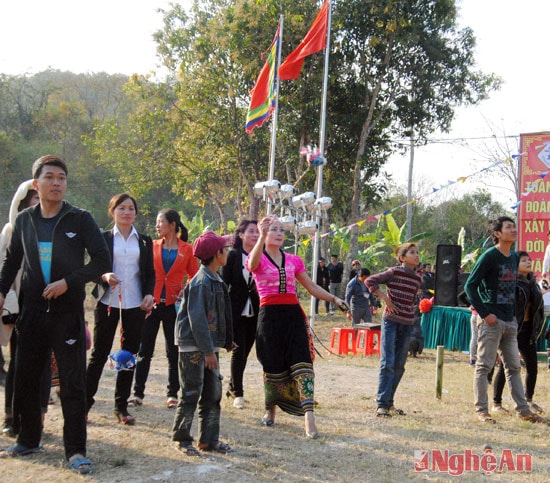 |
| Throwing the ball. |
During the festival night, folk songs and dances of the Thai, Mong, and Khmu ethnic groups will be performed, both lively and profound, imbued with the sounds of the border mountains and forests. This is an opportunity for visitors from near and far to better understand the rich cultural values of the highlands of Nghe An province. Then, the sounds of the khene, pi, gongs, and cymbals will create a vibrant symphony, like the rustling wind and the murmuring streams welcoming the arrival of spring.
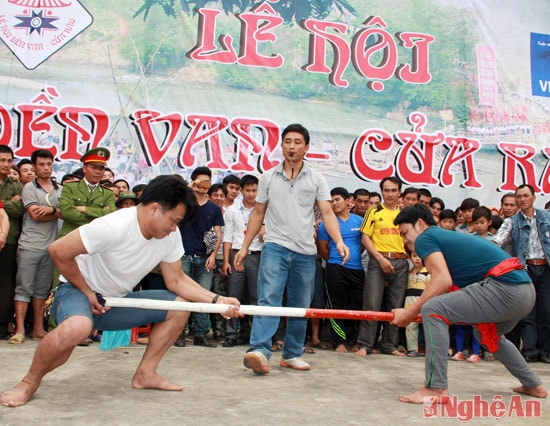 |
| Stick pushing competition. |
Thousands of people prepared to enter the procession, all praying for national peace and prosperity, favorable weather, abundant harvests, and peaceful villages. Outside the festival grounds, sports and folk games took place with great enthusiasm and excitement. Young men and women joyfully participated in folk games, showcasing their strength, solidarity, skill, and finesse.
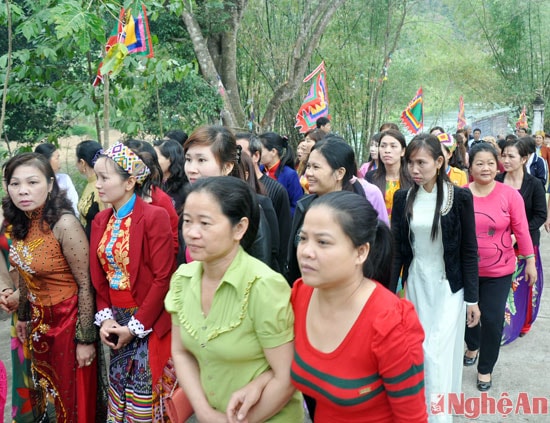 |
| The Van-Cau Rao Temple Festival attracts a large number of locals and tourists from all over to offer incense and participate in the festivities. |
Speaking with us, Mr. Luong Van Phan, Chairman of the People's Committee of Xa Luong commune, affirmed: "Coming to the Van Temple - Cua Rao Festival is returning to the historical roots of the struggle for national liberation and defense; it is returning to a picturesque countryside with friendly and hospitable people; a place where we can entrust our spirituality to live better in real life and a place where we can have moments of tranquility, excitement, and enthusiasm to begin a year of labor and production."
Cong Kien - Dang Cuong
| RELATED NEWS |
|---|


