
Visit Lang Son to see the Kingdom of the Wall-Treased People.
People from Lang Son often refer to Huu Khanh commune, Binh Loc district, Lang Son province with flattering terms such as: Kingdom of rammed earth houses, rammed earth street, or land of houses with rammed earth walls.
Seeing them in person, one can only admire the meticulous craftsmanship of these ancient rammed-earth houses. When asked about them, the village head, Ha Van Bon, in Kieng village, proudly replied: "I don't know when rammed-earth houses originated, but they were already there when the Tay people settled here. Now, nobody builds rammed-earth houses anymore, so only Mr. Ha Van Dan still knows the secret."
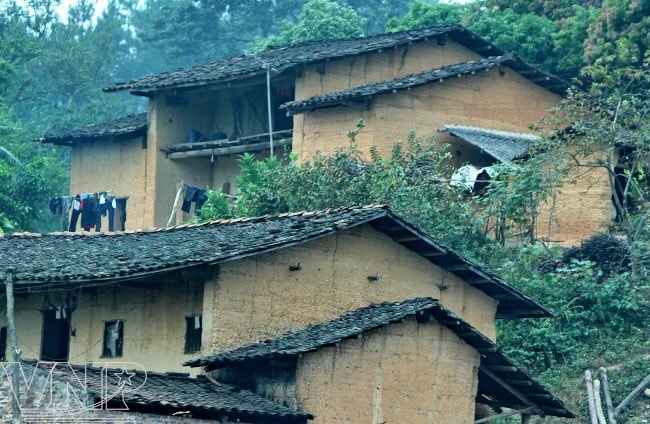
The rammed earth houses in Huu Khanh are hundreds of years old. According to the Tay people's feng shui, the rammed earth houses are built with their backs against the mountain.The door faces the lake, a traditional Vietnamese house layout.
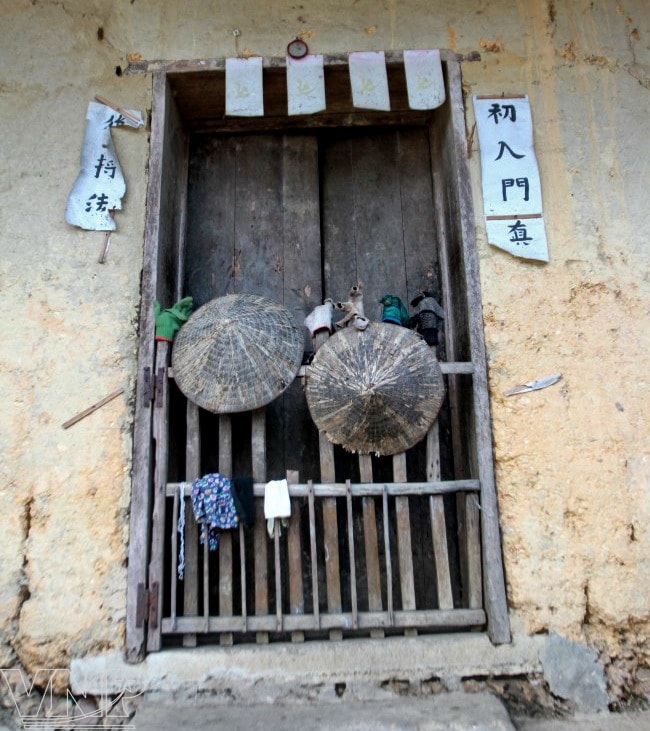
A sign placed outside the house, carved into the wall, informs the villagers that the homeowner will be away for an extended period.
Upon arriving at Mr. Dan's house, I was struck by how magnificent it was. Three two-story rammed earth houses stood side-by-side, stretching over 30 meters in length like the longhouses of the Ede people, all connected by doorways. Mr. Dan was over 80 years old, but when asked about the rammed earth houses, he radiated a sharp intellect, as it had been a long time since anyone in the village had mentioned the story of building them. He explained: “We Tay people have two techniques for building rammed earth houses. The first is direct ramming using earth. After selecting the land, a frame is used to compress the clay for the walls. The second is using molds to cast clay bricks, then building like modern houses, but the mortar and plaster are also made of clay.” He added that the most difficult part of building a rammed earth house is choosing the right land. According to Tay feng shui, similar to the Kinh people's way of building houses, the house faces south and is backed against a mountain. In Huu Khanh, the terrain is mainly hilly and steep, so building houses on the hillside is most suitable. But most importantly, the land must be surrounded by many trees, the older the better, because according to the age-old experience of the Tay people, land with many trees will never be subject to landslides.
As for the two-story rammed-earth houses, the techniques involved are very advanced. The most difficult part of building a two-story house is reinforcing the foundation and ramming the walls of the house pillars. The foundation is reinforced solely by the technique of stacking stones; the stones must be tightly packed to withstand the load and ensure stability. The four pillars at the four corners of the house, which are the four load-bearing piles, must also be stacked with stones before the walls are rammed. In the old days, the process of selecting the land, stacking the foundation stones, and stacking the pillar stones had to be done directly by Mr. Dan himself. Because, according to him, if those steps were not done accurately, the rammed-earth house could collapse at any time.
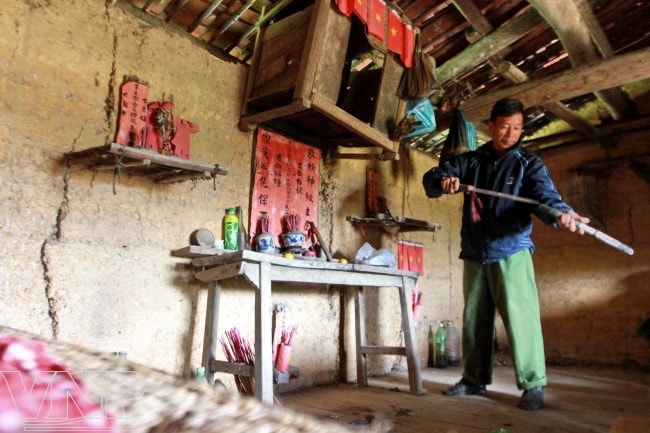
The altar corner of the Tay people in their traditional earthen house.
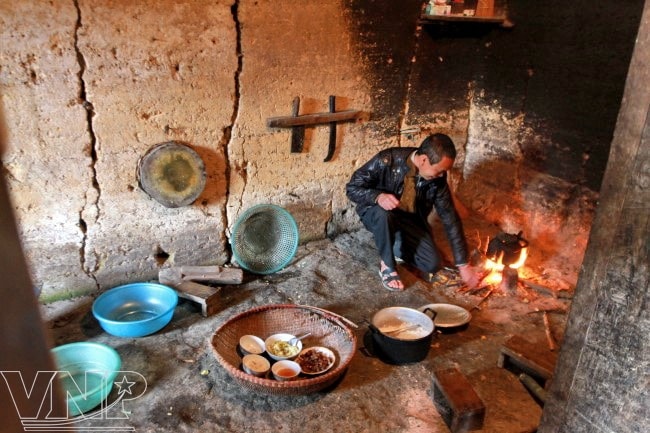
Kitchen corner in a traditional Vietnamese house.
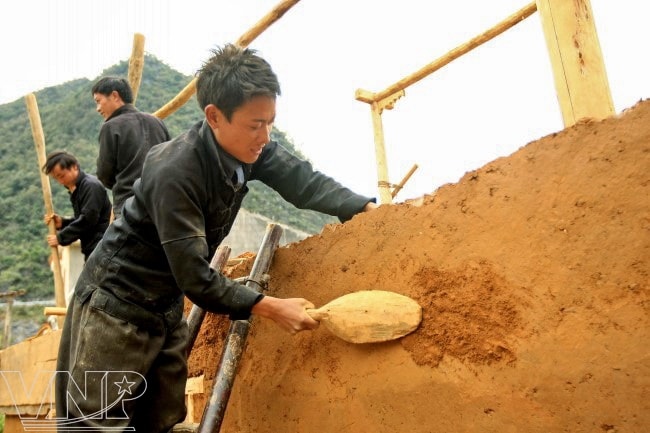
Repair any bumps or uneven areas on the walls of the rammed earth house.
According to the Tay people's beliefs, a good rammed earth house is one whose walls do not absorb water during the rainy season. To prevent water from seeping into the earth walls even during prolonged rain, the process of compacting the earth must be meticulous and careful. Many houses built by the Tay people themselves in the past took more than three months just to complete the earth-compacting process. Rammed earth houses are warm and windproof in winter, and cool and heat-resistant in summer. The only drawback of rammed earth houses is that they tend to get damp and moldy during the rainy season. However, the Tay people have cleverly built a fireplace in the middle of the house to combat the cold and dispel the dampness and mold. Because of the constantly burning fireplace and the smoke clinging to the walls, the rammed earth houses in Huu Khanh are even more mossy and ancient.
Huu Khanh commune currently has 7 villages that still preserve more than 1000 traditional rammed-earth houses that have stood the test of time. Binh Loc district is developing a project to preserve the rammed-earth streets in Huu Khanh to promote cultural tourism in the near future.
According to VNP-M


