
History of the Formation and Development of Vietnam's Law of the Sea
(Baonghean.vn) -Question 5. Vietnamese Law of the Sea: History of Formation and Development?
Reply:Based on the history of Vietnam's maritime management, the following periods can be distinguished:
- Before 1884: The feudal states of Vietnam paid attention to the exploitation and management of the sea: mainly organizing the exploitation of marine resources such as opening trade with other countries: Van Don (11th - 15th centuries), Hoi An (17th - 18th centuries). The development of trade through sea routes required the implementation of corresponding activities to manage the sea and combat piracy in the sea areas adjacent to the mainland and the Hoang Sa and Truong Sa archipelagos.
- The French Colonial Period (1884-1954): Immediately after establishing colonial rule in Cochinchina and protectorate rule in Annam and Tonkin, France focused on applying the maritime laws of the "mother country": A decree issued on December 9, 1926, stipulated the application of the law issued on March 1, 1888, prohibiting foreigners from fishing within the 3-nautical-mile territorial waters of French colonies. On August 22, 1936, the French Minister of Colonies signed a decree defining the Indochina fishing zone as 20 km from the lowest low tide mark. Regarding the Paracel and Spratly Islands, France, in the name of the Vietnamese State, organized protection and management, including: garrisoning, patrolling, establishing administrative units, building meteorological stations, radio stations, and lighthouses...
- Period 1954-1976: The Republic of Vietnam (RVN), as a subject in international relations under the Geneva Accords, was a member of more than 30 international organizations and participated in the First UN Conference on the Law of the Sea in Geneva in 1958. By declaring on April 27, 1965, the RVN officially established a territorial sea width of 3 nautical miles. On April 1, 1972, the RVN declared an exclusive fishing zone extending 50 nautical miles from the outer boundary of its territorial sea. In 1967, the President of the RVN declared its exclusive jurisdiction and direct control over the continental shelf adjacent to its territorial sea. In 1970, the RVN passed the Oil and Gas Law. On June 9, 1971, it published a map dividing 33 oil and gas blocks on the continental shelf according to its unilateral position. During this period, the Democratic Republic of Vietnam (DRV) had not made any claims or published any legal documents concerning the sea, except for signing several fisheries agreements in the Gulf of Tonkin with the People's Republic of China (PRC) in 1957, 1960, and 1963.
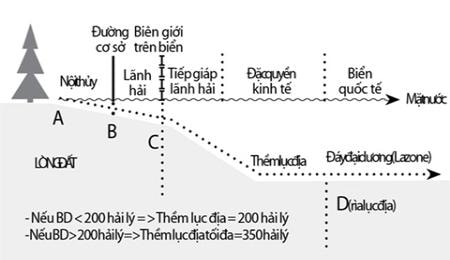 |
- Post-1976 Period: After the collapse of the Republic of Vietnam in 1975, the Provisional Revolutionary Government of the Republic of South Vietnam (PRS) became the official representative of the people of South Vietnam. Therefore, at the May 7, 1975 session, the Committee for the Examination of the Status of Members to the Third UN Conference on the Law of the Sea declared its recognition of the representative status of the Provisional Revolutionary Government of the PRS. After the reunification of the country, the representative status at this conference belonged to the Government of the Socialist Republic of Vietnam. The Vietnamese Government delegation attending the Conference supported the establishment of a 12-nautical-mile territorial sea and a 200-nautical-mile exclusive economic zone, as declared in Vietnam's declaration on maritime zones and continental shelf on May 12, 1977. Vietnam became the first country in Southeast Asia to establish a 200-nautical-mile exclusive economic zone. Regarding the continental shelf, Vietnam affirms its position based on the principle of the natural extension of the mainland territory of a coastal state to the outer edge of the continental margin. Vietnam also participates in the group supporting the principle of fairness applied in the delimitation of overlapping maritime zones and continental shelves between opposite or adjacent coastal states.
On November 12, 1982, the Vietnamese Government issued a Declaration on the baseline for calculating the width of the territorial sea. According to this declaration, Vietnam's baseline is a system of 11 straight baseline segments starting from point 0, located on the straight line connecting Tho Chu Island and Poulo Wai Island (Cambodia), through points A1-A11 connecting the islands running along the Vietnamese coast, excluding the part within the Gulf of Tonkin. The declaration also clarifies that the baseline for calculating the width of the territorial sea of the Hoang Sa and Truong Sa archipelagos will be specifically defined in a subsequent document, in accordance with the five points of the Vietnamese Government's Declaration of May 12, 1977, which states that all islands and archipelagos belonging to Vietnamese territory have their own territorial sea, contiguous zone, exclusive economic zone, and continental shelf.
On June 23, 1994, the National Assembly of the Socialist Republic of Vietnam (SRV) issued a Resolution approving this important legal document. Point 1 of the Resolution states: "By ratifying the 1982 United Nations Convention on the Law of the Sea, the Socialist Republic of Vietnam demonstrates its determination to work with the international community to build a just legal order, encouraging development and cooperation at sea." The National Assembly affirmed Vietnam's sovereignty over its internal waters, territorial sea, sovereign rights and jurisdiction over the contiguous zone, exclusive economic zone, and continental shelf on the basis of the provisions of the Convention and the principles of international law, and demanded that other countries respect Vietnam's aforementioned rights.
The National Assembly once again affirmed Vietnam's sovereignty over the Hoang Sa and Truong Sa archipelagos, and also clearly stated the State's position to peacefully resolve disagreements related to the East Sea in the spirit of equality, mutual understanding and respect, respect for international law, especially the 1982 United Nations Convention on the Law of the Sea, and respect for the sovereignty, sovereign rights and jurisdiction of coastal states in the East Sea over their exclusive economic zones and continental shelves; while striving to promote negotiations to find a fundamental and long-term solution, the relevant parties need to maintain peace and stability on the basis of preserving the status quo, refrain from actions that further complicate the situation, and not use force or threaten to use force.
On June 21, 2012, the National Assembly of the Socialist Republic of Vietnam passed the Law on the Sea of Vietnam. This law consists of 7 chapters and 55 articles, and came into effect on January 1, 2013. Vietnam's sovereignty over the Hoang Sa and Truong Sa archipelagos is affirmed in Article 1 of the Law on the Sea of Vietnam. This law was drafted in accordance with the 1982 United Nations Convention on the Law of the Sea.
And more


