
Will Venezuela follow in Brazil's footsteps?
(Baonghean) - Những ngày này, Tổng thống Venezuela đang tiếp tục chật vật đối phó với cuộc khủng hoảng kép chính trị - xã hội đang diễn ra tại nước này. Dù trong diễn biến mới nhất, Phó Tổng thống Venezuela khẳng định, nước này sẽ không tiến hành trưng cầu ý dân về việc bãi nhiệm Tổng thống; thế nhưng, tương lai chính trị của ông Maduro lúc này vẫn còn là dấu hỏi. Dư luận lo ngại, liệu sau Brazil, Mỹ Latinh có phải chứng kiến thêm một kịch bản xấu tại Venezuela nữa hay không?
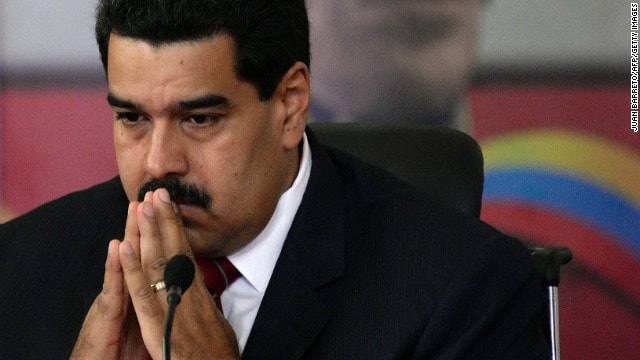 |
| Tổng thống Venezuela Nicolas Maduro đau đầu với khủng hoảng. Ảnh: Getty. |
Hồi hộp chờ chứng thực chữ ký đòi bãi nhiệm
In just the past week, President Nicolas Maduro has implemented a series of urgent measures, highlighting the seriousness and complexity of the political and social situation in the country. For example, on May 13th, Maduro declared a nationwide state of emergency to counter plots by the opposition and external forces aiming to overthrow his left-wing government.
At the same time, the President also had to extend the economic state of emergency for another three months, possibly even into 2017, to restore the country's production capacity. By May 15th, President Maduro had ordered the military to conduct a week-long exercise to counter foreign threats.
These moves follow a series of stopgap measures to address the severe economic crisis unfolding in Venezuela, such as advancing the time zone, cutting employee working hours, and implementing rolling power outages.
A series of solutions were proposed in the context of the Venezuelan opposition claiming to have collected 2.5 million signatures – far exceeding the constitutional requirement to pave the way for the president's impeachment.
However, in his latest statement, Venezuelan Vice President Aristobulo Isturiz affirmed that the country will not hold a referendum on no confidence against President Maduro. The reason given is that the procedures related to such a vote are "flawed."
Previously, the Venezuelan government had repeatedly accused the opposition of fraudulent practices in collecting signatures. Jorge Rodriguez, the mayor of Caracas and head of the special government committee appointed by President Maduro, along with the National Electoral Commission (CNE), to verify the signatures, asserted that more than 11% of the forms submitted to the committee were incomplete.
Of course, the opposition Democratic Unity Roundtable (MUD) in Venezuela has protested this statement and demanded that the National Electoral Commission expedite the signature verification process. The MUD also criticized the National Electoral Commission for its delays. This means that the political future of the Venezuelan president will depend on June 2nd, when the signature verification process is completed.
However, between now and then, Maduro will face numerous challenges in simultaneously addressing the severe socio-economic crisis at home and dealing with accusations and pressure from the opposition.
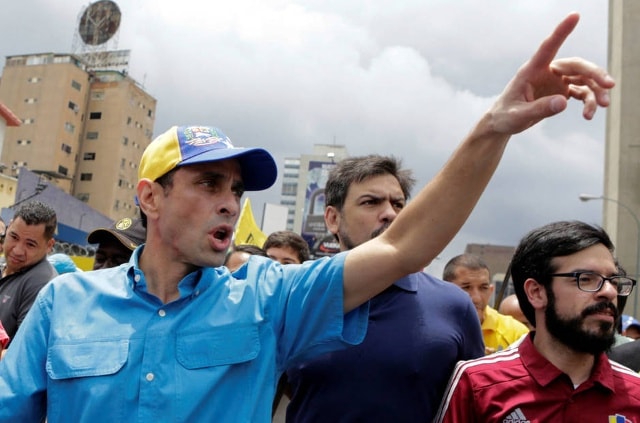 |
| Venezuelan opposition leader Henrique Capriles. Photo: Reuters. |
Are Latin American left-wing parties facing difficulties?
The big questions now are: What are the root causes of Venezuela's dire situation? Is this a domino effect from neighboring Brazil, also facing hardship? And could this be a sign of the decline of left-wing parties in Latin America?
According to the opposition, President Nicolas Maduro's government has been extremely weak and made serious mistakes in its economic and energy management policies. For his part, President Maduro has repeatedly accused external forces, specifically the United States, of orchestrating the opposition's actions to overthrow his left-wing government.
However, objectively speaking, observers believe that the problem stems from both sides. Firstly, it is undeniable that President Maduro's oil-dependent policies have been hampered by the recent sharp drop in oil prices. Oil accounts for 96% of Venezuela's total exports. The ruling left-wing party in Venezuela has also faced numerous accusations of corruption and inefficient management. A similar situation has occurred in Brazil recently. Given these unfavorable economic developments, the opposition in both countries will undoubtedly use them as pretexts to attack and undermine the ruling government.
The possibility of external interference, as President Maduro has alleged, cannot be ruled out. Venezuela is one of the leading left-wing countries in Latin America and is not favored by the US government. However, all these accusations remain unsubstantiated and unfounded to date.
Thus, for the time being, the severe political and economic crisis remains a major challenge for President Maduro. At the same time, if the signatures are authenticated and Maduro fails to win the referendum, Venezuela will have to hold early general elections.
However, this is not the end for Maduro. A similar referendum was held in 2004 against his predecessor, the late President Hugo Chavez, who won. Therefore, the question, "Will Venezuela follow Brazil's lead?", ultimately depends heavily on the efforts of President Maduro and his administration in navigating and managing the crisis in the coming months.
Khang Duy
| RELATED NEWS |
|---|


