
Sacred Temple of Ca
(Baonghean) - Nestled peacefully amidst the rice fields of Trang Thanh is the Ca Temple, built very early to commemorate the great contributions of Uy Minh Vuong Ly Nhat Quang. Along with the Ca Temple is a system of religious and spiritual structures such as Bao Lam communal house, Bao Lam pagoda, and the Saint's House… with famous and sacred ancient architecture.
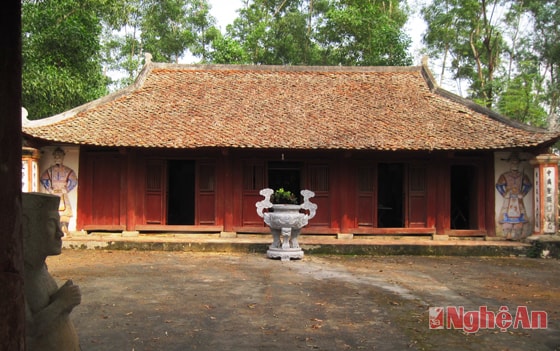 |
| Ca Temple (Dong Thanh commune, Yen Thanh district). |
| RELATED NEWS |
|---|
The Ca Temple is built on high ground with a spacious grounds. In front is a flat field, and in the distance, a system of airy, cool ponds and lakes serves as a bright and airy space. To the right are the Sacred House and Bao Lam communal house, while to the left and behind are peaceful villages with a dense population. The Ca Temple is a large-scale architectural complex with many components such as the triple gate, the dance hall, the left and right wings, the main hall, and the upper sanctuary. The triple gate of the Ca Temple is built of brick, stone, and mortar; it is not large in scale but quite beautiful. Behind the triple gate is the dance hall, also known as the eight-roofed Chong Diem. This is where the village elders and dignitaries rest and meditate before entering the temple to worship the gods or to watch folk songs and plays in the courtyard during festivals. This is also where the palanquin carrying the gods from other places is placed for joint worship at the Ca Temple.
This structure resembles the Khue Van Cac pavilion at the Temple of Literature (Hanoi). The main worship hall is the central architectural structure of the main temple. This relatively grand and spacious building is located behind the temple courtyard. The worship hall is constructed of ironwood, mahogany, brick, and tiles… The decorative sculptures are very diverse and displayed in many different locations.
The Ca Temple still preserves many exquisitely crafted ancient artifacts, showcasing the talent of folk artisans from Nghe An province. Typical examples of the religious objects preserved at the temple include incense altars, dragon palanquins, and dragon thrones for worshipping deities. The incense altars are made of wood, their outer surfaces divided into sections and carved with vivid images of dragons, mythical creatures, turtles, phoenixes, pine trees, bamboo, chrysanthemums, and plum blossoms. The dragon thrones, modeled after the shape of a golden throne, are decorated on the outside with dragon heads, phoenixes, and cloud patterns, while the inside is inscribed with Chinese characters listing the titles of the deities worshipped. Most of the religious objects displayed in the main hall are beautifully carved and gilded. During ceremonies, under the light of lamps and candles, these gilded objects become luminous and mystical, contributing to the sacred and solemn atmosphere of the memorial space.
Besides its tangible architectural and sculptural values, one of the highlights of Ca Temple is the system of written documents found in its remaining records, such as royal decrees and legends. Currently, the temple preserves four royal decrees, most notably the decree from the Vinh Khanh era (dating back nearly 300 years), one from the Canh Thinh era of the Tay Son dynasty, and two from the Nguyen dynasty. Furthermore, Ca Temple boasts a collection of couplets with beautiful verses praising the sacred land that has produced and nurtured many talented individuals who have made significant contributions to the country, while also reflecting the tradition of learning, respect for etiquette, and literary pursuits of the people of Nghe An. Visiting Ca Temple provides valuable information about the local religious beliefs and spiritual and cultural traditions.
In the late 19th century, Ca Temple served as a secret meeting place and living quarters for the resistance fighters of Nguyen Xuan On and Le Doan Nha during the Can Vuong movement against the French. It was also a revolutionary base of the Communist Party of Vietnam before the August Revolution and a hiding place for weapons and food supplies during the resistance against the Americans.
The Ca Temple Festival is held annually with ceremonial parts such as announcement, purification, bathing, procession, and solemn and sacred offerings, as well as festive activities such as wrestling, cockfighting, swing games, human chess, traditional opera, and folk singing, attracting tens of thousands of people and tourists from all over. Ca Temple holds many cultural and historical values and is also a place of cultural gathering and activity for the people to connect with their roots. Because of these values, the Ministry of Culture, Sports and Tourism recognized Ca Temple as a National Historical and Cultural Monument in 2012.
Van Thang


