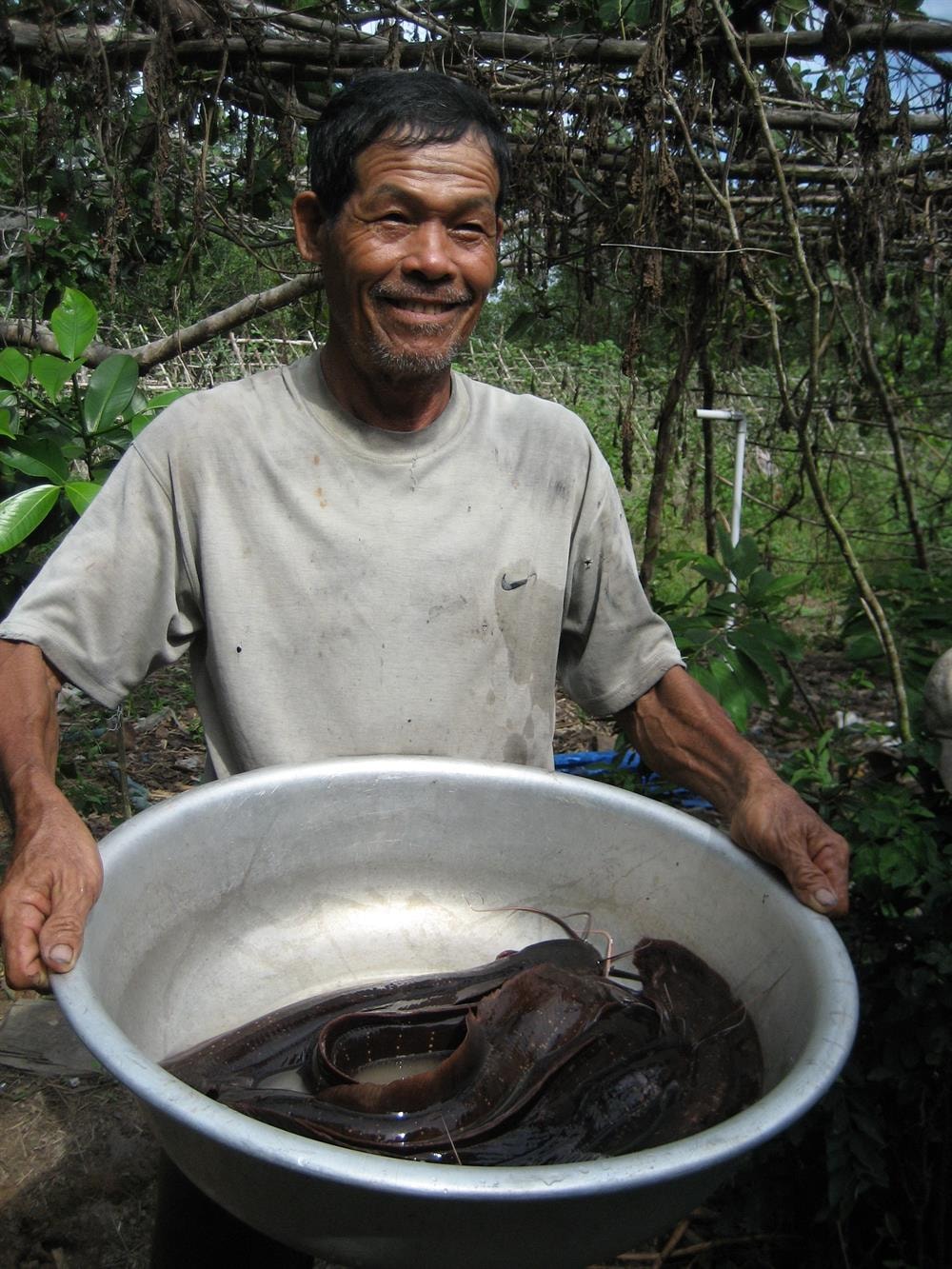
The rare fish species with a "catfish head and eel body"
With a flattened head resembling a catfish, but a slender, elongated body like an eel, adorned with beautiful, glossy patterns, and possessing fatty, firm, and uniquely flavorful flesh... This is the initial identification of the "Phu Quoc stream catfish" (CTSPQ) - a freshwater fish species endemic to the largest island in the western sea of Vietnam.
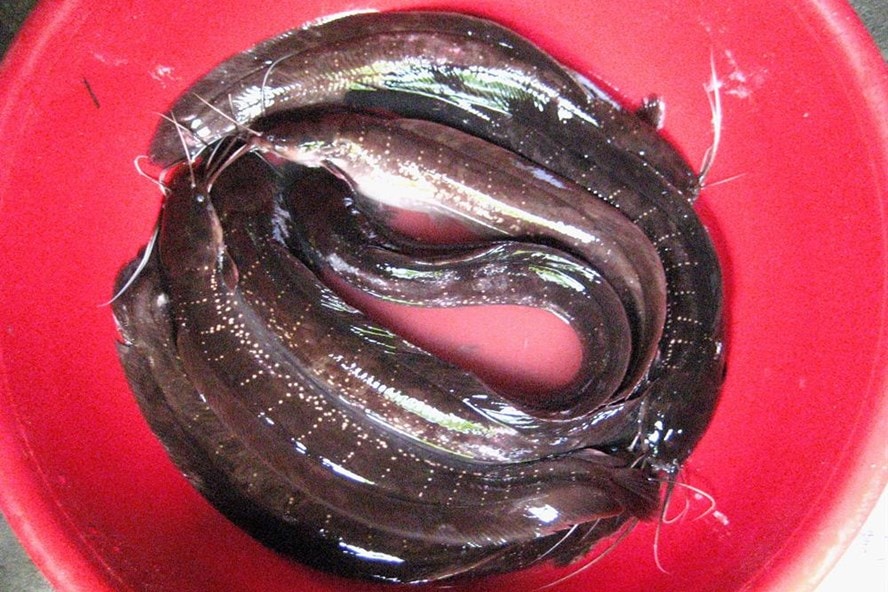
Phu Quoc catfish.
Phu Quoc stream catfish are unique and unusual.
Catfish are abundant in freshwater alluvial plains. But the presence of catfish on an island surrounded by sea like Phu Quoc is truly unique and rare. Phu Quoc stream catfish, also known as stream eel, is a rare and precious species. This fish was recently discovered and is endemic to Phu Quoc island district, Kien Giang province.
Interestingly, this unique fish only builds its "base" in sections of fast-flowing streams originating from the 99 legendary mountains on Phu Quoc Island, which is why locals call it the Phu Quoc stream eel. Vietnamese fisheries experts consider this a new discovery and believe that this freshwater fish, found in the open sea, will attract just as much attention as the Phu Quoc ridgeback dog on Phu Quoc Island (Kien Giang).

The Phu Quoc stream catfish is a species of stream fish endemic to the Pearl Island.
Ms. Dang Khanh Hong, M.Sc. - Deputy Director of the Agricultural and Fisheries Extension Center of Kien Giang province, who discovered and laid the foundation for research on CTSPQ (Citrus maxima fish species) - immediately caught our attention with her first sentence introducing this fish: "This is a unique fish species both in its external morphology and internal characteristics."
What makes Phu Quoc stream catfish different?
According to Ms. Hong, in terms of external morphology, CTSPQ resembles the crooked-tailed catfish (Clarias Nieuhofii) distributed in western Cambodia, the Malay Peninsula, southeastern Thailand, India, Laos, and Indonesia, meaning its body length is 8-9.5 times its body height.
However, there are subtle differences between them, such as the Phu Quoc dog having a dorsal whorl compared to other dogs. While the dorsal, caudal, and anal fins of C. Nieuhofii are almost fused together, these parts are separated in CCSPQ.
In particular, the patterns on the skin of CTSPQ are more diverse in detail and richer in color. While in C. Nieuhofii the pattern consists only of small yellow and white dots on a dark brown background, in CTSPQ there are three colors of pattern: yellow, red, white, and black, and the color of each pattern corresponds to different qualities, flavors, and appeal.

The stream catfish of Phu Quoc differs significantly in shape and color from common catfish.
Red goldfish, weighing over 2.5 kg (at one year old), have meat with a distinctive aroma. Similarly, white goldfish are larger, with tender, fatty meat. Black goldfish, however, have firmer meat and only weigh about 1 kg each...
According to the elders in Phu Quoc, this fish species is very intelligent and aggressive. They live in fast-flowing streams, making them difficult to catch, and when they detect an intruder in their "territory," they attack immediately, including humans.
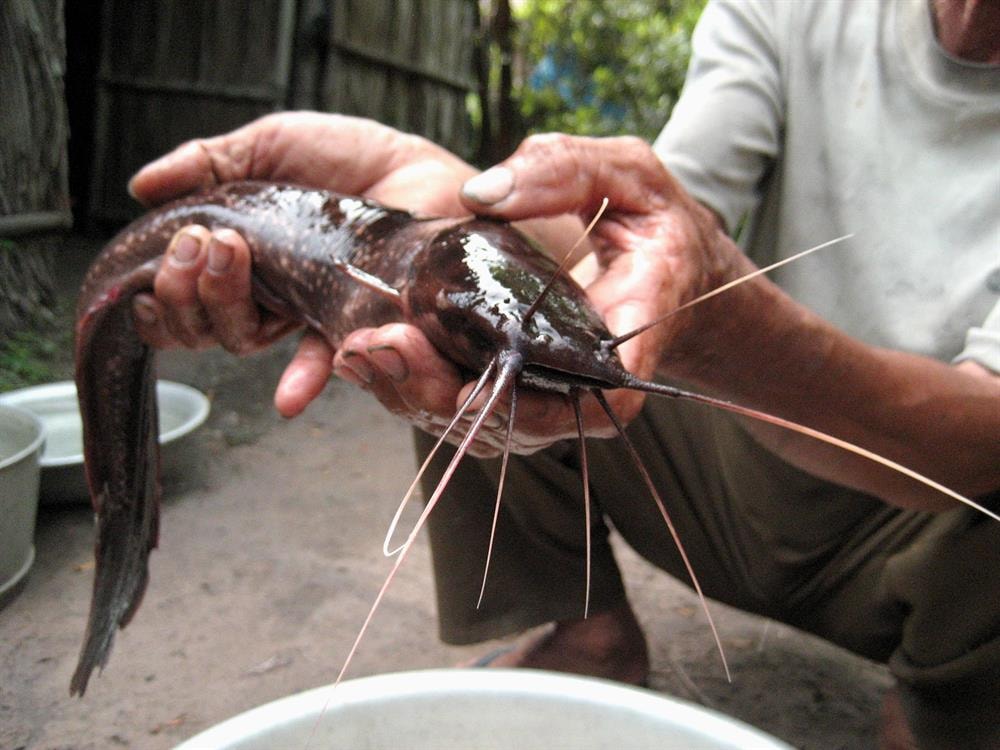

Phu Quoc catfish choose fast-flowing streams as their "base." The streams on the Pearl Island are the habitat and refuge of this unique and rare species of stream catfish.
Not only is it unique and captivating at first glance, but the Phu Quoc stream catfish also enchants travelers with its distinctive quality: firm yet tender and flavorful meat that is surprisingly delicious. Therefore, if properly exploited, this could be a lucrative product for Phu Quoc's tourism industry.