
Warnings from the Vietnamese automotive market in 2018
From this moment on, the roadmap for tariff reductions under international commitments has begun to reveal increasingly clear visions of the Vietnamese automotive market, with 2018 marking the starting point.
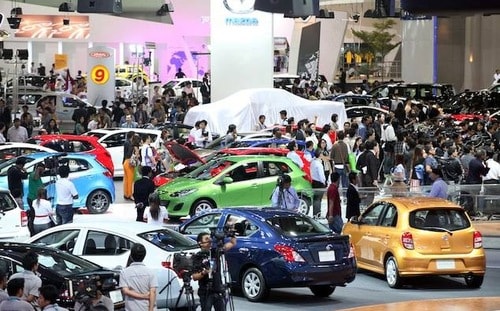 |
| In the current Vietnamese automotive market, vehicles from brands like Toyota, Ford, and Honda dominate the market share. Most of these manufacturers have at least one production plant located in Thailand or Indonesia, or both. |
First and foremost, it's important to affirm that the taxes enacted do not create technical barriers that differentiate luxury cars from other types of vehicles. The distinction is usually based only on criteria such as engine cylinder capacity or emission standards, with the aim of protecting the environment.
Luxury cars are overshadowed.
So why are luxury cars facing difficulties? The answer lies in the factor of origin and provenance.
According to the tariff reduction roadmap under the ASEAN Trade in Goods Agreement (ATIGA), from 2018, the import tax rate on completely built-up (CBU) automobiles from Southeast Asian countries will be reduced to 0%.
The tax reduction roadmap will be implemented in stages to better suit the reality and also to "cushion the shock" for businesses and consumers.
The problem is that, currently and even for the next decade, no luxury car manufacturer will open a factory large enough in ASEAN countries to serve export purposes.
Most luxury brands such as Audi, Mercedes-Benz, Porsche, BMW, Lexus, Cadillac, etc., are manufactured in their home countries, such as Germany, the United States, or Japan. At best, the scale of their factories is only comparable to the one Mercedes-Benz has in Vietnam.
Therefore, the faster the ATIGA tariff reductions occur, the more quickly the prices of imported cars from this region will become cheaper. Meanwhile, luxury cars are imported from countries outside the ASEAN region, so their selling prices will continue to be exorbitant in the long term due to high import taxes.
Note that the import tax plus the CIF price or the taxable price determined by the customs authorities will be the base amount from which a series of other taxes and fees such as excise tax, VAT, or registration fee are multiplied.
Another point to note is that there will be no loopholes for luxury cars to benefit from tax incentives. The preferential tax schedules developed and issued by the Ministry of Finance always clearly stipulate that goods must be imported directly from the country of origin.
For example, it's impossible for traders to transport Audi cars from China through Southeast Asia before importing them into Vietnam to benefit from tax incentives.
The advantage of mass-market cars
Meanwhile, most mainstream car models enjoy a significant price advantage due to reduced taxes. In fact, the prospect of the Vietnamese automotive market being flooded with cars of Southeast Asian origin since 2018 has been mentioned numerous times in the media.
In the current Vietnamese automotive market, vehicles from brands like Toyota, Ford, and Honda dominate the market share. Most of these manufacturers have at least one production plant located in Thailand or Indonesia, or both.
All of these factories are larger, even many times larger, than the factories that the corporation has located in Vietnam.
Over the past two years, major automotive corporations have clearly demonstrated a trend towards concentrating production in Thailand and Indonesia, with the aim of exporting to Southeast Asia in particular, and the Asia-Pacific and African regions in general.
For example, Toyota and Ford recently decided to build additional factories in Thailand and Indonesia, with each factory receiving an investment of between $200 and $400 million, equivalent to the total investment these companies have made in Vietnam over the past nearly 20 years.
Most recently, Nissan also inaugurated a new factory in Thailand with an investment of over $110 million.
A few years ago, as import taxes from ASEAN countries began to be reduced, automotive joint ventures in Vietnam started to narrow down their range of domestically assembled (CKD) products to compensate by importing fully assembled vehicles from Thailand and Indonesia. Even now, at least 10 models are being imported by distributors in Vietnam from these two countries in the region.
Amidst increasing pressure from integration, Vietnamese automobile manufacturers and assemblers must, on the one hand, propose and suggest to government agencies the creation of strong mechanisms and policies to boost the domestic automobile industry. On the other hand, they must also "protect themselves" by gradually "reserving a spot" in the CBU (completely built-up) vehicle market.
The reality clearly demonstrates this trend. Although, according to the ATIGA preferential import tariff schedule for the period 2012-2014, the import tax rate on completely assembled cars from ASEAN countries decreased quite slowly, from 70% in 2012 to 50% in 2014 for passenger cars with fewer than 10 seats, the import value from this region has continuously increased.
According to statistics from the General Department of Customs (Ministry of Finance), the total number of CBU (completely built-up) cars imported from ASEAN in the first five months of 2014 reached 4,282 units with a value of US$65.37 million, an increase of 1,104 units in quantity and US$11.92 million in value compared to the same period in 2013.
Of these, imports from neighboring Thailand reached 3,575 units and $58.49 million, an increase of 899 units in quantity and $9.45 million in value; imports from Indonesia reached 707 units and $6.86 million, an increase of 205 units in quantity and $2.46 million in value.
With such strong growth, the prospect of the Vietnamese market being flooded with cars from Thailand or Indonesia is very clear. And this is a strong warning about the hesitation and weakness of the domestic automotive industry.
According to VnEconomy


