
What is the solution to the problem of developing the forest economy?
(Baonghean) - Forestry has been identified as a strength of Quy Chau district. The forests of Quy Chau are distributed in three large strips and are rich in species. Recognizing this advantage, the Resolution of the 24th District Party Congress (2011-2015 term) identified investment and development of raw material forests as a key economic sector. However, to date, the forest economy has not yet yielded the results it has already achieved in terms of its potential.
(Baonghean) - Forestry has been identified as a strength of Quy Chau district. The forests of Quy Chau are distributed in three large strips and are rich in species. Recognizing this advantage, the Resolution of the 24th District Party Congress (2011-2015 term) identified investment and development of raw material forests as a key economic sector. However, to date, the forest economy has not yet yielded the results it has already achieved in terms of its potential.
Model for leveraging advantages
Looking at the lush green forests stretching along National Highway 48 from Chau Binh northward, one can somewhat see the initial effectiveness of the economic development strategy outlined in the Resolution of the 24th Congress of the Quy Chau District Party Committee. Following the directions of the commune's forestry officials, we found the home of Mr. Vi Duc Thuan, considered the "king" of forest planting in the commune. Through our conversation, we learned that after the red stone quarrying incident, with the support of the State in forest development, production, and livestock farming, Mr. Thuan discussed and collaborated with 36 Thai ethnic minority households in Ke Khoang and Binh Mai villages to form a large area of over 120 hectares for forest planting. Mr. Thuan is the group leader, organizing the purchase of seedlings, assigning tasks to the 36 households for land preparation, planting, protection, and harvesting during the season.
With a rotational system, harvesting several dozen hectares and then immediately replanting the forest on the same area, combined with livestock development, the households in Mr. Thuan's group have a stable income. This has promoted the sustainability of the forest-based economy. To facilitate planting, protecting, and harvesting the forest, in recent years, Mr. Thuan's group has spent 300 million VND to rent bulldozers and build about 7 km of roads up the hills to the planted forests. After the melaleuca harvest at the end of 2012 and the beginning of 2013, his group is planning to convert about 50 hectares to rubber plantations in accordance with the province's policy. Thanks to the development of the forest-based economy, his family's economy has improved significantly; he has built a house, purchased modern equipment for his life, and even bought a pickup truck to transport raw timber...
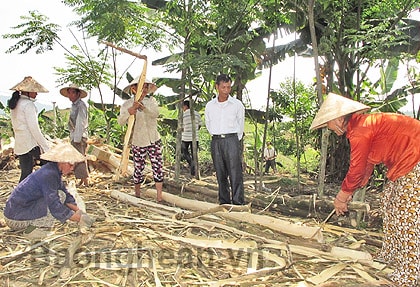
Harvesting acacia wood in Chau Binh commune.
Currently, in Chau Binh, wealthy individuals like Mr. Vi Duc Thuan, who have become rich from forestry, are not uncommon. Roughly speaking, the entire Chau Binh commune has hundreds of family-based integrated economic models involving concentrated forestry combined with commercial livestock and poultry farming. Among these, large-scale forestry models ranging from 10 to over 100 hectares have become exemplary models in Quy Chau district. Over 10,000 hectares of hilly land in Chau Binh have been leased to local people for forestry. To date, the forests in Chau Binh are entering their third harvesting cycle.
The identification of economic development based on the strengths of forests, along with adequate investment in forest development, has led to increased awareness among the people regarding forest planting for economic development. According to a report from the Department of Agriculture and Rural Development of Quy Chau district, forestry accounts for 30% of the total production value; in the two years from 2011 to 2013, the entire district planted 2,284.6 hectares of concentrated forest and 260,000 scattered trees of various types; in particular, attention has been paid to planting high-economic-value trees such as rubber (92 hectares), and fragrant root trees.
Following the principle of "short-term gains to support long-term growth," starting in 2012, the District Agricultural and Forestry Extension Station implemented a project to cultivate fragrant root and ginger under the forest canopy. This included a pilot project of 21.5 hectares of fragrant root in the communes of Chau Thang, Chau Thuan, Chau Hanh, Chau Binh, Chau Phong, and the town, and 1 hectare of ginger in Chang village, Chau Thuan commune. The advantage of these crops is that they thrive under the forest canopy, utilizing forest land and generating short-term income to support long-term growth. Simultaneously, forest conservation, protection, and care are being prioritized, with 75,036.7 hectares well-cared for; 14,507 hectares of bamboo and reed forests have been restored and developed, raising forest cover to 78%.
According to calculations by forest farmers, if the selling price of raw materials remains as it is now, each hectare of planted forest will yield an average of about 60 million VND/hectare/year upon harvest. This doesn't include income from intercropped plants such as fragrant roots, cassava, and ginger, which represent a significant profit in forestry production. However, the development of the forest economy in Quy Chau still faces obstacles and difficulties, preventing it from fully exploiting its potential and advantages.
Find a direction for development.
Mr. Lo Thanh Son, Head of the Agriculture and Rural Development Department of Quy Chau district, said: "With the terrain, conditions, and potential of Quy Chau, only forests can help people escape poverty, stabilize their lives, and become wealthy. But what kind of trees to plant to bring economic efficiency is the problem, because for generations, people have had forests but remained poor (to date, the poverty rate in Quy Chau is still 50.06%). After careful research, the district agreed to plant acacia trees. But to develop sustainable forestry economics, it is necessary to combine crop cultivation and livestock farming to generate short-term income to support long-term growth. Meanwhile, the project to plant ginger and fragrant roots under the forest canopy is still only at the model stage, calculated in hectares, and the people are responsible for finding markets for the products themselves."
Another obstacle in reforestation is that people are not yet confident in producing on forest land because they have not been allocated land by household contract and have not been issued forest land certificates. According to statistics, Quy Chau has transferred 16,943.81 hectares of protective forest to production forest for the communes. Of which, Chau Binh has 1,103 hectares, Chau Hanh 4,938 hectares, Chau Thuan 2,436 hectares, Chau Phong 2,497 hectares, etc. However, to date, this area is still managed by the localities, and the forest ranger force is thin, so forest management and protection are ineffective. Quy Chau currently has 8,382 households that need to be allocated forest land for production. But resolving this is difficult due to a lack of funding for consultation and surveying. It is estimated that approximately 17 billion VND is needed for surveying, consultation, and procedures for issuing land use right certificates. Therefore, the district needs a mechanism to generate funding for surveying, consulting, and reviewing land allocated to the locality, carrying out forest land planning, and allocating land to individual households.
Furthermore, given the large annual output of forest raw materials, a key solution is to focus on deep processing to create added value for forest products. Attracting businesses to invest in processing lines for forest products will ensure a market for local people, reduce transportation costs, maximize the use of branches, twigs, and small tree trunks, minimize wood waste, and increase the value five to seven times compared to selling raw materials. Simultaneously, it will create stable jobs for local workers.
Forest planting, especially timber plantations, is an opportunity to increase income and stabilize the lives of ethnic minority communities in the mountainous areas of Quy Chau. Therefore, overcoming difficulties by encouraging businesses from within and outside the province to invest in forest planting, linked with processing and consuming forest products, is a long-term approach that needs further research and more feasible solutions in Quy Chau.
Text and photos: THANH PHUC


