
Practical benefits from pine forests
(Baonghean) - Constantly threatened by caterpillar infestations, and requiring frequent vigilance in forest fire prevention and control… yet the pine forest area in Nghe An continues to develop, contributing to a rapid increase in forest cover and creating high economic value, helping people in the semi-mountainous region have a stable income.
(Baonghean) - Constantly threatened by caterpillar infestations, and requiring frequent vigilance in forest fire prevention and control… yet the pine forest area in Nghe An continues to develop, contributing to a rapid increase in forest cover and creating high economic value, helping people in the semi-mountainous region have a stable income.
Pine trees are very difficult to cultivate. Besides requiring significant effort in care and protection, planting pine trees also demands constant vigilance against caterpillar infestations and forest fire prevention and control. Therefore, to effectively manage and exploit pine forests, Do Luong Forestry Company Limited has implemented solutions through joint ventures with forestry workers and local residents in the surrounding areas.
Specifically, the company invests 100% of the capital in developing pine trees, which are then managed, protected, and harvested by forestry workers or local people, with 30% of the profits shared with the recipients. Alternatively, the company and local people invest in planting, managing, and harvesting pine trees, with 50% of the profits shared. Thanks to the flexible application of joint venture models and the creation of advantages for local people in caring for, managing, and harvesting pine forests, Do Luong Forestry Company Limited has achieved efficiency in pine resin extraction, while also providing high incomes for forestry workers and families in the region.
The family of Ms. Bui Thi Huong, a forestry worker in Giang Son Tay commune (Do Luong district), is contracted to manage 18 hectares of pine forest from the company. Under this arrangement, the family receives 30% of the profits from caring for and protecting the forest. From this income, Ms. Huong's family earns over 60 million VND per year. Similarly, the family of Mr. Pham Xuan Anh, a forestry worker at the Quyet Thang Pine Resin Extraction Station, harvests resin from 1,200 pine trees. Thanks to their efficient harvesting methods, the family earns an average of 10 million VND per month. Neighboring households also participate in harvesting resin from 700-1,500 pine trees, earning between 6-10 million VND per month. Typical examples of this approach can be found in Bai Son commune, where the family of Thai Ngo Sau harvests nearly 1,500 pine trees, and the family of Mr. Dao Cong Son harvests resin from nearly 1,200 trees...
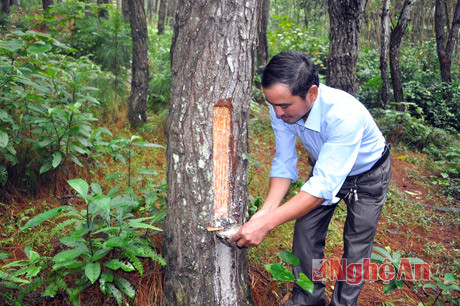 |
| Pine resin extraction area in Bai Son commune, Do Luong district. |
The pine forest area in Do Luong district is approximately 7,000 hectares, and the Do Luong Forestry Company Limited has 1,700 hectares (of which 700 hectares are currently being exploited for resin). Currently, 390 households in 8 communes of the district are contracted to manage pine forests. Due to the relatively good and stable income from forest management, protection, and resin extraction, the people are secure and committed to the forest. This is an important basis for the enterprise to improve its competitiveness in the resin market and always promptly fulfill large-scale consumption contracts. In 2012, nearly 261 tons of pine resin were extracted, and from the beginning of 2013 to the present, the Quyet Thang, My Son, Hoa Son resin extraction stations and joint ventures with Trang Son, Dong Son, Hong Son communes, etc., have extracted more than 250 tons of resin, and it is expected that by the end of this year, 270 tons of pine resin will be extracted.
Meanwhile, at the Yen Thanh Protective Forest Management Board, in recent years, investment in developing pine forest areas has created a strong advantage in supplying pine resin and increasing revenue for the unit. Currently, the Board has 300 hectares of pine forest (of which 200 hectares are being harvested) spread across 6 communes in the semi-mountainous region: Xuan Thanh, Bac Thanh, Trung Thanh, Dong Thanh, etc. Here, the Yen Thanh Protective Forest Management Board also applies a joint venture method with households that are contracted to care for, manage, and harvest pine resin. Using this model, 130 households within the Board's pine forest area have stable incomes from pine trees.
Mr. Nguyen Van Thanh, a manager at the Yen Thanh Protective Forest Management Board, said: “To ensure that people feel secure and committed to the pine forest, and to gradually increase their income, the Board regularly invests in and supports the people in strengthening pest and disease control and fire prevention. From the beginning of 2013 until now, all pine forest areas have been cleared of undergrowth, firebreaks have been created, and caterpillar control spraying has been carried out…” Currently, on the 200 hectares of pine forest in the harvesting stage, the Yen Thanh Protective Forest Management Board harvests 250 tons of pine resin annually, and revenue from this source always accounts for 50% of the Board's total revenue.
It has been learned that pine trees have existed in Nghe An province for a very long time, and currently, this type of tree has become one of the important trees in the province's forest areas. Mr. Nguyen Tien Lam – Deputy Director of the Department of Agriculture and Rural Development said: “Nghe An currently has a stable pine forest area of about 30,000 hectares, of which nearly 7,000 hectares are being exploited for resin and are mainly concentrated in Do Luong, Nam Dan, Nghi Loc, Yen Thanh, Quynh Luu… Annually, the pine resin production ranges from 3,500 to 4,000 tons and the export value reaches nearly 8 million USD. Thanks to the vast pine forest area, not only does it contribute to a rapid increase in forest cover, but it also creates high economic efficiency from forestry. In particular, about 2,000 households in the semi-mountainous areas have stable lives thanks to participating in forest management, protection, and pine resin exploitation.”
In recent times, despite the complexities of the rosin market, Nghe An rosin has been highly favored by the Japanese, Chinese, and EU markets, resulting in relatively stable demand. According to some rosin suppliers, the current purchase price for raw rosin in Nghe An is over 30 million VND per ton. However, to increase the value of rosin, investment in standardized rosin processing plants is needed, and the practice of selling rosin as raw material should be gradually reduced.
Hoang Vinh


