
"Opening the way" for science and technology activities.
(Baonghean) - For science and technology to become the foundation and driving force, creating breakthroughs in the socio-economic development of the province, a well-structured strategy and synchronized solutions are needed. In the short term, it is necessary to overcome limitations such as the "achievement-oriented" mentality and the "campaign-style" approach in implementing research projects.
According to Mr. Tran Quoc Thanh, Director of the Department of Science and Technology, an upcoming solution is to use cooperatives and businesses as intermediaries to transfer science and technology to farmers, with farmers being the beneficiaries in that production chain. These organizations ensure the quantity, uniformity, and readiness of goods production. This requires the participation of cooperatives, associations, and businesses in the household economy – a crucial economic component of rural areas today. Another reason for choosing these intermediaries is that businesses have better conditions for implementing, applying, and replicating models, and a higher willingness to take risks. Practical experience shows that science and technology strongly impact product quality, increase the competitiveness of businesses, and affirm their position. Businesses that are interested in science and technology and invest in it will succeed. Examples include TH Group, Nghe An Agricultural Materials Joint Stock Company, and Vinh Hoa Company (Yen Thanh)...
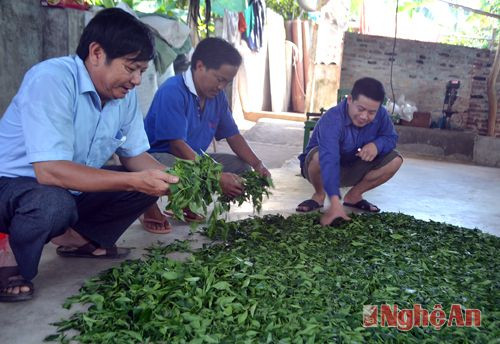 |
| Tea production according to VietGAP standards in Hung Son (Anh Son). Photo: CL |
The unique characteristic of scientific work is the urgency of the research topics, making it impossible to wait for the annual plan and fiscal year; therefore, timely funding is necessary. However, in reality, funding still has to wait for the budget to be disbursed in installments. Recently, the Ministry of Science and Technology has been drafting a plan for disbursement based on a fund, aiming to move towards disbursement according to the progress of the research project to ensure timely funding for scientific work.
On average, Vinh City allocates 2 billion VND annually to the application of science and technology. In particular, after testing and evaluating successful models (a model is considered successful if it achieves a net profit of 33% or more compared to revenue), the city "stimulates" the replication of these models through capital support policies. The City People's Committee, in coordination with the Social Policy Bank, guarantees loans for farmers to implement science and technology application models; and contracts with the City Farmers' Association to "take full responsibility on behalf of the city for certain models." Therefore, the organic chicken farming program, with 519 participating households in 9 communes in the city, has been successful, with no households experiencing any risks. According to Mr. Nguyen Van Chinh, Vice Chairman of the Vinh City People's Committee, the "stimulus" capital for replicating the model is crucial. Therefore, in addition to the coordinated efforts between intermediaries such as cooperatives and businesses with farmers, the State plays a leading role, providing technical support, directing the replication of the program, and inspecting, monitoring, and evaluating it. Furthermore, the replication of the model must be selective, choosing households and individuals with suitable land, labor, and economic conditions to implement it, rather than imposing it on any organization or individual. Simultaneously, it is necessary to attract investment from Japan and South Korea to provide capital and consulting services for environmental sanitation, wastewater treatment at centralized slaughterhouses, and the supply of clean products such as green vegetables to the market.
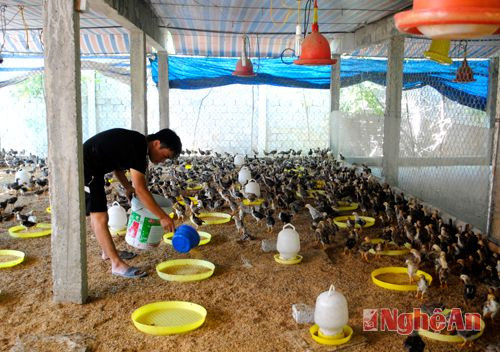 |
| Mr. Le Van Sau's chicken farm (Dien Trung, Dien Chau) applies biological bedding for economic efficiency and environmental hygiene. Photo: vt |
According to Mr. Ngo Hoang Linh, Deputy Director in charge of the Center for Application of Advanced Science and Technology in Nghe An: For research projects, after basic research, there must be a pilot production phase for testing. However, in our province, this phase is not yet clear; each research project is immediately put into large-scale production. For widespread successful application by the people, there must be a transitional phase (pilot production). Therefore, additional government intervention is needed, although the government's support costs will not be as high as initially. For example, with the biological bedding model in livestock farming, initially within the framework of a small project, the scaling-up phase, if supported by the government in terms of technology, training, and essential input materials for the people, will create a strong ripple effect. This is because people are still hesitant to invest in initial pilot projects. Furthermore, the maintenance phase after the scientific project ends requires the participation of relevant sectors, businesses, and the people, aiming towards the socialization of scientific work. If science focuses solely on businesses (because businesses have the resources to implement and utilize it), it will disadvantage the people. Therefore, careful consideration is needed regarding which types of investments should be made in businesses and which should be made in the community, aiming for the maximum effectiveness of science and technology. Another difficulty is that in the selection process, the choice between novelty and practicality is often made, while strong practicality is more likely to be widely adopted.
Discussing solutions to overcome future limitations, Mr. Tran Quoc Thanh, Director of the Department of Science and Technology, stated: Since 2015, the Department of Science and Technology has sent official letters to all districts, departments, and businesses, specifically "ordering" their needs for models or technologies. Initially, there has been a positive response from some districts and businesses, such as Ky Son district requesting technical support for cultivating certain medicinal plants; Nafoods Company requesting support for a gac fruit seed production program, etc. In particular, the province has agreed on a product-centric approach. The Department of Science and Technology proposed submitting 100 products for the entire province based on proposals from the districts. For example, the development of the Que Phong passion fruit brand will revolve around the product axis, meaning it will impact the entire product chain (seeds, production, science and technology, diseases, inputs - outputs) with the ultimate goal of creating a truly valuable and commercially viable product. Science and technology management agencies should even seek out businesses to invest in projects, prioritizing business proposals because businesses have the resources to implement them and socialize capital to carry out the research-development (R&D) model. Continued research is needed to improve science and technology, while also researching management and input-output markets.
Focusing on practical applications, in 2014 our province signed agreements with institutes and universities inside and outside the province to cooperate in research, application, and transfer of scientific and technological advancements to the province. This is also an effective solution to minimize losses for scientific and technological projects. The province's science and technology development orientation aims to achieve a relatively high level of scientific and technological capacity compared to other localities nationwide by 2020, building Nghe An into a Science and Technology Center of the North Central region. Thus, the task is extremely challenging, requiring a strong push for innovation in state management of science and technology across all sectors; for investment in agricultural, forestry, and fisheries production, it is necessary to adhere to the industry restructuring plan; and for other sectors such as industry and trade, it is also necessary to "benefit" from science and technology.
Chau - Quynh - Truong
| RELATED NEWS |
|---|


