
Long Chau - A Red Address
Vietnam and China have a long-standing tradition of friendship. Along with the development of multifaceted friendly cooperation between the two countries, the Chinese side has initiated the organization of the "Vietnam-China Red Tourism" route, focusing on exploiting historical sites related to the Vietnamese revolution, especially those related to President Ho Chi Minh, in the southern provinces of China. One of the most important highlights of this tourism route is Longzhou in Guangxi province.
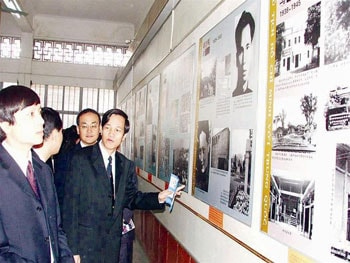 |
Central Committee of the Youth Union officials visit the photo exhibition. |
At the end of the 19th century, Ton That Thuyet, the leader of the Can Vuong movement, went to Long Chau but his plan failed, forcing him to live in seclusion there. Frustrated, he often wielded his sword to cut through rocks, so the people there called him "Ta Xec Lu" (Da Thach Lao - the old man who cuts rocks). He died in Long Chau in 1913. Moved by his chivalrous spirit, a Chinese scholar composed a couplet in his memory:
"The enmity between them is irreconcilable; their names will be remembered for eternity in Xiang County."
"The Emperor's private residence is a tranquil place, his thousand-year-old remains are inscribed in Longzhou."
(Our enemies share no common sky; our glorious name will forever be remembered in Tuong Quan. Helping the king find his final resting place, our remains will be entrusted to Long Chau for a thousand years.)
When the Bai Say uprising leader Nguyen Thien Thuat was suppressed by the French, he went to Long Chau to meet Ton That Thuyet to plan and also stayed in Guangxi.
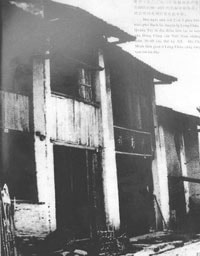 |
Houses No. 2 and No. 3, Bach Sa Street |
When the patriot Phan Bội Châu went abroad to initiate the Đông Du movement, he also visited Long Châu. In his "Chronology," he wrote: "Long Châu had quite a few people living there, but more than half were cooks for Western merchants and officials; moreover, this place had a French consulate. Therefore, I dared not stay long, and immediately hired a boat from Long Châu to Thái Bình. Commander Trần Thế Hoa even arranged a special boat for me to go to Nanning, and all the supplies on the boat were provided by Mr. Trần. This is a testament to the affection of the Chinese people towards our country."
Long Chau was the birthplace of the early base of the Vietnam Revolutionary Youth Association, led by Bui Ngoc Thanh. Many Vietnamese people passed through Long Chau to attend political training courses opened by leader Nguyen Ai Quoc in Guangzhou.
In 1933, Le Hong Phong returned to Long Chau to establish a Communist Party branch, train cadres, and expand activities to the northern provinces. Many relics related to Le Hong Phong, Bui Ngoc Thanh, Hoang Dinh Rong, Hoang Van Thu, and others still remain in the area.
Long Chau was a place where President Ho Chi Minh stayed and worked many times, and many relics and artifacts related to him are still preserved there. Before the August Revolution, Nguyen Ai Quoc visited Long Chau three times.
The first time was in October 1939, under the pseudonym Ho Quang, when Uncle Ho came to establish contact with Vietnamese revolutionaries. Later, he recounted: "Our Central Committee sent Comrade X to Long Chau to find me. Unfortunately, X had been cheated out of all his money by a friend and had to return to his country before I arrived in Long Chau."
The second time he came to Long Chau for revolutionary activities was around the end of 1941 and the beginning of 1942. According to Professor Hoang Tranh, Vice President of the Guangxi Academy of Social Sciences, "In Long Chau, he monitored and directed all the work of the First Office of the Vietnam National Liberation Alliance."
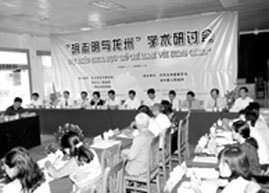 |
Scientific conference "Ho Chi Minh and Long Chau" |
The third time Uncle Ho visited Long Chau was in August 1944. He stayed in the Long Chau district town for about 20 days, then selected 18 trained Vietnamese youths to return to Vietnam to prepare for the General Uprising. After returning to Vietnam, he also crossed the border in the Long Chau area many times.
In 1950, to secure the support and assistance of the Soviet Union and China, President Ho Chi Minh secretly traveled to China and the Soviet Union via the Shuikou and Longzhou ports. "On the evening of January 16th, he arrived in Longzhou town and spent the night at the Longzhou Sub-district Command Headquarters. Upon returning, nearing Longzhou on March 13th, he composed a poem in Chinese characters:
"NEAR LONG CHAU;
Long Châu is thirty miles away.
The sound of cannons and the roar of engines.
The Vietnamese people are truly brave.
The resistance will surely be victorious, and nation-building will surely be achieved.
Translation: APPROACHING LONGZHOU
There are still thirty miles to Long Châu.
Hearing the planes roaring and their cannons shaking the ground,
The Vietnamese people are truly heroic.
Defeating the enemy and rebuilding the nation will surely lead to success.
(Translated by Phan Van Cac)
During the resistance war against the French, especially during the Border Campaign, President Ho Chi Minh frequently crossed the border in the Long Chau region to work with Comrade Tran Canh, a Chinese military advisor, to discuss matters.
Later, the people of Long Chau who had helped him and the Vietnamese revolution were remembered by him, invited to visit Vietnam, and warmly received by him personally. Among them were Mr. Nong Ky Chan, Phan Toan Tran... They became sworn brothers of President Ho Chi Minh.
Today, Longzhou is becoming a gateway to the China-ASEAN Free Trade Area and the "Two Corridors, One Economic Belt" zone, so many changes have taken place. But one thing remains unchanged: the deep respect and affection of the people of Longzhou for President Ho Chi Minh. Thanks to the attention of the Guangxi and Longzhou governments, the relics related to President Ho Chi Minh are preserved and restored, becoming invaluable assets symbolizing the friendship between the people of the two countries. On the occasion of the 106th anniversary of President Ho Chi Minh's birth, the people and government of Guangxi solemnly inaugurated the Exhibition House on the activities of President Ho Chi Minh and Vietnamese revolutionaries at house number 76, Nan Street (now number 99), Longzhou City.
Two seminars, "Ho Chi Minh and Long Chau" and "Economic Cooperation at the Thuy Khau - Ta Lung Border Gate between Vietnam and China," were also held in Long Chau. To commemorate the 108th anniversary of President Ho Chi Minh's birth, the Chongzuo City Government, the Chinese Academy of Social Sciences, and the Ho Chi Minh Museum jointly organized the second scientific seminar "Ho Chi Minh and Long Chau" to further verify documents and relics related to President Ho Chi Minh, serving to promote the "Following in the Footsteps of Ho Chi Minh" tourism route.
We firmly believe that the relics related to President Ho Chi Minh and Vietnamese revolutionaries in China in general, and Longzhou in particular, will continue to be preserved, restored, and effectively promoted, becoming attractive historical sites for Vietnamese, Chinese, and international tourists.
Nguyen Xuan Thuy -(Kim Lien Historical Site)


