
Class for married Hmong women
(NAO)This is a literacy class taught by young volunteer intellectuals from the 4th Economic-Defense Brigade to married Mong ethnic women aged 20 to 50. The majority of these students were illiterate or had relapsed into illiteracy, having recently settled in the new Lien Son village about a year ago, having come from the villages of Nam Khien and Huoi Nhao in Nam Can commune, Ky Son district (Nghe An province).
A person who has a special connection with the local culture.
The person we approached was Mr. Pham Hong Phuong, the team leader of the young intellectual volunteer team of the Economic-Defense Corps of Military Region Four (KT-QP 4).
Nearly two years ago, Pham Hong Phuong was assigned to lead a team of young volunteer intellectuals to the Mong ethnic minority villages in Nam Can commune, Ky Son district, to encourage families to settle in the new Lien Son village. He was later appointed deputy head of the construction team. He and 12 other young volunteer intellectuals spent nearly four months working with the villagers, cutting trees, leveling the ground, and building houses to construct the new village.
|
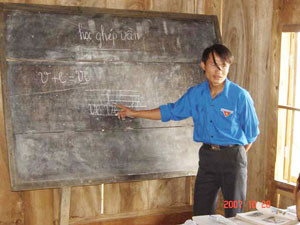
In addition to their assigned duties in the villages, the team members continued to visit the villages of Nam Can commune, Ky Son district, to encourage people to come down from the mountains and participate in building the new Lien Son cluster of two villages.
Hmong women want to learn to read and write.
Speaking with us, young volunteer intellectual Lo Thi Minh said: "Initially, the team didn't plan to open a literacy class; the team members only acted as 'tutors' for some young children attending school in the village. But then some mothers and sisters in the village came to ask us to teach them. At first, there were only a few people, but after a week, there were 12, so we started discussing opening a class. The village's cultural center wasn't finished yet, so the team borrowed a space at the house of Mr. Va Ba Xenh A, the deputy village head of Lien Son."
Knowing the significance of this initiative, the Party Committee and the command of the 4th Economic-Defense Brigade allocated funds to purchase textbooks, notebooks, pens, ink, and blackboards to distribute to the women in the village. The Nậm Càn commune government provided tables, chairs, and a blackboard for the classroom. Next, the Brigade's volunteer youth team conducted a survey in the new village, finding a very high illiteracy rate, mainly among married women aged 20-50 who had not attended school previously. The team members encouraged families to create favorable conditions for the women to attend literacy classes. Within just one month of opening, 21 women had enrolled. Classes were usually held on Saturdays and Sundays, but during the farming season or on rainy days, the women would gather at the class, requesting the "volunteer" teachers to come to class.
Ms. Xong Y Chu, the class vice-president, shared: "I'm over 50 years old, but this is my first time attending school. Back in my old village, we women didn't have the opportunity to go to school. After getting married and working in the fields, no one wanted to learn to read and write. Now it's different. If we don't learn, we're embarrassed to go to the market and don't dare meet people from the lowlands. Every day we come to class, our husbands and children help out, and the whole family learns to read and write."
The teacher teaches, and the teacher also learns...
|
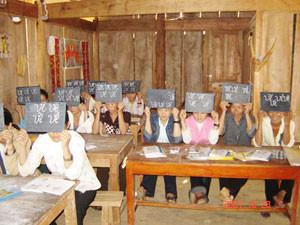
The young volunteer intellectuals also guide the women on parenting, family planning, the position, role, and importance of women in the family and society... According to the plan, the classes will be held until May 2008, and after that, the members of the young volunteer intellectual team will continue to conduct new classes for women in Tham Hin village, Nam Can commune, Ky Son district.
Despite the age difference, the teacher-student relationship is very intimate and close. The members of the young intellectual volunteer team are all called "teacher" or "mentor" by the women and mothers. Gifts for the teachers include a few taro roots, green pumpkins, and roasted sticky corn... This reflects the simple sincerity, deep empathy, and gratitude of the women and mothers in Lien Son village towards the young intellectual volunteers.
Mr. Quoc Lan