
Huoi Cang Fire
The biting cold and thick fog blanketed the only road leading to Huoi Cang village in Bac Ly commune, Ky Son district. The UAZ vehicle carrying the Nghệ An Border Guard's performing arts team had to stop midway up a long, winding slope to allow the tires to cool down from the constant braking. The acrid smell of smoke rising from the four tires caused the female members of the Border Guard's performing arts team to vomit uncontrollably... After the steep, precarious stretch of road beside a deep ravine, they encountered a muddy, bumpy section. And, as usual, the vehicle got stuck in the mud. The Khmu villagers, returning from their fields, enthusiastically helped the soldiers push the vehicle. We arrived at Huoi Cang village late in the afternoon; the cold from the gray rocky slopes seemed to penetrate every cell, causing excruciating pain.
(Baonghean)The biting cold and thick fog blanketed the only road leading to Huoi Cang village in Bac Ly commune, Ky Son district. The UAZ vehicle carrying the Nghệ An Border Guard's performing arts team had to stop midway up a long, winding slope to allow the tires to cool down from the constant braking. The acrid smell of smoke rising from the four tires caused the female members of the Border Guard's performing arts team to vomit uncontrollably... After the steep, precarious stretch of road beside a deep ravine, they encountered a muddy, bumpy section. And, as usual, the vehicle got stuck in the mud. The Khmu villagers, returning from their fields, enthusiastically helped the soldiers push the vehicle. We arrived at Huoi Cang village late in the afternoon; the cold from the gray rocky slopes seemed to penetrate every cell, causing excruciating pain.
Huồi, in Thai, means stream. The village lies along the banks of the Cáng stream, in a deep valley, overlooking towering mountains on all sides. From the Bắc Lý Commune People's Committee headquarters, a deep cave entrance is clearly visible on a sheer, smooth cliff face. No one has ever set foot there, and the villagers have passed down a story for generations: In the early days of the village, a couple, whose origins are unknown, wandered to this place. The dense forest, dangerous waters, lurking wild animals, and incessant floods forced the couple to flee high into the mountains and take refuge in this deep cave, a place where no wild animal could ever reach. Every day, the husband, named Dín Hùa Na, went hunting, while his wife, Gầu Dua, stood outside the cave with their child, waiting for him in the deep evenings... The descendants of Gầu Dua and Dín Hùa Na were born one after another, grew up, and left the cave, spreading throughout the region, having children and grandchildren, becoming the human race we know today... Mr. Mùa Nỏ Xừ, Vice Chairman of the People's Committee of Kỳ Sơn district, said – “It's not surprising that the Hmong, Thai, and Khơ-mú people in these high mountains all explain the origin of humankind with the same legend...”. Because here, for generations, these ethnic groups have stood side by side, making a living, surviving, and coping with the uncertainties of nature and enemies...
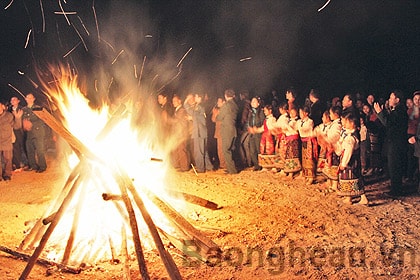
A warm campfire night in Huoi Cang
Just recently, in July 2012, a devastating flash flood swept away dozens of houses in Huoi Cang, along with a school and a health station. The flood was so sudden that most villagers were out working in the fields that day, so there were no casualties, but houses, cattle, pigs, chickens, and property were swept away by the raging floodwaters. Mud and sand piled up, cliffs collapsed, and tree trunks lay scattered everywhere. The road to Huoi Cang was cut off for two days, preventing rescue forces from the District People's Committee from reaching the area. On the spot, officers and soldiers of the Task Force, from Border Guard Post 527, worked with the villagers to mitigate the damage. The villagers voluntarily provided assistance with a spirit of mutual support. The Thai, Mong, and Khmu people, along with border guards, worked together, salvaging pieces of wood and leaves from the rubble to help rebuild their homes... Lieutenant Colonel Ha Dinh Tin, a border guard officer assigned to serve as the Party Secretary of Bac Ly commune, recounted: “On the first night after the flash flood swept through, I looked at the devastated village in the darkness and tears welled up in my eyes. For ten years I had carried my backpack to Bac Ly on duty, and I felt the changes happening here every day, yet in just a few dozen minutes, the flash flood swept everything away... I thought it would take a long time to recover, but unexpectedly, in just nearly a month, thanks to effective support from above and the utmost efforts, the lives of the people have temporarily stabilized. I will never forget the night when the village head, Moong Van Bay, re-installed a small hydroelectric motor, pulling wires from the stream to light up the house, then turned on the TV, and the whole village came to watch, it was so much fun. At that moment, my heart was also filled with emotion.” "Yes, sir!"
During the dry season, the Cáng stream flows only a small trickle through isolated rocks. Along a 300-meter stretch of the stream, I counted 13 small hydroelectric motors, each with a power output of about 1.5-2 kW, installed by the villagers to generate electricity. And just as Party Secretary Hà Đình Tín had said, at night, walking along the precarious path around the cliff, I looked down at Huồi Cáng village, the electric lights shimmering like falling stars, stretching along the Cáng stream. It was a river of stars...
Here, there is no national power grid and no mobile phone signal. The only telecommunication channel with the outside world is a V-SAT satellite landline phone installed at the commune's People's Committee headquarters, but it's very unreliable. Whenever an urgent call is needed, Lieutenant Colonel Ha Dinh Tin, Secretary of the Bac Ly Commune Party Committee, has to ride his motorbike to Cong Troi (Heaven's Gate), where there are only a few bars of Viettel mobile phone signal, enough to transmit information, even a call lasting only a few minutes would drop off 4 or 5 times. Once, upon arriving at Cong Troi, as soon as he turned on his phone, dozens of messages flooded in. After making calls and replying to messages, his phone battery died!
The chairman of Cụt Phò Dương commune told me, "Mr. Tín is now one of our people; you should go to his house and see for yourself!" It was a small, neat, and charming house. Secretary Tín, along with a land management official, had also been assigned to Bắc Lý commune. Here, the surrounding area was a model of a well-organized garden, pond, and livestock enclosure. In the yard, the chickens, ducks, and geese were plump and healthy. The chairman of Cụt Phò Dương commune introduced him, saying, "Secretary Tín is setting an example and role model for the villagers!"
When Lieutenant Colonel Ha Dinh Tin first became the commune's Party Secretary, he determined that poverty alleviation for the local people had to start with developing household economies. He believed that mere propaganda and persuasion weren't enough; it required "visual aids," allowing people to see clearly before they could follow suit. With this in mind, Secretary Tin used his salary to buy plant and animal breeds for farming and raising. He single-handedly built pens and dug ponds in low-lying areas for fish farming. His small farm, located right next to the commune's People's Committee office, with its full range of plants, animals, and three fish ponds, served as a model for people to see, hear, and emulate.
The resolution of the Bac Ly Commune Party Committee (2010-2015 term) identified the development of production, focusing on expanding the area for peanut cultivation. Secretary Ha Dinh Tin instructed commune officials to first directly participate in labor to alleviate poverty and set an example for the people; this was considered one of the criteria for evaluating the completion of tasks. With support from the Ky Son District Department of Agriculture, including 5 quintals of peanut seeds and 6 quintals of fertilizer, and guidance on planting and caring techniques, a peanut cultivation model was established by Bac Ly commune officials on land that had been left fallow for many years. The area under peanut cultivation gradually expanded. Officers and soldiers of Border Guard Post 527 joined the people in plowing, hoeing, and sowing seeds... The people of Bac Ly truly trusted this Border Guard Party Secretary and the changes he brought to their homeland...
On Sunday morning, fog enveloped Huồi Cáng, bringing a biting cold. Two girls, Cụt Thị Mai and Cụt Thị Tiên, had the day off from school and were pounding rice while reviewing their lessons under the stilt house. I asked them, "How can you remember your lessons while pounding rice and reviewing like this?" The two girls shyly replied, "Tomorrow, if we don't know the lesson, our homeroom teacher, Hờ Và Tu, will be angry. He's kind, but very strict. We have to study..."
Bidding farewell to the two girls, I slung my backpack over my shoulder and continued on to Huoi Bac village, about 15 kilometers away through a treacherous forest. There, a military-civilian medical station would begin construction tomorrow... The warmth from the fire under the stilt house where the two girls lived seemed to linger with me.
Notes - Hoai Quan


