
Choose plants that are adapted to the weather.
(Baonghean) - Transforming crop structures and gradually adapting to drought conditions is a trend that local farmers are focusing on to ensure efficiency in agricultural production.
Effective models
These days, in the Lien Chau fields of Thanh Lien commune (Thanh Chuong district), farmers are actively tending to 5 hectares of green squash, a crop converted from rice paddies lacking water. This is the third year that green squash has proven to be a profitable crop in this area.
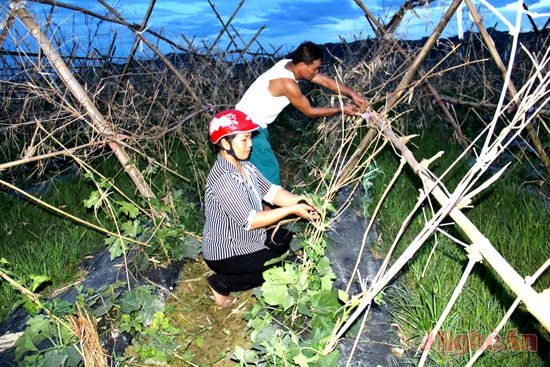 |
| A model for growing green squash in Thanh Lien commune (Thanh Chuong district). |
Ms. Nguyen Thi Lan from Hamlet 3 shared: “At first, we were worried that the pumpkin plants wouldn't adapt well because of the drought and the difficulty in securing irrigation water. However, after starting cultivation, we realized that it's an easy-to-grow crop, the seeds are readily available, and it's very suitable for the soil here. The average yield is nearly 40 tons/ha. Even more encouraging is that green pumpkins are easy to sell; traders come directly to the fields to buy them, making product sales convenient. With a selling price of 3,700 VND/kg at the field, after deducting costs, we earn over 9 million VND/sao/season. The time from land preparation to harvest lasts 3 months, so we can plant the winter crop according to the seasonal schedule, which gives us complete peace of mind.”
As one of the communes located in a hilly area, Thanh Lien suffers from severe water shortages for rice cultivation. This year's summer-autumn crop sees 128 hectares of vegetable crops planted, including 10 hectares converted to drought-resistant crops on water-scarce rice fields. Mr. Phan Ba Ngoc, Chairman of the Thanh Lien Commune People's Committee, shared: “Previously, on the converted land, people cultivated two rice crops and one corn crop. However, after realizing the economic benefits of pumpkins, farmers boldly switched to growing pumpkins on water-scarce rice fields during the summer-autumn season. Currently, the market for the product is quite stable, not only consumed within the province but also transported to northern markets such as Hai Duong and Hanoi… This is thanks to the high quality of the pumpkins, and also because the commune government has contacted traders to ensure the purchasing process. In the future, the commune will expand the area to 7 hectares and plans to stop at this level to ensure production and product consumption capacity.”
In Nghia Phuc (Tan Ky district), over 30 hectares of black sesame are thriving, with cultivation areas spanning across Phuc Thanh, Tan Hoanh, and Da Son hamlets. Mr. Tran Van Tam (Da Son), one of the successful households using the drought-resistant sesame cultivation model, shared: “Currently, my family is cultivating 4 sao (approximately 0.4 hectares) of black sesame after harvesting peanuts and beans from the spring crop. For the past three years, I have maintained this cultivated area because sesame is quite drought-resistant; the recent drought only affected a small portion of the seedlings. The average yield per hectare is nearly 7 quintals (700 kg), and with the current price of 47,000 VND/kg, we earn nearly 33 million VND. After deducting expenses, we still make a profit of 25 million VND.”
Sharing his thoughts on this matter, Mr. Nguyen Van Hoa, Vice Chairman of the Tan Ky District People's Committee, said: “Sesame is considered a crop that adapts well to drought, especially in dry, hilly areas. It can withstand temperatures up to 40°C while only needing 600 m³ of water per hectare, only 1/5 the water requirement of rice. Growing sesame not only effectively solves the need for irrigation water but also helps farmers maximize the potential of this crop, reduce production costs, and increase income in the current hot weather conditions. It is also a crop that requires little care, has a short growing season, and can be harvested in 2.5 months. This year's summer-autumn crop saw the entire district planting 100 hectares of sesame, with a high concentration in Nghia Phuc and Giai Xuan communes, promising high economic efficiency.”
Choose the right type of plant.
The drought is predicted to continue for an extended period. In today's increasingly erratic climate, water scarcity in agricultural production is considered unavoidable; living with climate change is something the agricultural sector must adapt to. One effective and appropriate measure is to restructure crop patterns to combat drought. However, achieving both drought mitigation and high economic efficiency and safety is a crucial consideration. Over the years, localities within the province have made significant efforts to identify suitable crops for the specific conditions of each region in order to develop effective crop restructuring plans.
Mr. Ho Ngoc Sy, Director of the Department of Agriculture and Rural Development, said: "Every year, the area converted throughout the province reaches hundreds of hectares, especially in recent years when the drought situation during the summer-autumn crop season has become increasingly severe and intense. In particular, rice-growing land in the lowland and coastal districts is mainly being converted to growing drought-resistant crops such as various types of beans, peanuts, sesame, etc. This conversion also has many advantages because these are traditional crops of Nghe An, but due to food shortages, many areas have abandoned them and switched to rice cultivation. Farmers have experience in farming, and the soil and climate conditions are quite suitable. These are also crops that yield high economic value and efficiency. Therefore, besides the purpose of drought mitigation, the conversion to these crops also meets the need to increase economic efficiency in production, and is enthusiastically received and implemented by the people, especially as more and more new and advanced varieties are introduced into production."
However, for effective conversion, in addition to selecting suitable varieties and crops, localities and people also need to pay attention to implementing appropriate farming practices. Although drought-resistant, all crops require a certain amount of water and moisture to thrive. According to agricultural experts, crops such as corn and sugarcane should be covered with plastic or straw after planting to retain moisture. If possible, try to apply drip irrigation or sprinkler irrigation combined with fertilization to ensure stable growth and development, and maximize yields.
In mountainous areas, it is necessary to focus on developing perennial industrial and fruit crops with deep root systems and good drought resistance, such as rubber, coffee, oranges, and lemons. These are crops that have developed strongly in our province in recent years and have proven their advantages, even thriving in arid hilly and mountainous regions. Mr. Thai Van Thanh, Chairman of the People's Committee of Dong Thanh commune (Yen Thanh district), said: “Orange trees are a traditional crop in the locality, so when the commune decided to expand, develop, and renovate the orange growing area in Dong Thanh, the people enthusiastically responded. To date, in addition to Mr. Le Xuan Giao's orange farm with an area of nearly 55 hectares, there are 25 households growing oranges from 2 to 10 hectares, with many households earning billions of dong each year. Seeing the clear effectiveness, the households have invested in drilling wells to irrigate their orange trees to increase productivity, quality, and efficiency. Currently, seedlings and land have been prepared to plant an additional 10 hectares of oranges this autumn.”
Through trials and research by scientists, we have gradually found suitable crops that are drought-resistant and highly economically efficient. However, to transform the crop structure and improve agricultural production efficiency, in addition to identifying suitable crops and applying effective farming techniques, localities need specific planning for each region, strengthening linkages, forming concentrated commodity production areas, and building stable markets to reassure farmers and encourage intensive farming.
Phu Huong - Thanh Quynh


