
Personnel rotation: What works and what doesn't.
(Baonghean)- Cadre rotation aims to help officials gain practical experience and enhance their capabilities, thereby assisting localities in promoting economic and social development. However, to date, due to the lack of comprehensive policies on cadre rotation and the insufficient and inaccurate evaluation and assessment of cadres during rotation, regrettable incidents have occurred...
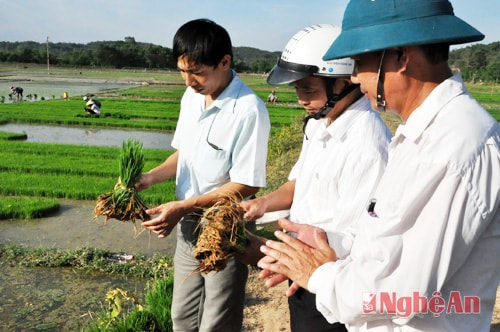 |
| Comrade Le Van Bieu - Chairman of the People's Committee of Boi Son commune, Do Luong district (center) inspects the progress of summer-autumn production. |
Training environment for cadres
Implementing the rotation of cadres, the Do Luong District Party Committee has strengthened the workforce by assigning many cadres from the planning list to key positions in the communes. These cadres, transferred to the grassroots level, have effectively demonstrated their capabilities, contributing to the stability of the political system and the socio-economic development. From June 2012, Comrade Nguyen Tat Hiep – Member of the Standing Committee and Head of the Propaganda Department of the District Party Committee – was transferred to the position of Secretary of the Party Committee of Trang Son Commune. Thanks to a clear understanding of his responsibilities, from the very beginning, he actively fostered unity within the Party Committee, government, and mass organizations; together with the Standing Committee of the Commune Party Committee, the government, and the people in the area, he promoted land consolidation and exchange, focusing on developing production and livestock farming towards a commodity-based approach. These efforts have significantly contributed to reducing the commune's poverty rate from 7% to below 5%. Comrade Nguyen Tat Hiep stated: “Like my colleagues who are being rotated to the communes, I need to actively participate in many areas; contributing to helping localities effectively utilize external resources, develop internal strengths within the people, create significant socio-economic changes, and foster sustainable development…”. From June 2014, after successfully completing his rotation, Comrade Nguyen Tat Hiep was assigned by the District Party Committee Standing Committee to the position of Head of the District Party Committee's Propaganda Department.
In Do Luong district, Comrade Nguyen Tat Hiep's case is just one of seven leading officials from various departments, agencies, and organizations in Do Luong district, born in the 1970s, who have been selected to serve as key officials at the commune level since 2012. Among them, one is a member of the District Party Committee Standing Committee, three are District Party Committee members, four have been transferred to assume the position of Party Committee Secretary, and three serve as Deputy Secretaries and Chairmen of the Commune People's Committees. Those who were transferred, have returned, or are still leading local affairs have all demonstrated their abilities, quickly adapted to their new work environment, shown responsibility, and earned the trust of officials and the people in their areas.
Immediately after its establishment, the Standing Committee of the Thai Hoa Town Party Committee issued Project No. 01-DA/ThU dated September 23, 2009, on the rotation of leading and managerial cadres. It can be said that thanks to the early issuance of the project and its fairly specific and systematic implementation, out of the 7 comrades rotated, 2 comrades in the first rotation phase were transferred back to higher positions than before the rotation. For example, Comrade Bui Trong Thao, before being rotated from the position of Town Party Committee member and Deputy Head of the Department of Natural Resources and Environment to Chairman of the People's Committee of Nghia Hoa commune (May 2010-March 2014). Nghia Hoa is one of the most difficult communes in Thai Hoa: its infrastructure is very weak, there are many loopholes in land management, and the most important difficulty is the shortage and weakness of the cadre. With the strengthening and rotation of Comrade Bui Trong Thao, and from March 2014 to the present, Comrade Hoang Nghia Thai, Director of the Land Use Rights Registration Office, holding the position of Secretary and Chairman of the People's Committee of the commune, land management has been fundamentally tightened, infrastructure has been continuously invested in, and the construction of new rural areas has been promoted, resulting in a truly radiant appearance of the commune. In particular, Nghia Hoa has now trained key officials who can assume leading roles in the next term.
Every year, the Provincial Party Standing Committee plans the rotation of cadres from the province to districts, cities, and towns, and the transfer of personnel from grassroots levels to the province. This work actively contributes to strengthening the grassroots political system and fostering cadre training for the province. A prime example of those recently rotated to grassroots levels is Comrade Tran Quoc Thanh, currently the Director of the Department of Science and Technology. He served as the Secretary of the Que Phong District Party Committee for three years, under the Provincial Party Standing Committee's leadership. During that time, he worked with the District Party Standing Committee and Executive Committee to strengthen the grassroots political system and promote economic development and poverty reduction programs. He left his mark by coordinating with the District Party Standing Committee to issue resolutions on economic development and reforestation; and developing economic models focusing on the region's specialty crops and livestock to elevate them into marketable commodities. In particular, the development of rubber and passion fruit cultivation is opening up many opportunities for crop diversification and sustainable income increase for the people in the border region of Que Phong. At the time of his transfer to the district (in 2010), Mr. Thanh held the position of Deputy Director of the Department of Agriculture and Rural Development. After demonstrating his capabilities and achieving the aforementioned results, he was appointed by the Provincial Standing Committee to become Director of the Department of Science and Technology.
As for Comrade Nguyen Thanh Hien, Principal of the Provincial Political School, he also spent more than three years being transferred by the Provincial Party Standing Committee from the Provincial Population Department to become the Secretary of the Anh Son District Party Committee. Upon arriving in the district, he actively fostered unity and cooperation, effectively organizing the "Year of Democracy" with activities such as dialogue within the Party, dialogue with the people, and meetings of Party secretaries of communes. From these forums, many pressing issues and opinions were discussed and solutions were decisively implemented, such as: building infrastructure for schools; creating sources for Party development; and implementing social policies for target groups. In addition, the Anh Son District Party Standing Committee had a policy of assigning cadres from the Party, mass organizations, government, police, and military sectors, divided into 21 groups, to participate in Party branch activities at grassroots Party committees. These activities have been replicated and regularly maintained in Anh Son district...
Most of the transferred officials have generally complied well with the Party committee's transfer decisions, demonstrating clear understanding of the policy, feeling secure in their work, and striving to successfully complete their assigned tasks. The Party committees and local authorities receiving the transferred officials have trusted and facilitated their development, resulting in a 71% rate of excellent performance. The majority of transferred officials, assuming new positions, have demonstrated strong roles and responsibilities, made significant efforts, successfully completed their assigned tasks, shown personal growth, quickly adapted to new environments, and made progress in their understanding, perspectives, and leadership methods, effectively utilizing their abilities and strengths. After the transfer period, those who performed exceptionally well have been reassigned to more suitable positions.
A costly lesson
Looking at the overall picture of cadre rotation at all levels, we affirm that cadre rotation is a correct policy of the Party aimed at training, nurturing, and creating a pool of cadres. However, due to many subjective and objective reasons, the process of cadre rotation still has shortcomings. In some cases, rotated cadres have not been fully committed, have not developed programs and plans, have not truly integrated and connected with the socio-economic development movements of the people in the area, and even cases of law violations have occurred, leading to the loss of cadres.
Thanh An commune (Thanh Chuong district) is a semi-mountainous area. Five to seven years ago, it was known for its difficult terrain, weak commune officials, and lackluster community movements. To create a turning point for the locality, the Thanh Chuong District Party Committee transferred two deputy heads of departments to take on leading roles in both the Party Committee and the government. Initially, the dynamism of the transferred officials attracted significant investment in infrastructure development for the commune. After three years, the district Party Committee withdrew the officials, but "brought with them" a case related to the misconduct of the two transferred officials. The incident led to two district officials being transferred to the commune as Party Secretary and Chairman, receiving prison sentences according to the law. The seismic impact of this case significantly affected the people's trust in the Party Committee and the government. Comrade Nguyen Danh Luong, Secretary of the Party Committee of the commune, reflected: “After that incident, commune officials and civil servants felt apprehensive, as if they had lost their footing and confidence. Therefore, we focused on consolidating operations, increasing meetings and exchanges with the people to rebuild public trust…” The case in Thanh An was taken by the Standing Committee of the Thanh Chuong District Party Committee as a “painful” lesson in the work of rotating, training, assigning, utilizing, and inspecting and evaluating cadres.
In Thai Hoa, although the rotation of personnel has generally yielded quite good results, with rotated officials creating a positive momentum and those who have been rotated becoming more mature and appointed to higher positions, some rotational positions have not been convincingly effective. When rotated officials take on leadership roles, they tend to focus on administrative tasks rather than demonstrating vision and strategic planning for local development. Comrade Vuong Duc Binh, Head of the Party Committee's Organization Department, acknowledged: "Due to shortcomings in the comprehensive evaluation of cadres, the prediction and assessment of the capabilities and ability of cadres to fulfill their duties in new positions have not been accurate. For example, the Standing Committee's decision to assign a cadre to work in culture but to take on the leading role in grassroots government work has revealed limitations. The Standing Committee of the Thai Hoa Town Party Committee has planned to conduct a preliminary review and objectively and specifically evaluate the effectiveness and limitations of cadre rotation to make appropriate adjustments in cadre rotation planning, ensuring that the right person is assigned to the right job."
A process is needed.complete
Although most districts have done well in planning, training, and developing cadres, they have not yet approved a plan (or project) for cadre rotation. Meanwhile, the process for cadres appointed to higher levels requires them to have worked at the grassroots level. Therefore, in many localities, cadre rotation lacks effective management, monitoring, evaluation, support, and training solutions. Consequently, many cadres, upon being rotated to the grassroots, fail to make a significant impact. This stems from the fact that many cadres, upon being rotated to the grassroots, are only concerned with maintaining their position to be promoted further, rather than actively engaging in practical work. Furthermore, it is possible that cadres at some grassroots levels are outwardly supportive but inwardly resentful of the rotated cadres, leading to a lack of cooperation and collaboration.
On another level, in the initial stages at the grassroots level, transferred officials often perform their duties well, but in later stages, they show signs of arrogance and self-importance, leading to a loss of their own integrity. Regarding this aspect, Comrade Le Quang Dat, Secretary of the Thanh Chuong District Party Committee, stated: “For a long period, the district had not developed a plan, regulations, or timeline for the rotation of cadres to grassroots levels. In addition, the cadres who were rotated performed very well in the initial stages when they adapted to local realities. However, the monitoring of the situation, the organization of inspections and evaluations of cadres were not thorough enough, and adjustments and reviews were not conducted promptly, leading to some cadre violations being detected and corrected late. Learning from that experience, at the beginning of 2014, the Standing Committee of the District Party Committee issued Plan No. 97-KH/HU on cadre rotation for the period 2014-2019; In this plan, the district took appropriate and cautious steps, promoting democracy and paying attention to policies for rotated cadres…”
One of the difficulties at the district level is that, for a long time, officials from departments and offices, when transferred to communes, have retained their positions as heads or deputy heads at the district level. The fundamental reason is the shortage of staff in these localities. Therefore, they are forced to "hold onto" the positions of officials while they are working at the grassroots level. This reality leads to a shortage of personnel in the departments and offices where leaders are transferred to communes, limiting the process to merely "delegating authority" to their deputies, causing professional activities to be stalled and lacking decisiveness. And after the transfer period ends, the officials return to their original positions, failing to create motivation for the transferred officials…
On the other hand, to address the issue of "localism" in personnel placement and leadership at the grassroots level, Do Luong district is a pioneering unit directed by the province to pilot a model of "horizontal" personnel rotation. This means that the Party Secretary or Chairman of the People's Committee of one commune will be rotated to another commune in a similar position, and vice versa. After several steps of arrangement, the district has rotated 3 pairs (6 officials) in 3 communes according to this model. This new approach is posing many challenges for the rotated officials. Because these officials are not from the local area, although they have extensive leadership experience, they have to start from scratch in their new location, getting acquainted with the local population, customs, and surveying the socio-economic situation… Comrade Nguyen Hong An - Head of the Organization Department of the Do Luong District Party Committee shared: “In the district's cadre rotation plan, we specifically instructed units and localities to combat parochialism, closed-mindedness, and isolationism, which create difficulties for the rotated cadres. To achieve this, it requires strengthening inspection and supervision, and prioritizing ideological work for cadres and Party members, both those being rotated and those being received. The process requires careful implementation, a strict roadmap, and thorough preparation of conditions at both the sending and receiving locations.”
It can be affirmed that the rotation of cadres is essential and contributes positively to the training and development of cadres; therefore, it needs to be carried out regularly and continuously. However, due to the lack of standardized regulations or specific, synchronized policies and mechanisms for cadre rotation and placement, a piecemeal and hasty approach is unavoidable, resulting in low effectiveness. This requires Party committees at all levels to plan a specific roadmap, based on the results of the initial planning approval, to review and supplement the plan as a basis for effectively carrying out cadre rotation in conjunction with training and development based on practical experience. Comrade Dau Van Thanh, Deputy Head of the Provincial Party Committee's Organization Department, stated: "All issues related to the rotation of cadres from the provincial level to the grassroots level are compiled, reviewed, and promptly advised by the Provincial Party Committee's Standing Committee to propose specific solutions. In reality, this work has been carried out for a long time and is continuing to be implemented to make the rotation of cadres increasingly in-depth, achieving high quality and effectiveness; contributing to the training and development of successor cadres at all levels through practical experience at the grassroots level…".
Huu Nghia -Nguyen Son


