
Luong Khac Thanh: Writing to express gratitude to life.
(Baonghean) - I've known the name Luong Khac Thanh for quite a while, since I happened to copy one of his poems that was published in a literary newspaper. Then, fate brought me back to Nghe An, where I had the opportunity to meet many poets I admired and knew well.
Writing to express gratitude to life.
And I also had the opportunity to meet the author of the poem I had copied into my school notebook. I was quite surprised to learn that those poems, full of sadness and nostalgia, were written by someone who worked in finance (Luong Khac Thanh, formerly a specialist at the Nghe An Department of Finance).
And on a sunny morning by the tranquil Goong Lake, amidst the gentle autumn breeze, sitting with his literary friends, Luong Khac Thanh proudly showed off his newly written poem by… singing it aloud. He said that when writing this poem, he hummed it to the rhythm. He innocently tapped his thin fingers on the wooden table of the café and sang. The song – the poem – speaks of the sunny, windy southern region, a certain land he had traveled through, and felt deeply attached to, even if only for a fleeting encounter. That's it, just a fleeting encounter, yet Luong Khac Thanh could love, could remember, felt indebted… Perhaps that is why Luong Khac Thanh lived and wrote as a way to express his gratitude to this life – even though it had brought him no small amount of hardship.
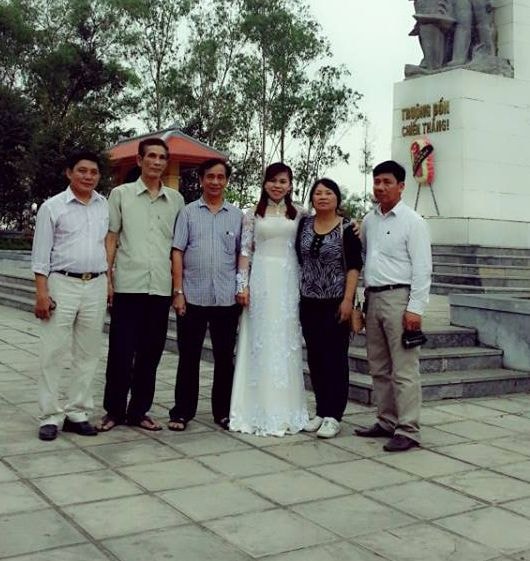 |
| Luong Khac Thanh (third from the left) with singer Que Thuong and friends during a filming session for the song "Letter from Truong Bon". |
The poet Thach Quy revealed to me that Luong Khac Thanh "has the ability to read palms"! Curious, I asked him about the mystery of palm lines, what they could tell him about his destiny. He laughed heartily, explaining to me things related to intuition, about people and the changes in life, about how effort can bring about change, about how kindness will triumph over evil… These weren't new things, but he explained them so simply. Surely he must have gone through a lot of hardship? I asked, and he just nodded slightly…
A deep longing for home.
Then, in the intimate conversations that followed, Luong Khac Thanh told me about his childhood. A childhood filled with hardships on the scorching sands of Nghi Duc (formerly Nghi Loc, now part of Vinh City), but also "full of luck," as he himself saw it, because his father was a Confucian scholar who also practiced medicine, highly valuing literacy and always saving money to buy books. The world within each page awakened dreams and aspirations in him, urging him to leave later. But his deep affection for his homeland, for the unceasing longing for the sweet potatoes and cassava, kept him returning: "The poor homeland, its sands burning my feet / I can't stop walking, but I keep returning home."
He said that in those old days, hunger and cold were so "real." They were tangible, something you could see, not just a feeling. "Grazing for potatoes until my feet ached / Yet I still couldn't overcome the hardships of childhood." Born in 1954, while still in high school, Luong Khac Thanh joined the army, participating in Unit 559. After liberation, he continued his education in the military, then studied Finance and Accounting at university, graduating and becoming a lecturer at the Finance Officer Training School. In 1987, Luong Khac Thanh transferred to a different field, working at the Provincial Department of Finance until his retirement. But even after returning to live in his hometown, his longing and nostalgia seemed to remain undiminished. All those feelings are reflected in his poetry.
It can be said that the poems about his homeland are the simplest, most moving, and best poems of Luong Khac Thanh – a man who always considers himself an "outsider," someone who entered the "game of poetry" in a very amateurish way. And in this "game" of writing, he published two volumes of poetry (he no longer possesses any of his own), and that love for his homeland was given the title "Memories of the Village." He said he wrote them as a way of thanking life, thanking "the sweet potato and a few eggplants / that bent the backs of his mother and father for a lifetime," thanking "a piece of the soul of the homeland / where the paper kite returned to childhood," thanking the people who fell, as in "The Letter from Truong Bon" (a poem that was set to music by composer Le An Tuyen)...
Therefore, Luong Khac Thanh was known among his friends in the literary world not only as a poet, but also as someone deeply committed to rediscovering the history and culture of his ancestors. Concerned about the ancient relics that had "disappeared" from the villages, he tirelessly sought ways to restore them. Through persistent persuasion, mobilization, and seeking assistance, he was one of the key figures in "reviving" the An Hau Pagoda. In his poetry, one still encounters these anxieties: "The temple courtyard is also full of complexities / The paulownia tree stands silently amidst a thousand falling leaves / The old temple has been demolished / But the stone lion still smiles serenely."
Leaning on poetry…
Luong Khac Thanh says that he came to poetry very naturally, as a way of recording his emotions, since his childhood. For him, "poetry is like the wind," to cool, to soothe, to share, to comfort... Sometimes it's just to "lull" himself to sleep. Therefore, in addition to his poems about his homeland, Luong Khac Thanh also has a very worthwhile body of poetry about current events, in which he shares many reflections.
Luong Khac Thanh said he believed in fate. In his life, everything seemed to have unfolded according to a predetermined plan, according to "assignment." It seemed he couldn't choose or decide anything for himself; he joined the army, then followed military assignments to study, and after graduation, he followed assignments to work… only poetry seemed to be a form of resistance to these predetermined plans. But with poetry, he found support, a foothold to stand up in a life filled with sorrow, uncertainty, and injustice… "I believe that a true poet cannot do evil," Luong Khac Thanh said.
Through poetry, he found himself "training himself to reach for beauty and nobility," and more importantly, he found solace. In that whirling "dance of survival," he saw: "The stage turns into a magic show / In the blink of an eye, the wizard transforms into a fairy...", "Everywhere you see weary figures / Rushing madly towards the end of twilight." Clearly, he, like many other poets, with his experiences and sensitivity, looked directly at life with its endless clashes, to name these "magic tricks," to remind himself that life is inherently like this, "one nothing, one color, one shore of dreams," how to live authentically, love and trust the right people, and be tolerant of everything. Was there sadness? Surely there was: "The world's evil never grows old / Sadness takes root and now sprouts green," or "Life's games must be played for amusement / Little did I know that a cup of wine would reveal the sadness," but then: "The seed of love sprouts again, stirring the human realm."
Reading about the world in Luong Khac Thanh's poetry, I've always encountered someone who is "startled" and self-reflecting, someone who has weathered storms and experiences, looking back on their journey, becoming enlightened, and taking more cautious, compassionate steps forward... "The Grave by the Roadside" is one such poem. It's about the author passing by a grave that folklore says belonged to a beggar, and constantly pondering: "Who lies there? Good and evil in this world remain the same," he thinks about what has been born and lost in life, about the human condition, about himself having "forgotten the anniversaries of his ancestors," the carelessness and haste of people in the present, caught up in the cycle of making a living, the cycle of illusion... Living as if he had enough strength to forget the past. Living as if he was about to touch the future. Knowing that "Fleeting on all paths of life / The vicissitudes of creation still speak of the ancients / The desolate afternoon, a few drops of sunlight / A hundred years of fame and fortune are like a game in this world…" But the poet also realized with astonishment that, despite the mistakes, despite the thought of forgetting them, compassion still remained. There was still the "conical hat tilted in wait," the "boat tilted in anticipation," "the riverbank still intact"... Everything still remains, life still brings beautiful surprises, and people should open their hearts to feel them.
And I, in that moment of holding the thin hand of poet Luong Khac Thanh to bid him farewell, at a time when the city lights were on and people were bustling along the city streets, I clearly felt the warmth of a heart always yearning for life's hardships, embracing its own "ups and downs" to cherish happiness... His lines of poetry, at times, would suddenly resonate, sometimes during gatherings with literary friends, sometimes in songs. And for the "amateur" poet Luong Khac Thanh: That was more than enough!
Thuy Vinh
| RELATED NEWS |
|---|


