
The reason Trump suddenly turned his back on Putin.
Trump was eager to take action to assert his and America's position against Russia, precisely when allegations about the Skripal case emerged.
|
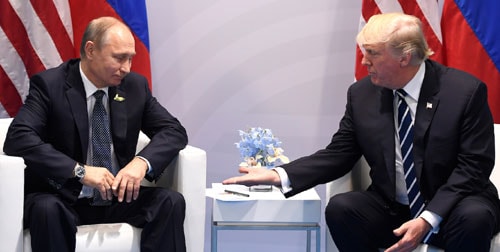
US President Trump (right) and Russian President Putin during their meeting in 2017. Photo:AFP. |
Russian President Vladimir Putin yesterday ordered the expulsion of diplomatic staff from 23 Western countries, just one day after demanding that 60 American diplomats leave the country and closing the US consulate general in St. Petersburg.
This is Moscow's strong reaction after Washington and 27 other countries simultaneously expelled Russian diplomats in retaliation for the poisoning of former spy Sergei Skripal in the UK. This tit-for-tat move also marks the worst period in Russia-US relations under President Donald Trump, who had previously publicly expressed friendliness towards Moscow and his counterpart Putin.
According to commentator David A. GrahamAtlanticNothing has hampered Donald Trump's presidency more than his attitude toward Russia. During his campaign, he repeatedly praised Putin and refused to condemn Russia's annexation of Crimea. Trump also publicly called on Russia to release stolen emails from former U.S. Secretary of State Hillary Clinton, which his aides later dismissed as "a joke."
After taking office, Trump continued to show a clear preference for Russia. He refused to acknowledge allegations of Russian interference in the US elections and consistently sought to block investigations into the issue, causing considerable political and legal turmoil for him, as many Americans suspected the President of obstructing justice and lacking a proper stance on the Russia issue.
However, things changed when British Prime Minister Theresa May accused Russia of being "highly likely" behind the Skripal poisoning. While the former Russian intelligence colonel was in critical condition in hospital, May called Trump and other Western leaders, urging them to launch a coordinated attack on Moscow. In this instance, Trump unexpectedly turned his back on Russia.
Skripal was previously sentenced to prison in Russia for transferring classified documents to foreign intelligence, but was later brought to the UK in a spy exchange deal between Russia and the US. He and his daughter were found poisoned in Salisbury, England on March 4th.
The US decision to expel 60 Russian diplomats on suspicion of espionage and close the Russian consulate in Seattle surprised many allies due to the scale and severity of the Trump administration's sanctions.
In early March, the new Russian ambassador to the US, Anatoly Antonov, also had to write a letter appealing for help after a series of US congressional and administration leaders refused to meet with him. This is in stark contrast to the treatment Washington gave to his predecessor, Sergey Kislayak, who was escorted into the Oval Office to meet with Trump last year and was even rumored to have heard some classified information revealed by the US President himself.
According to observers, Trump's dismissal of National Security Advisor HR McMaster and replacement with John Bolton, who holds a hardline stance on Russia, is a sign of a shift in his attitude toward Moscow.
John Herbst, a scholar at the Atlantic Council, said that advisers like Bolton had a significant influence on Trump's decisions. "The Trump administration had policies that its predecessors didn't want to pursue, such as providing anti-tank missiles to Ukraine. President Trump didn't want to do it deep down, but for some reason, he was willing to listen to his advisers," Herbst said.
Some argue that Trump's decision to impose harsh sanctions on Russia was aimed at dispelling conspiracy theories that Putin possessed evidence that could "control" the US president. However, commentator Graham suggests that Trump's turning against Putin stemmed from a desire to assert the legitimacy of the US presidency.
Special Counsel Robert Mueller's investigation has so far found no evidence linking Trump to any "collusion" with Russia in the 2016 election, so Trump has no reason to worry about accusations of being controlled by Russia. However, such conspiracy theory-based accusations make Trump feel his position as President of the United States is being questioned, forcing him to take drastic action to assert his right to lead America.
A source revealed toNBC NewsDuring discussions about expelling Russian diplomats, Trump clearly expressed his displeasure with Putin's recent claims that Moscow possessed new nuclear "superweapons" that Washington couldn't stop. He felt he needed to do something to assert American dominance over Russia, right when May called to inform him about the Skripal case.
Graham argues that Trump is unlikely to erase the fact that Russian interference contributed to his victory in last year's election, but he will find ways to assert his legitimacy. This helps explain Trump's willingness to punish Russia over the Skripal affair, while still quickly dismissing any allegations of Moscow interfering in the election.


