
Explaining why the car's brake warning light comes on.
There's nothing to worry about if the brake light comes on when you forget to release the parking brake, but if it's still on after you've released the brake completely, you need to check it.
 |
Many people assume that when the brake lights are on, it means the brakes are engaged and there's nothing to worry about. However, behind that warning light lies a problem that car owners need to pay attention to.
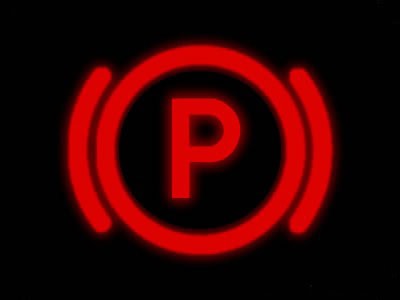
On some car models, the parking brake often has a unique symbol: the letter P with a circle in the middle. If the user sees the brake warning light on and flashing continuously, whether the brake pedal is pressed or not, the braking system should be checked immediately and the system fluid should be topped up.
According to experienced automotive experts, this phenomenon could be caused by a loss of brake pressure to the cylinders or insufficient fluid level in the reservoir. If the fluid level is low, the sensor will send a signal to the ECU, which will then activate the brake warning light.
Additionally, oil leaks can occur in systems such as the master cylinder, slave cylinder, or brake fluid lines. Therefore, you should also check the warning light, as it may come on again if the warning light doesn't illuminate. The consequences of this leak can be dangerous for the driver, potentially leading to brake failure while driving.
Hydraulic circuit in the braking system
For front-wheel drive vehicles, there are two hydraulic circuits: one for the front brake assemblies and the other for the rear brake assemblies.
In rear-wheel drive vehicles, one circuit is used for the front left and rear right brake assemblies, and the other circuit applies to the front right and rear left brake assemblies.
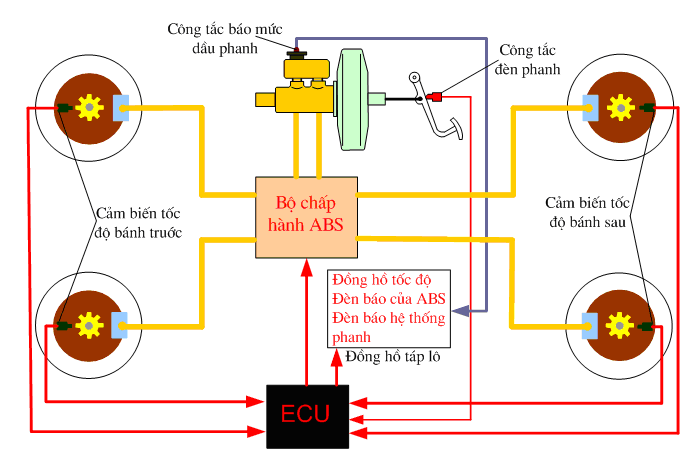 |
This arrangement is intended to provide safety support in the event of an accident; if one circuit loses brake fluid pressure, the remaining circuit will assist in deceleration. Furthermore, a pressure switch is installed on the master cylinder or on the oil line behind the master cylinder. If a leak occurs in either circuit, this switch will activate the brake warning light.
ABS brake warning light
Nowadays, most modern cars are equipped with an anti-lock braking system (ABS), which has a separate warning light. Under normal operating conditions, the light only illuminates when the ignition key is turned on and while the engine is starting; otherwise, it will turn off.
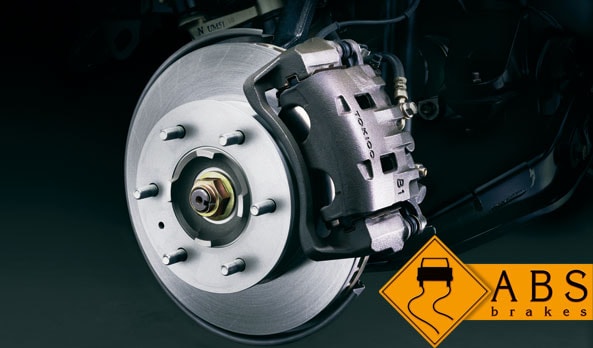 |
Therefore, if the warning light illuminates while the vehicle is in operation, it indicates a malfunction in the ABS system, even though it may otherwise function normally except in emergencies. In the event of an unexpected incident, the ABS will not activate, making skidding more likely.
There's also a case called "nonlatching" where the warning light comes on and then turns off, but the ABS system continues to function normally. This is also not a serious issue, so car owners don't need to worry too much.
In particular, thanks to the system's memory, errors occurring in the ABS system are stored as a code that can be read by a diagnostic tool. This makes repairs easier.


