
The 'matrix' of imported car prices in Vietnam.
Short-term fluctuations in tax and fee levels make it difficult for importers to set prices.
Currently, at least two new regulations on excise tax are affecting the price of imported cars in Vietnam. First, there's the new excise tax calculation method, effective from January 1st. Second, there's the new excise tax rate, effective from July 1st.
According to the authorities, the reason for the change in the method of calculating excise tax is to standardize it across different product types in the market. Domestic vehicles have been subject to this method, while imported vehicles are calculated based on their import price.The special consumption tax rate recently approved by the National Assembly aims to restrict the sale of vehicles with large engines, prioritizing vehicles with smaller engines and lower fuel consumption.
The problem lies in the fact that these two policies were implemented too close together, affecting pricing and business planning for all importers.
Special consumption tax is calculated using the following formula:Tax = Price x Tax Rate. Both "Price" and "Tax Rate" change, so to calculate the amount of excise tax payable, it is necessary to clearly determine the new price and the new tax rate that will apply.
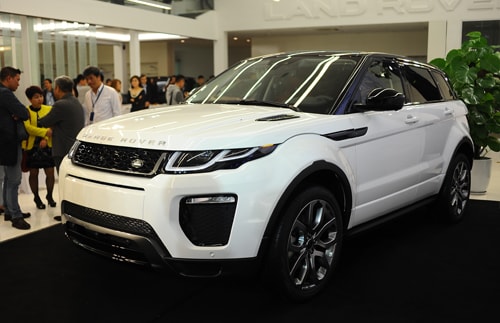 |
Range Rover Evoque 2016. |
The new excise tax calculation price is stipulated in Decree 108, which details some provisions of the amended Law on Excise Tax. The new tax calculation price applies to imported vehicles with fewer than 24 seats.Accordingly, these types of vehicles were previously subject to excise tax based on their cost price, but under the new law, this calculation is based on the wholesale price using the following formula:
Wholesale price = cost price + expenses (transportation, advertising, sales) + business profit. The wholesale price must not be lower than 105% of the cost price.
Based on the formula, the method for calculating wholesale prices seems quite clear; however, businesses distributing imported vehicles say they are actually quite uncertain. At the launch event for the new Range Rover Evoque earlier this year, UK Auto Vietnam did not provide a price. The answer was that the company had not yet calculated a specific price.
According to the director, his company is awaiting daily changes in new tax rates that will affect car prices. Furthermore, besides the aforementioned regulatory changes, the company has not yet received detailed instructions on how to calculate the tax from the relevant authorities.
"Based on how advertising costs, sales, or profits are calculated, and whether there are any limits beyond 105%, we are completely unprepared for that information," he explained.
Some new luxury car brands entering Vietnam explain that to sell well, importers need to invest heavily in marketing and promotion, but when these costs increase, the special consumption tax also skyrockets, driving up prices. The high car prices discourage customers from choosing their models.
"This pricing method has become a major barrier to us reaching customers. Setting low prices means the business won't make a profit, but setting high prices due to taxes means we won't have any customers."
The calculation method is still facing difficulties.new tax baseImported cars are also about to face additional charges.New special consumption tax effective from July 1st.Accordingly, the specific rates for each vehicle are as follows:
| Capacity cylinder | Tax rate current | New tax 1/7/2016-1/12/2017 | New tax from January 2018 |
| 1,500 cm3 or less | 45% | 40% | 35% |
| Over 1,500 - 2,000 cm3 | 45% | 45% | 40% |
| Over 2,000 - 2,500 cm3 | 50% | 50% | 50% |
| Over 2,500 - 3,000 cm3 | 50% | 55% | 60% |
| Over 3,000 - 4,000 cm3 | 60% | 90% | 90% |
| Over 4,000 - 5,000 cm3 | 60% | 110% | 110% |
| Over 5,000 - 6,000 cm3 | 60% | 130% | 130% |
| Over 6,000 cm3 | 60% | 150% | 150% |
Most of the main models from most luxury car manufacturers have engine capacities exceeding 2 liters, making them subject to significantly higher special consumption tax rates in the near future. For example, a luxury sedan with a 3.5-liter engine would see its tax rate increase from 60% to 90%, resulting in a price increase of at least 20%, not including the increase due to the new tax calculation method.
Some manufacturers have stated that, to avoid excessively high car prices due to the new tax, they will only import versions of larger vehicles with smaller engines. For example, the Audi Q7 in Vietnam has two versions: a 2-liter and a 3-liter, currently priced at 3 billion and 3.45 billion VND respectively, a difference of 0.45 billion VND. If the new tax calculation method takes effect from July 1st, the 3.0-liter version will increase in price while the 2.0-liter version will see a slight increase, thus widening the price difference from the initial 0.45 billion VND. Many customers may hesitate between the 2.0-liter and 3.0-liter versions.
For large luxury cars, small engines are not the preferred choice for traditional Vietnamese customers, due to the perception that a small engine cannot handle a large vehicle. Therefore, manufacturers cannot ignore cars with large-displacement engines. The remaining challenge is to balance the pricing of different versions and models to ensure sales compensate for profit.
"Never before have we been so short of a full-year plan by the end of the first quarter. Everything is uncertain and very unpredictable because it depends so much on policy," said the general manager of a luxury car distributor.
According to VNE
| RELATED NEWS |
|---|


