
Matchmaking at weddings
(Baonghean)The role of matchmakers is not unique to The Tale of Kieu; in the wedding customs of the Khmu, Mong, and Thai people, matchmaking plays a special part. Matchmakers can speak on equal footing with the groom's parents. Without matchmakers, a wedding would not be conducted according to tradition...
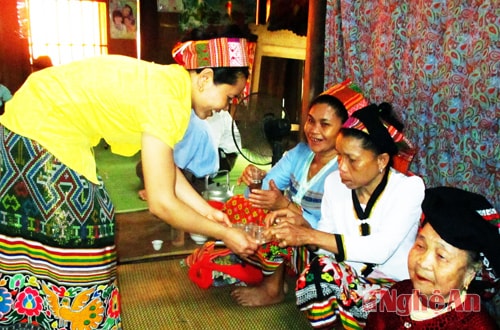 |
| A young matchmaker offers betel nuts at a Thai wedding in Chi Khe - Con Cuong. |
When a son grows up and finds a girl he likes to marry, he informs his parents so they can arrange the wedding. The first thing the parents think about is choosing someone to act as a matchmaker for their son. The matchmaker is usually from the paternal or maternal side of the family, representing the family at the engagement and wedding ceremonies. Therefore, the matchmaker is chosen very carefully.
The matchmaker must be a relative of the groom, either paternal or maternal, someone the groom will later call "father." Therefore, the matchmaker must be at least an older relative (possibly an older brother, cousin, brother-in-law, or uncle). In some cases, according to our research in Tuong Duong, even a grandfather can act as a matchmaker for his nephew.
Another important factor is that the matchmaker should ideally be married and have both sons and daughters. In that case, the matchmaker's wife automatically becomes the "matchmaker" and is indispensable when proposing marriage for their son. Besides these factors, the matchmaker must be eloquent. In the past, matchmakers were often skilled at singing and call-and-response, and some even practiced shamanism. The matchmaker would be responsible for offering ancestral food to the groom's family during the engagement and wedding ceremonies. Reputable shamans in the community often acted as matchmakers for many descendants within their lineage. Those who were matched were called "lực lăm," or "lúc lám" in the Tay Thanh Thai language (roughly translated as "matchmaker").
Mrs. Lo Thi Thuc, 72 years old, residing in Nam Dinh village (Chi Khe - Con Cuong), recounts the story of her late father, a man who had 11 "matchmakers." This is something to be proud of, as few in the village have as many chosen representatives to propose marriage for their children as this old man. However, managing so many weddings, not to mention the children in the family, is no easy feat. In the past, Thai wedding customs were heavily burdened with complex rituals, and the matchmaker was absolutely essential to handle these ceremonies. First and foremost was negotiating how to make the dowry beneficial to both sides. If the bride's family demanded whatever amount of chickens, pigs, silver ingots, wine, and meat, it would be a heavy burden for the family. The matchmaker had to be skilled in negotiation, knowing how to propose a reasonable amount that both sides could accept.
After the dowry negotiations are complete, the engagement ceremony and wedding date are set six months in advance. Before the wedding, the matchmaker, along with the bride's family, must personally go to each house in the extended family to invite guests. If the bride's relatives, both near and far, number 100 houses, the matchmaker must climb the stairs and bow 100 times according to tradition before extending invitations to attend the wedding on a particular date. Mrs. Thuc recalled: "Every morning when it was time to invite guests to the wedding, he would urge his wife and children to prepare sticky rice so he could pack up and set off. Once, it took him three months of walking from one village to another, even to the villages of the Hmong and Khmu people, to complete the wedding invitation process." But it is precisely because of this that the matchmaker gets to travel to many places, is knowledgeable, and is highly respected by the community.
After a long period of inviting guests to the wedding, the matchmaker still has many other procedures to handle. The matchmaker leads the procession to fetch the bride. He carries a gong, striking it three times to announce the joyous occasion to the village. To test the matchmaker's skills and the groom's family, the bride's family often creates obstacles. They lock the gates, drape a headscarf or embroidered blanket over them, and force the groom's family to "open the gate." Upon reaching the bride's house, the matchmaker sings in a call-and-response style until the bride's family is satisfied and opens the gate for them to enter. After climbing the stairs and entering the house, the matchmaker formally explains to the bride's family the reason for the wedding. The story, told in rhyming verse, details the couple's relationship, their courtship, their love, their decision to ask for her hand in marriage, the parents' choice of pigs and chickens, the brewing of wine, the selection of a matchmaker, and the auspicious date for the wedding. Finally, the matchmaker explains the time and place of the bride's arrival and invites the bride's family to the groom's house to share in the joy. Afterward, the matchmaker prepares an offering to the bride's ancestors, asking the "house spirits" for permission for the daughter to marry into the family. Next, during the festivities leading up to the wedding procession, the matchmaker is the main speaker in the singing contest with the bride's family, initiating further exchanges until the auspicious time when he leads the procession, beating gongs, to escort the bride to the groom's house.
In the bride's room, the matchmaker finally plays her role. The matchmaker performs the ritual of placing a hairpin in the bride's hair. The matchmaker also spreads a mat on the bed for the newlyweds. For many Thai communities in Con Cuong, the wedding ceremony is not over even after the bride has gone to her husband's house. On the wedding night, the matchmakers must stay up all night receiving guests, mainly those in the bride's wedding procession. The following day, the official ceremony at the groom's house is held. The matchmakers must also perform the ritual of the bride bowing before the ancestral altar, "asking to be accepted as a daughter in the family." This is also one of the rare occasions in her life that the bride sets foot in the ancestral shrine of the Thai people. After the bowing before the ancestral altar, the matchmaker begins the procedure of introducing the newlywed couple to both families. At this point, the matchmakers' work is essentially complete. After the wedding ceremony, the newlyweds must bring a meal to the matchmakers' house. On the table, there is a pig's leg offered as a token of gratitude. This is also the final ritual of a wedding.
However, the role of the matchmakers continues throughout the couple's later life. Every year, on Tet (Lunar New Year), and even on the Dragon Boat Festival (the 5th day of the 5th lunar month), the couple must offer a meal to the matchmakers. Even after the matchmakers have passed away, they must still offer a meal to their altar.
In today's community, not many people are still skilled in the rituals and procedures of Thai weddings. However, weddings still cannot be without matchmakers. Parents still have to choose someone from their family to propose marriage for their son, and often the matchmaker is chosen primarily because of family ties. Nowadays, some young matchmakers are unable to perform the rituals when proposing marriage for their son and have to rely on knowledgeable people to accompany them and do the work. These types of matchmakers are humorously called "lamp-pap" (dependent matchmakers). The number of matchmakers who rely on older, knowledgeable people is increasing...
According to our research in Luu Thong village, Luu Kien commune (Tuong Duong district), the role of the matchmaker among the Hmong people seems "less demanding" compared to the Thai people in Con Cuong. The matchmaker also acts as the representative to ask for the bride's hand in marriage on behalf of the groom. The rituals in a Hmong wedding are not as numerous as those of the Thai people. The matchmaker only plays a role in the engagement and wedding ceremonies. When the wedding procession arrives at the groom's house, the matchmaker pours wine for the family members, reporting that everything has gone smoothly and safely. Only then does the matchmaker conclude his role!
Huu Vi


