
Who will I pass this trade on to in the future?
(Baonghean)In the fragrant atmosphere of molasses mixed with fresh ginger, we were told by Mr. Nguyen Xuan Tung (born in 1959) and Mrs. Nguyen Thi Phu (born in 1962) from Hamlet 8, Hung Chau Commune, Hung Nguyen District, about their traditional craft of making peanut candy and "cu do" (a type of Vietnamese candy), a "family business" that has helped them raise four children to adulthood.
Tung doesn't remember exactly when his family started making peanut candy. He only knows that his childhood was filled with the sounds of his mother shelling peanuts and pounding ginger every night, and his father's rhythmic movements as he lit the fire. Every day, the sweet, warm aroma of molasses, fresh ginger, and peanuts wafted from the cramped kitchen, waking all nine siblings and prompting them to rush downstairs to help their parents. That's when his father would laboriously carry a huge pan of peanut candy and pour it onto the banana leaves his mother had spread out on the mold.
Without a word, someone quickly used a large chopstick to spread the candy evenly while it was still hot. Another hurriedly poured syrup into a pan and placed it on the stove, preparing for the second batch... And so it continued until morning. The first batch of peanut candy solidified. Father took a knife and cut the candy into perfectly even bars, just in time for Mother to take to the early morning market. The peanut candy business helped his parents raise nine children. They even helped each of them get married thanks to the sale of their candy at the market each day. Five members of the family followed in their parents' footsteps.
In 1980, Mr. Tung got married. Ms. Phu was also from the same village but was an "outsider" to the craft. Upon becoming a daughter-in-law, she was taught the family's "traditional" secrets by her mother-in-law. From how to choose the best peanuts and molasses, to how to cook the molasses, and when to add the peanuts and crushed fresh ginger... She fell in love with this craft as much as she loved her mother's son. Living with her parents for five years, they quickly mastered the steps and techniques of candy-making. When she moved out on her own, she always remembered her mother's words: "Our family is poor; your parents only have this craft passed down. Try your best to maintain it; this profession isn't prestigious, but it can still provide for you..."
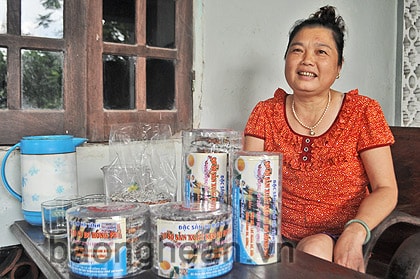
Ms. Phu introduces Hong Phu's "cu do" (a type of Vietnamese candy).
They started their business with money borrowed from relatives. They had the skills, but maintaining and developing it was no easy feat. Selling only at My Market wouldn't be enough to make a living. The peanut candy making trade was a blessing from nature to many other families in the village. They needed to take their product further. Thinking this, Mrs. Phu, with her rickety bicycle, traveled countless kilometers a day, bringing peanut candy to Vinh and even to Ha Tinh. Initially, due to lack of experience and unattractive packaging, there were days when Mrs. Phu only sold a few packets. Undeterred, she discussed with her husband the idea of switching from peanut candy to making "cu do" (a type of Vietnamese candy). Mr. Tung thought it was a good idea because "cu do" looked more presentable and attractive. Moreover, they didn't have to worry about rice paper, as it was also a traditional craft of the village. From selling only 5 packets of peanut candy a day, Ms. Phu switched to making "cu do" candy, and now she sells 10 packets, then 20, 50... Today, Hong Phu's "cu do" candy has become a brand, sold at stalls in Vinh Market, Xuan An Market, and at Cui Temple in Ha Tinh.
To ensure sufficient supply for the market, the couple borrowed additional capital and hired workers for packaging. They always have two regular workers at home, earning 1.5 to 2 million VND per person per month. During peak seasons, they have to hire extra staff to meet demand. Besides selling to the market, Hong Phu's "cu do" candy is also frequently purchased by regular customers as gifts when traveling or when guests visit. On average, they produce over 100 bags of various types of "cu do" candy daily.
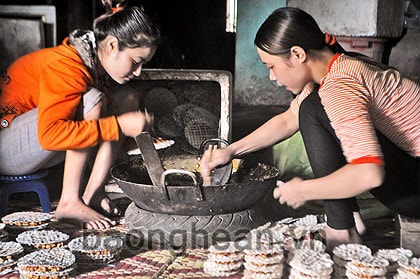
The process of using rice crackers to sandwich peanut candy.
Not only are they dynamic in developing the economy through their traditional craft, but Mr. and Mrs. Tung Phu also raise well-behaved and academically successful children. Speaking of this, Mr. Tung looks at his wife affectionately: "It's all thanks to the hard work and dedication of their mother." When the children were young and born close together, Mrs. Phu only took a month and a half of maternity leave before getting up to manage the household and help her husband make candy. When the children were just over two months old, Mrs. Phu would cycle to Ha Tinh and Vinh to deliver goods from morning. Sometimes, engrossed in her work, she wouldn't return until 1 or 2 pm. Mr. Tung often had to soothe the children who cried incessantly because they wouldn't stop crying from hunger for breast milk. As the children grew older and went to school near home, transportation wasn't a concern anymore. The only worry was how to earn money to support their education. Mr. Tung often tells his children: "Your parents didn't have the opportunity to receive a proper education, but luckily our grandparents passed down this trade to us. We have a responsibility to maintain this trade, and your duty is to study hard and do well."
Even now, whenever she recalls it, Ms. Phu always silently thanks her grandparents and parents for giving her and her husband the peanut candy making business. Thanks to this profession, they have raised four children to adulthood, with stable jobs and happy families. When mentioning her children, Ms. Phu's face lights up: Her eldest daughter, born in 1981, studied food chemistry; her second daughter, born in 1982, studied pharmacy; her third daughter, born in 1987, studied petrochemicals; and her youngest son, born in 1990, works at the airport. All four children are currently working in Da Nang.
According to Mr. Le Khanh Quang, a cultural officer of Hung Chau commune: "Not only are they successful in business and contribute to preserving the traditional peanut candy making craft of Hung Chau, but Mr. Tung and Ms. Phu are also one of the exemplary cultural families in the hamlet and the commune, creating jobs for several laborers in the village. Recently, during the summary of 10 years of the 'All People Unite to Build a Culturally Rich Life' movement, they received a certificate of merit as an exemplary cultural family for 10 consecutive years."
However, the biggest concern for Ms. Phu and her husband right now is: Who will they pass on their skills to in the future?
Text and photos: Thanh Hien


