
Pieces of Love
(Baonghean) - Knowing that when the country is not at peace, the home is also not stable, so I have to swallow my tears every time I visit home. From two "fragments of war," we have pieced together a complete family filled with love. While participating in building the army, I also compensate for the losses and hardships suffered by my loved ones and myself by cherishing and caring for my family.
I was born in 1928, and at the age of 17, I was active in the local "Red Self-Defense Force." I remember the night of August 20, 1945, when the self-defense force assembled. On August 22, 1945, the self-defense force defeated a platoon of French colonial soldiers to seize the Kim Nhan outpost (Anh Son district), taking power back into the hands of the people. At the end of 1946, I joined the Nghe An self-defense battalion. That same year, just after turning 18, I married Hoang Thi Tum, a girl from my hometown. We hadn't been married for a full year when, one day in July 1947, I left my young wife and elderly parents to go to Military Region 10 (Viet Bac Military Region). I participated in six campaigns: the Border Campaign, the Northwest Campaign, the Ly Thuong Kiet Campaign, the Upper Laos Campaign, the Hoa Binh Campaign, and finally the victorious Dien Bien Phu Campaign. After that, we continued to receive assignments to take over Bac Ninh and Bac Giang provinces. The system of paid leave was implemented in 1957, but it wasn't until 1958 that I was able to get a leave of absence lasting exactly 15 days.
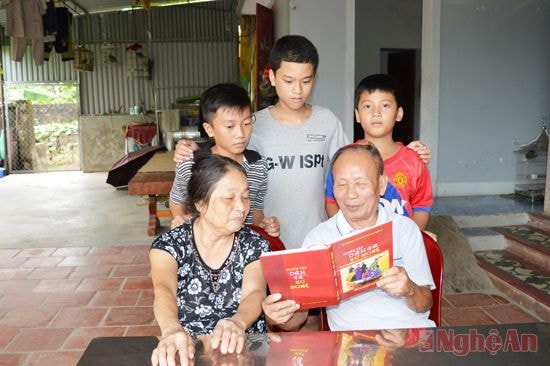 |
| Everyday moments of Major General Bui Duc Tung with his wife and grandchildren. |
For thirteen long years, separated by distance, without communication or letters, my wife remained steadfastly loyal, waiting patiently. Our family life, with the village girl who married a "Red Self-Defense" soldier, lasted less than a year before I joined the army to fight in the war. Then came thirteen long years of caring for my parents-in-law and waiting for him to return from battle. I, a soldier returning home from the Battle of Dien Bien Phu amidst the glory of victory, was heartbroken to see our family in such dire straits, lacking even a bed to sleep on. My 15-day leave passed in the blink of an eye, and I had to leave again before my wife could even conceive.
In 1960, while working in Thai Nguyen, I received a letter from my wife filled with worries. We had been married for many years but had no children, and she was very distressed. I wrote back, clearly stating my address so she could visit. Knowing her feelings, I encouraged her to stay and wait until she became pregnant before returning home. That time, my wife came to visit, and we stayed together for seven months. When she confirmed she was pregnant, she returned to her hometown, overjoyed at the prospect of becoming a mother after 15 years of marriage. I told her that whether it was a boy or a girl, we should name the child Thai, to remember Thai Nguyen – the place where she visited me and where we had spent the longest time together since our marriage. In 1961, hearing the news that my wife had given birth to our first daughter in our hometown, I felt even more motivated to fight, hoping for peace in the country so I could return to my small family.
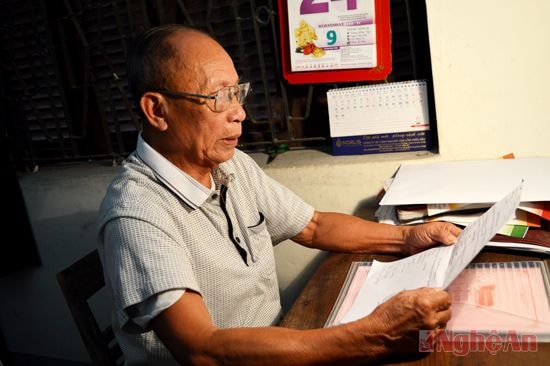 |
| Major General Bui Duc Tung reads documents to help relatives of fallen soldiers search for their remains. |
In 1963, our battalion received orders to fight in the South. We fought on the fronts of North Binh Dinh, Quang Nam, Quang Ngai, and then Kon Tum. In the early 1970s, we were transferred to fight in Southern Laos, at which time I had taken on the role of Deputy Political Commissar of the 2nd Division. The 2nd Division was reinforced with an additional battalion, mainly soldiers from Nghe An province. By chance, two soldiers from my village came to see me. The first thing they said when they met me was that my wife had passed away. One soldier said my wife died in January 1971, due to overwork and illness, but she kept it a secret from everyone. By the time her condition worsened, it was too late to get treatment... My heart ached. The circumstances of war weighed heavily on every family, and a woman like my wife bore so much hardship and sorrow. She had a husband, but he was away, and when she died, he couldn't even light a candle for her...
I was once again drawn into military life, fighting on the battlefields of Dak To, Tan Canh... When the Paris Agreement was signed, I was sent to study politics and only then was I allowed to return home to visit.
Knowing my situation, the unit provided a vehicle to accompany me. As we approached the village, amidst the children happily following the car, I saw a small, thin, dark-skinned girl with a bundle of dry firewood on her head, trudging along silently. I vaguely heard an old man say, "Your father is going back to the Thai Te." Immediately, I opened the car door and jumped out. Only then did I realize that the poor, pitiful little girl was my daughter. Her mother had died, her grandparents were old and frail, and her father was away fighting in the war. At just over 10 years old, my daughter had been going into the mountains every day to collect firewood to help her grandparents. After a few days, I realized the situation was dire. Leaving my daughter at home, orphaned and separated from her father, with the great risk of her dropping out of school, was unbearable. Therefore, when I went to the North to study politics, I brought my daughter with me. An old comrade of mine in Hanoi offered to take her in, care for her, and provide for her education. A teacher in Hanoi, whose husband was also fighting in the war, offered to tutor my daughter. I went back to the battlefield, while my child grew up in the warm family home of my comrades.
In 1973, while studying politics, I occasionally visited my parents. At that time, local officials, who were also my friends and relatives, suggested that I start a family so that I could continue my work with peace of mind. I was introduced to Ms. Nguyen Thi Lien, whose husband had died in the war (his grave has never been found), and whose only younger brother had also died on the battlefield. Like me, Lien had a daughter (Tran Thi Ha) with her deceased husband. Understanding her circumstances and sympathizing with the irreplaceable losses caused by the war, after that short leave, Lien and I came together with respect and shared understanding. Then I returned to the battlefield until the complete victory in 1975. We subsequently had our children, Bui Thi Nguyen (born in 1975), Bui Duc Quyen (born in 1977), Bui Thi Loi (born in 1980), and Bui Duc Loc (born in 1982).
I was assigned the position of Commander of the Nghe Tinh Provincial Military Command, and then in 1981 I was transferred to become Deputy Head of the Inspection Department of Military Region IV, stationed in Nam Thanh (Nam Dan). On my days off, I still cycled home to help my wife and children. At that time, even though I was already a colonel and a high-ranking military officer, every weekend I would still bring a sack, a stick, and a water canteen to the Vinh rice mill to squeeze rice husks for fuel. Life was busy, difficult, and lacking, but my wife and I still cherished and shared with each other joys and sorrows, both past, present, and future. More importantly, with our children, we did not discriminate between our biological children and our stepchildren, and we did not hurt each other, always trying to make them feel the love of their parents.
In 1986, I was reassigned to the position of Commander of the Provincial Military Command, but as soon as my work at the unit was finished, I would throw myself into doing housework, whatever it took. Before that, in 1984, I was promoted to Major General, and at the unit, "military orders are absolute," but at home, I was always a warm and caring father, someone who could always share things with my wife and children.
Because of this, our children now love each other very much. My daughter Bui Thi Thai's family is now settled in Australia, my daughter Tran Thi Ha's family lives near my wife and me, and the other children have all married and live in Hanoi. I now have 13 grandchildren, and I'm about to have my second great-grandchild. All my children are harmonious, united, mature, loving, and very caring towards their parents.
From a member of the "Red Self-Defense Force" to being promoted to general, I fully participated in the two sacred resistance wars of the nation, feeling and witnessing countless losses, hardships, and suffering in a country at war. My family's circumstances were difficult, but we were still much luckier than many other families. The tragedy of a country at war is a "common denominator," sparing no one, and my family was no exception.
My family could be described as two "fragments of war" pieced together, but through love, sharing, and mutual respect, my wife, Nguyen Thi Lien, and I overcame everything to create a new, harmonious, and united family. I believe that for the peace of the nation – our extended family – we may sometimes have to sacrifice our smaller families. And to have a happy smaller family, parents must make sacrifices for their children. The sacrifice of a father or mother here means dedicating more time to the family and their children. If you want your children to be well-behaved, parents must be exemplary, truly love and cherish each other.
(Recorded based on the account of Major General Bui Duc Tung, former Commander of the Provincial Military Command, former Chairman of the Provincial Veterans Association)
Ngo Kien


