
Taking strong measures to improve the quality of education.
(Baonghean) - In the list of 207 university training programs whose enrollment has been suspended, recently announced by the Ministry of Education and Training, Nghe An province has two universities on the list: Vinh University and Vinh University of Technology and Education. Currently, both universities are preparing explanations.
In recent days, the public nationwide has been surprised by the Ministry of Education and Training's announcement of suspending enrollment for 207 undergraduate programs at 71 training institutions across the country. In the list published by the Ministry, some institutions had only one program suspended, while the University of Theatre and Film had the most, with 15 programs suspended. Closer to Nghe An province, Ha Tinh University had 14 programs suspended. The Ministry of Education and Training's reason is that these institutions did not meet the conditions stipulated in Clause 1, Article 2 of Circular 08/2011 on Regulations on conditions, dossiers, and procedures for opening training programs. One of the first mandatory conditions for universities and academies to be considered for opening undergraduate programs is: "Having a full-time teaching staff responsible for at least 70% of the training program's workload, including at least one lecturer with a doctoral degree and three lecturers with master's degrees in the registered field." Previously, on March 29, 2013, the Ministry of Education and Training conducted a survey and compiled statistics on higher education institutions nationwide. The schools whose enrollment was suspended were those that did not meet the required conditions. In Nghe An province, two universities were included in the Ministry's list: Vinh University of Technology and Education (Vinh University of Technology and Education) with two majors whose enrollment was suspended (Accounting and Industrial Technology Education), and Vinh University with the major in Investment Economics.
Dr. Nguyen Hong Minh, Rector of Vinh University of Technology and Education, stated: The Faculty of Economics was established in 2011 and currently offers two majors: Business Administration and Accounting. Before its establishment, the university had two PhDs in economics specializing in the field. However, after a period of work, both PhDs left. In October 2012, Dr. Nguyen Hong Minh became the Rector and taught directly at the faculty. At the time of the Ministry of Education and Training's review, the Faculty of Economics only had two Master's degree holders in accounting, while Circular 08 stipulated that there should be three Master's degree holders... But the faculty's teaching shortage only occurred for a short time. Currently, the university is processing the recruitment of one PhD in economics to teach, one who is currently a doctoral candidate, and four Master's degree holders in economics. Regarding the Industrial Technology and Education major, Dr. Nguyen Hong Minh believes that this is a training program that has been part of the university's tradition for many years. “Currently, the school has many PhDs in pedagogy, educational management, electrical engineering, mechanical engineering, and electronics participating in teaching subjects in the Industrial Technical Teacher Training program and meeting the requirements of Circular 08 of the Ministry of Education and Training. The school will submit an explanation to the Ministry of Education and Training,” said Dr. Nguyen Hong Minh.
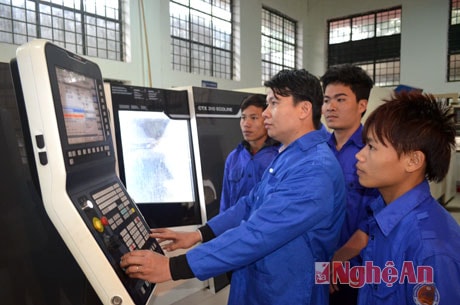 |
| Practical session at the Department of Mechanical Engineering, Vinh University of Technology and Education. |
Meanwhile, Dr. Nguyen Xuan Binh, Head of the Training Department at Vinh University, stated that the reason the Investment Economics major was included in the list of discontinued programs was due to an error in the review report. Vinh University was authorized by the Ministry of Education and Training to offer a full-time undergraduate program in Economics in 2012. At that time, the university had developed a training plan, prepared the necessary facilities, curriculum, and teaching staff. This plan was reviewed by the Nghe An Department of Education and Training, the Ministry of Education and Training, and the National Economics University's Appraisal Council, ensuring it met all the required conditions. At that time, the Economics major had one PhD and five Master's degree holders as lecturers. During the training process, the university supplemented and improved the expertise of its teaching staff.
Currently, the Faculty of Economics has a faculty of 7 PhDs and 9 lecturers pursuing doctoral studies both domestically and internationally. The Faculty offers four majors: Accounting, Business Administration, Finance and Banking, and Auditing. The Investment Economics department alone has 3 PhDs and many Master's degree holders teaching. “When reporting to the Ministry of Education and Training, we did not categorize the PhD lecturers into specific specializations, but only listed them generally as the number of PhDs participating in training and teaching at the Faculty of Economics. Vinh University has provided a full explanation and commitment to the Ministry of Education and Training regarding the full faculty, the number of PhDs and Master's degree holders as required, and hopes the Ministry will consider allowing the university to continue enrollment according to the plan in 2014,” affirmed Dr. Nguyen Xuan Binh.
Thus, like several other universities nationwide, Vinh University and Vinh University of Technology and Education have responded to the Ministry's decision. Each university has different reasons, and the conclusion regarding right and wrong is awaiting the opinion of the Ministry of Education and Training. However, this incident has also sparked many differing opinions. Expressing his viewpoint, Dr. Le Van Phot, People's Teacher and Chairman of the Nghe An Association of Retired Teachers, said: This is an opportunity for the Ministry of Education and Training to review the teaching conditions of universities, so that each university can strengthen its teaching staff to ensure compliance with industry regulations and improve the quality of education. However, the simultaneous suspension of enrollment in 207 majors, just over a month before students begin submitting their university entrance exam applications, is unreasonable. This causes anxiety among students, especially those preparing for the exam and intending to apply to the majors currently suspended. From the perspective of the schools, when deciding to establish a new major, they have already prepared the necessary conditions regarding facilities, teachers, etc. Now, not allowing the major to continue enrolling students will cause losses for the school. Public opinion is truly "shocked" and skeptical about the quality of education that has been provided by schools for a long time, and will be confused when choosing a field of study for their children.
Some argue that suspending enrollment in programs that lack a sufficient number of full-time faculty is necessary. However, that's not the most important thing. What's most crucial now is for the Ministry of Education and Training to review all universities, rationally organizing program codes across universities and regions. This will prevent situations where technical or basic training schools are licensed to offer economics or finance programs, or where too many universities offer teacher training programs, leading to unemployed graduates and low-quality education. The Ministry of Education and Training bears some responsibility for this, as it hasn't been closely monitoring local conditions and hasn't regularly inspected university enrollment. Some universities prioritize quantity and market demand over quality, each pursuing its own approach without direction or alignment with the needs of the labor market.
Mr. Thai Huy Vinh, Deputy Director of the Nghe An Department of Education and Training, stated: According to Circular 08, all universities, colleges, and vocational schools must go through the Department of Education and Training for approval before opening new majors and must meet all the necessary conditions. Therefore, at the time of granting the major codes, there was certainly no shortage of full-time teachers. However, the Department of Education and Training only "manages" the superficial aspects, while the subsequent process of determining enrollment quotas involves schools working directly with the Ministry of Education and Training. Consequently, the department cannot track the arrival and departure of teachers, determining which majors have sufficient staff and which do not. This is where the "loophole" lies. Schools also lack the awareness to report any personnel changes to the Department.
Not only did the Ministry of Education and Training take strong action against universities that did not meet the required standards, but just before the 2014 enrollment season, it also "warned" 296 college-level programs at 74 universities nationwide that did not meet the standards according to Point a, Clause 1, Article 3 of Circular 08. One of the conditions for considering the opening of a college-level program is: "Having a full-time teaching staff that undertakes at least 70% of the training program's workload, including at least 4 lecturers with a master's degree in the registered field." In this case, the Ministry of Education and Training allowed the training institutions to temporarily continue enrollment and training according to the authority stipulated in the Training Regulations. At the same time, the training institutions were responsible for developing a plan to strengthen and supplement their full-time teaching staff. No later than December 31, 2014, the training institutions had to submit reports to the Ministry of Education and Training as required. After December 31, 2014, departments that failed to report or supplement their full-time teaching staff as required will be penalized. In this list of college-level training programs, Nghe An province has three schools that received disciplinary action: Van Xuan University of Technology with its Business Administration, Finance - Banking, and English Language programs; Vinh University of Technical Education with four programs including Accounting, Industrial Technical Education, Electronic Engineering Technology, and Information Technology; and Vinh Medical University with its Nursing program.
It can be affirmed that the Ministry of Education and Training's decisive action of halting enrollment in 207 university-level programs at 71 institutions and suspending enrollment in 296 college-level programs at 71 institutions nationwide is a correct decision, demonstrating the sector's determination to rectify the quality of higher education. The Ministry's announcement of this list has alerted many higher education institutions, especially given the increasing number of institutions opening without meeting standards, lacking qualified teachers, and failing to provide adequate teaching quality.
.
Nghe An is the educational and training center of the North Central region, providing high-quality human resources to serve the economic and social development of the country. Currently, in addition to Vinh University, which is part of the national key university system, there are 5 other universities offering undergraduate and college-level programs in the province, along with a system of many other colleges, vocational colleges, and professional secondary schools, with more than 80,000 students enrolled. Recently, Nghe An province has made great efforts to say no to substandard training institutions and has rejected proposals to upgrade some colleges to university status when they have not met the requirements for human resources, teaching staff, and infrastructure. With the strong intervention of the Ministry of Education and Training in rectifying and improving the quality of training, and resolutely eliminating substandard institutions, it is hoped that in the coming time, universities, colleges, and vocational schools in general, and training institutions in Nghe An province in particular, will continue to improve their professional skills and standardize the qualifications of their teachers and lecturers to enhance the quality of training and meet the increasingly high demands of social development.
My Ha -Nguyen Khoa


