
A miniature sun provides an inexhaustible source of energy.
American scientists are developing a fusion power plant, similar to the reaction that occurs on the Sun, with the potential to provide an inexhaustible source of energy.
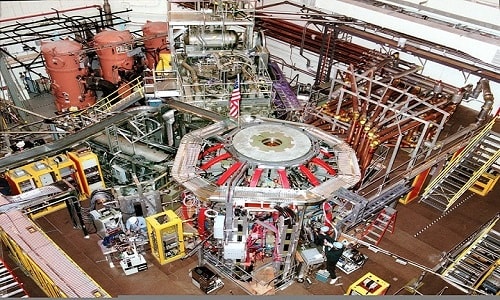 |
A panoramic view of the site where the fusion reaction test device is located. Photo: Princeton Plasma Physics Laboratory. |
According to Nature World News, physicists at the Princeton Plasma Energy Laboratory (PPPL) in the US have created a "miniature sun" in experimental form. It has the potential to provide clean, safe, and virtually inexhaustible energy for humanity, ending our dependence on fossil fuels.
The experimental device is in the form of a monolithic spherical tokamak. A tokamak is a device used to create controllable fusion reactions in a plasma environment. Currently, only two such devices have been built in the world: the National Spherical Torus Experiment-Upgrade (NSTX-U) at PPPL and the Mega Ampere Spherical Tokamak (MAST) at the Culham Fusion Energy Research Centre in England, according to Eurek Alert.
Modern nuclear power plants utilize fission reactions, generating energy through nuclear decay. While highly efficient, this reaction is expensive and dangerous due to the production of radioactive waste as a byproduct.
Conversely, fusion reactions generate energy through nuclear fusion, making them safer and producing no radioactive waste. However, this reaction requires temperatures hotter than the Sun. This is why spherical tokamaks are used. Tokamaks can create plasma, the fourth state of matter, at very high pressures and temperatures, which can trigger fusion reactions with relatively low magnetic fields and at low cost.
The device operates in three steps. First, plasma is generated using...superheated hydrogen gas (approximately 150 million degrees Celsius)in the laboratory.
Next, the pressure is increased to compress the plasma and force the nuclei to collide with each other, creating a fusion reaction. Strong magnetic fields generated from superconducting coils wrapped around the plasma are used in this process. Scientists hope that the heat released by the reaction is sufficient to sustain itself and convert some of it into electrical energy.
While traditional tokamaks are rather bulky, toroidal-shaped, spherical tokamaks are more compact and resemble the core of an apple. Tokamak fusion reactors could lay the groundwork for the field of fusion energy.
"We are opening up new options for future power plants," said Jonathan Menard, lead author of the study and director of the NSTX-U upgrade program at PPPL.
However, several challenges remain, such as increased turbulence when plasma is introduced into a magnetic field, reaction disruptions occurring when plasma density in the reactor is too high, or contamination due to interaction with the reactor walls. Researchers at PPPL, Culham, and around the world need to find ways to address these challenges for future generations of reactors.
According to VNE
| RELATED NEWS |
|---|


