
The first nuclear deterrent missile prototype of the US Navy.
The introduction of the Regulus missile gave the US Navy a sea-based nuclear deterrence capability before the advent of ballistic missiles.
|
One Regulus I grenade is still preserved at the museum. Photo: Wikipedia |
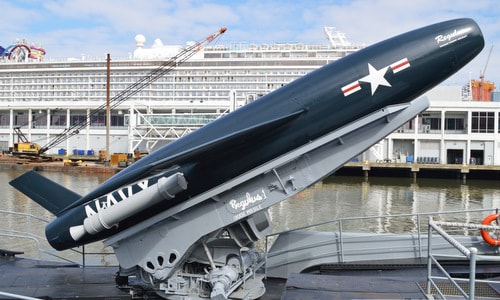
In 1955, the US Navy commissioned the SSM-N-8 "Regulus" cruise missile, marking the first time the force possessed nuclear deterrence capabilities and laying the foundation for the later development of the BGM-109 Tomahawk cruise missile, according to WATM.
Initially, the US Navy wanted to improve the performance of the V-1 cruise missile captured from Nazi Germany through the JB-2 Loon project, but without significant results. By May 1947, the US Army Air Force began developing the MGM-1 Matador cruise missile using a jet engine. The US Navy decided to join the race with the Regulus project, aiming to create a completely new type of missile capable of being launched from submarines.
By August 1947, the specifications for the Regulus missile were finalized, including a 1,400 kg warhead, a range of 930 km, a cruising speed of 1,050 km/h, and a target radius of 4.5 km at maximum range. Testing took place from 1947 to 1953 on the submarines USS Cusk and USS Carbonero. However, the first Regulus prototypes lacked protective casings, preventing the submarines from submerging before launching the missile.
The complete Regulus version, designated SSM-N-8, measures 9.1 m in length, has a wingspan of 3 m, a diameter of 1.2 m, and weighs 4.5-5.4 tons. Each missile carries a Mk 5 nuclear warhead with a yield of 40 kilotons, equivalent to 40,000 tons of TNT, or a W27 warhead with a yield equivalent to two million tons of TNT.
The Regulus missile resembles the F-80 fighter jet in appearance but lacks a cockpit; the experimental version even had landing gear for recovery and reuse after each launch. After launch, the missile is guided to its target by two control stations, usually submarines or surface vessels equipped with fire control systems, or remotely controlled by a patrol aircraft.
The U.S. Navy's operational doctrine requires always having four Regulus missiles ready for combat at sea. Initially, this required deploying two submarines simultaneously, the USS Barbero and USS Tunny, as each could only carry two missiles. Later-generation submarines such as the USS Growler, USS Grayback, and USS Halibut can carry four to five missiles, allowing them to patrol independently.
|
A Regulus I missile launched from the submarine USS Tunny. Photo: Wikipedia. |
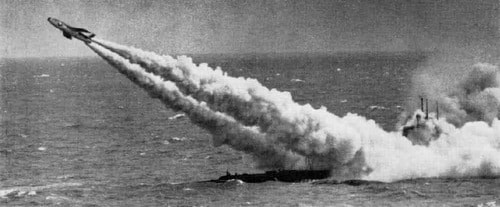
Five Regulus-class missile submarines stationed at Pearl Harbor conducted a total of 40 nuclear deterrence patrols in the North Pacific from October 1959 to July 1964. Their mission was to destroy the Soviet naval base of Petropavlovsk-Kamchatsky in the event of a nuclear war. These were the first such deterrence patrols in U.S. naval history, predating the Polaris-class ballistic missile submarines.
The upgraded SSM-N-9 Regulus II, developed in 1958, had a range of 2,200 km and a speed of 2,500 km/h, equipped with a new, more accurate guidance system. A total of 48 test launches were conducted, of which 30 were successful, 14 were partially successful, and 4 failed. However, the high cost of up to one million USD per missile, coupled with budgetary pressures and the emergence of the UGM-27 Polaris ballistic missile, led to the cancellation of the Regulus II project.
Production of the Regulus missile ceased in January 1959 after the 514th missile rolled off the assembly line. At the same time, the submarines carrying Regulus missiles were replaced by the George Washington-class submarines carrying Polaris ballistic missiles. The Regulus class was completely retired in August 1964, with some missiles retained as flying targets for the US Air Force at Eglin Air Force Base.
Despite being in service for only nine years, the Regulus provided the US with valuable experience in sea-based nuclear deterrence and laid the foundation for the later Tomahawk cruise missile.


