
A new shade of green in Chau Binh
(Baonghean) - Chau Binh (Quy Chau), once a notorious "capital" of rubies and precious stones, is now enjoying a peaceful new life with the green of acacia forests, sugarcane fields, and cultivated rice paddies. The people have boldly borrowed capital to invest in production, building effective business models and making significant contributions to the poverty reduction movement in the area. This is still about giving money and resources to the land, but not through the destructive digging of the past, but rather a sustainable revival for this once "fierce land"...
| RELATED NEWS |
|---|
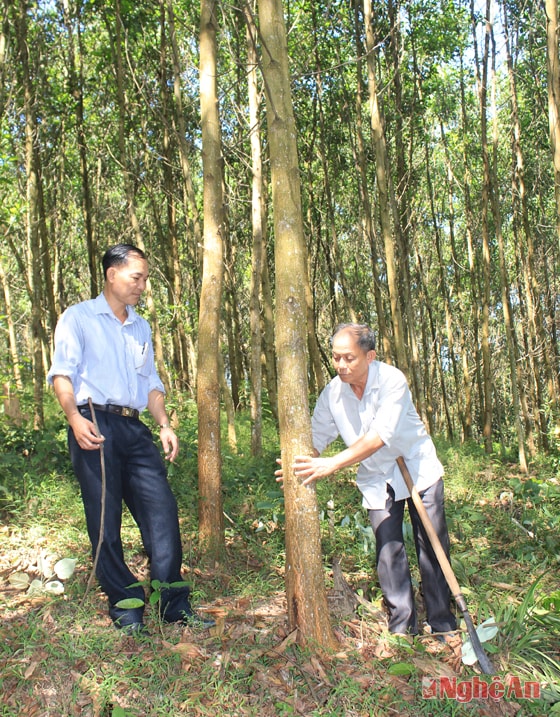 |
| Mr. Nguyen Ngoc Tuan's acacia forest in Quynh 1 village. Chau Binh commune (Quy Chau) |
Thanks to the guidance and propaganda efforts of various agencies, units, and localities, Mr. Tuan's family took on 10 hectares of forest land. In the first year, he planted cinnamon, then acacia intercropped with cinnamon, and now he has planted entirely acacia. In addition, on more favorable land, Mr. Tuan's family also planted over 1 hectare of sugarcane. In 2013, the family earned over 50 million VND from sugarcane, and in the recent sale of acacia, they earned over 200 million VND. They will soon be harvesting over 2 hectares of acacia that are ready for harvest. It is known that in Quynh 1 village, people are currently planting over 400 hectares of acacia and nearly 20 hectares of sugarcane. Thanks to forest planting and industrial crops, the lives of the people are becoming stable, and many households have become well-off.
Mr. Lang Van Duong from Binh 2 village also once abandoned his fields and went to Ty and Trieu hills to seek his fortune with rubies. He found no luck, only the loss of all his family's possessions. After much deliberation, Mr. Duong resolved to start over. With the support of the Chau Binh Commune People's Committee, in 2000 he borrowed 15 million VND from the bank to buy a tractor to provide services to farmers in the commune. Gradually, step by step, Mr. Duong's family received nearly 1 hectare of land for sugarcane cultivation and 2 hectares for acacia cultivation. The land rewarded his hard work, and his family's life gradually stabilized. During the harvest season, the tractor rarely rested, and thanks to good care and proper techniques, the fields yielded high productivity every year. Currently, Mr. Duong has two children studying at college and one at university. This was probably the greatest joy for him, who had once been deceived by the illusion of wealth through luck and thought he could never start his life over again.
Chau Binh commune currently has 13,000 hectares of natural land, of which 11,000 hectares are forest land and only 2,000 hectares are for agricultural production. Mr. Kim Van Duyen, Chairman of the Chau Binh Commune People's Committee, said that while the commune only has about 300 hectares of rice paddy land, forest land remains the main source of livelihood for the people. Of the 11,000 hectares of forest land in Chau Binh commune, Co Ba Forestry Station manages about 6,000 hectares, and the commune manages 5,000 hectares. Mr. Kim Van Duyen also stated that currently, out of 2,600 households in the commune, as many as 1,000 do not own a single square meter of forest land. One of the reasons identified is that in the past, when land was allocated, the people did not accept it. Now that the land and forest allocation process has basically stabilized, the need for reforestation has become urgent. In response to this situation, in 2013, the Provincial People's Committee reclaimed 1,135 hectares from the Co Ba Forestry Farm and transferred it to Chau Binh commune for management. Based on this, combined with the remaining area, Chau Binh commune now has an additional 1,900 hectares. Currently, the Commune People's Committee and relevant units are conducting surveys and handing over the land to households. To date, an additional 50 households have been allocated forest land. According to the plan, by 2015, Chau Binh will arrange to hand over at least 1 hectare of forest land to each household.
The most encouraging aspect of Chau Binh, once the capital of gemstone production, is the change in the mindset of its people. This is most evident in their proactive approach to investment and production. To date, the people have borrowed nearly 80 billion VND from the Social Policy Bank and the Agricultural Bank to invest in economic development. Remarkably, there have been no overdue loans. As a result, the economic structure has shifted in the right and positive direction. Chau Binh commune has 705 hectares of sugarcane, 200 hectares of cassava, and over 100 hectares of vegetables and legumes. In 2013, sugarcane yielded 42,000 tons, generating 40 billion VND in revenue for the entire commune. The poverty rate decreased from over 60% to 51.4%. The local government is striving to further reduce it by 7% by 2015. Implementing the National Target Program for New Rural Development, Chau Binh commune has completed 11 out of 19 criteria. Specifically, in terms of average per capita income, Chau Binh ranked first and was among the highest in the entire district, at 16 million VND/person/year.
During our stay in Chau Binh, we also met Mr. Lang Van Chiec – a man living in poverty and destitution in Khe Khoang village. In his old, flat-roofed house, clad in washed stone – a "fashionable" style once favored by families who struck it rich in red gemstones – Mr. Chiec, frail and thin, sat alone. It was hard to imagine the man who once spent money lavishly. In conversation, he smiled sadly: “I was the first person in this commune to strike it rich in red gemstones. Then I built a house, bought a fancy motorbike… But now I have nothing left. My son also died in Que Phong from the nightmare of searching for precious stones. Now all that's left is this house, as you can see… Only honest labor can sustain life! Planting trees and raising livestock is the only way to make a living!”
Dao Tuan - Nguyen Son


