
A new shade of green in Caoshan
(Baonghean) - High-rise buildings, smooth asphalt roads stretching throughout the commune's alleys, brand-new cars... dreams that once seemed far-fetched have now become a reality in Tao Son commune, Anh Son district. This reality is thanks to the economic models that the people have strived to implement.
Escaping poverty through watermelon
Leading us to meet Mr. Dao Van Bac – one of the first people to bring watermelon seeds to plant in Tao Son – Mr. Hoang Van Cam, Chairman of the Tao Son Commune Farmers' Association, said: Mr. Bac is one of the pioneers in experimenting with growing crops like watermelons and pumpkins in Tao Son. He created a model for a while so that the villagers could see and learn from him. Once he achieved results, he switched to buying agricultural products from them. Indeed, looking at Mr. Bac's current estate, no one would think it was built by a farmer. Mr. Bac said that in 1994, due to poverty, he went to Nha Trang to work on watermelon farms. Realizing that watermelons could be grown in Tao Son, he left Nha Trang and returned home, not forgetting to bring some seeds with him. Initially, fearing that the watermelon plants wouldn't suit the soil and climate, he only dared to plant 1 hectare. After two months, the first watermelons yielded income, making him so happy he cried. By 1999, he boldly expanded his melon cultivation area to 4 hectares, bringing in nearly 20 million VND in revenue. At that time, that was an amount of money few farmers in this area dared to dream of.
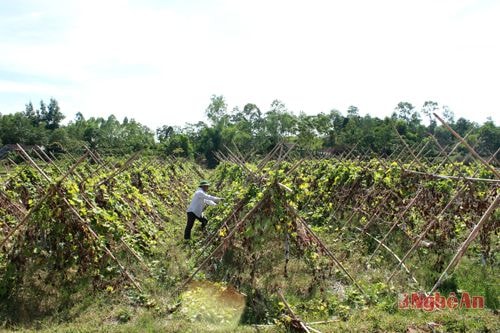 |
| A model for growing green squash in Cao Son. |
Inspired by the highly effective watermelon farming model of Mr. Dao Van Bac, in 2000, the entire Tao Son commune launched a watermelon cultivation movement. By 2002, the watermelon cultivation area in Tao Son commune had expanded to nearly 80 hectares, yielding thousands of tons of watermelons each season. Tao Son's watermelons became well-known throughout the province. Traders from all over flocked to buy them, placing orders even before the watermelons bore fruit. A bustling atmosphere of business enveloped the entire commune. In just over five years of implementing this model, the people of Tao Son truly escaped poverty. Families competed to rebuild their houses and buy motorbikes and cars.
After seeing the people of Tao Son successfully grow watermelons, several other localities also began experimenting with growing them. In 2006, they invited Mr. Dao Van Bac to implement this model. These included the communes of Cam Son and Duc Son (Anh Son district); Da Son, Tan Son, and Thuan Son (Do Luong district); Thanh Tien and Thanh Lien (Thanh Chuong district)...
Making a fortune from zucchini
Watermelon cultivation has been closely associated with Tao Son for a long time, transforming a poor commune into a high-income commune in Anh Son district. However, watermelon farming has its ups and downs, successes and failures, as is common. Therefore, restructuring crop patterns is a necessary undertaking. And the person who spearheaded this transformation is none other than Mr. Dao Van Bac.
Mr. Bac said that in 2006, he visited Dak Lak and saw many farms growing green squash, which brought in a large profit. Growing squash only takes 3 months, and the labor and capital required are not as expensive as watermelon. Upon returning home, he decided to experiment with growing 2 hectares of green squash on trellises. After 3 months, each hectare yielded over 2 tons, and traders came directly to his farm to buy the produce. Thanks to this initial success, the following season he expanded the area to 7 hectares. Seeing his model, the local people began to learn from him and follow suit. By 2009, Tao Son commune began to widely implement this model, with the cultivated area reaching nearly 100 hectares.
Mr. Hoang Van Cam led us to visit the family of Mr. Phan Van Dinh in Hamlet 10, one of the households that have become wealthy from growing green pumpkins and is the most successful in this pumpkin season. Mr. Dinh's house has been rebuilt and is now spacious and well-equipped, with several tons of pumpkins still piled up in the yard waiting for traders to come and buy them. Mr. Dinh welcomed us with a cup of tea brewed from dried pumpkin juice, a drink that, according to him, is only consumed in large quantities by the people of Tao Son. He smiled and said: Six years ago, seeing that watermelon farming was becoming increasingly unstable and risky, he followed his neighbors and switched to growing green pumpkins. Green pumpkins don't require a large investment, and the harvest can be done early or late depending on the market, so there's not much to worry about. Last season, he planted 10 hectares of pumpkins and harvested over 25 tons, earning over 50 million VND. After deducting expenses and labor, he still made a profit of over 40 million VND. Since adopting this model six years ago, his family has earned hundreds of millions of dong each year.
Not only the Phan Van Dinh family, but also many other households in the commune have prospered from this crop, such as the Dao Van Tu family in Hamlet 5, the Tran Van Danh family in Hamlet 10, etc. Each household cultivates 5-8 hectares and earns a high income. Many people who initially grew pumpkins, like the Dao Van Bac and Dinh Van Huynh families (Hamlet 2), have now switched to buying pumpkins from other farmers and have also become wealthy from it.
The first steps towards developing a gac fruit cultivation model.
While visiting some farming models in Tao Son commune, we encountered many farmers weeding and tending to their gac fruit vines. Curious, I asked Mr. Hoang Van Cam why these families weren't growing pumpkins but gac fruit instead, and whether anyone would buy their produce. Mr. Cam smiled and said, "Those are some families who have finished harvesting their pumpkins and are now growing gac fruit. This is a new model initiated by the Farmers' Association. It's only been two years, but the farmers have started implementing it on a large scale. To date, 102 households have participated in planting it, and it's initially yielding economic benefits. This model is implemented by Nghe An Food Joint Stock Company under contract with the Farmers' Association. The company guarantees the purchase of the produce on-site and arranges for the participating households to visit gac fruit farming models in Quy Chau, so the farmers are very enthusiastic."
Approaching Mr. Le Van Tuyen's farm (village 2), where he was tending his gac fruit garden, to inquire about his progress, he stopped hoeing and confided, "I don't know what the future holds, but for now, things are good." According to him, after being encouraged by the Farmers' Association to plant gac fruit and visiting a successful model farm, he converted 1 hectare of land previously used for corn cultivation to gac fruit, planting 250 trees. He invested in building sturdy trellises with concrete posts for the gac vines to climb, ensuring their long-term use. The gac variety yields a harvest once a year, after which the vines are pruned to encourage new shoots. In this way, a single tree can live for over 15 years. The best part was the first season, when some trees produced up to 150 kg of fruit, with some weighing up to 4 kg. Last season, he harvested nearly 8 tons of gac fruit, bringing in over 20 million VND in profit. He weeds a few times a year and fertilizes with phosphorus and potassium when the trees are about to bear fruit, so he can rest assured of the harvest. Compared to growing pumpkins, the income from gac fruit is not much, but the price is stable, and the effort and investment costs are not high, so he feels secure in producing it.
Mr. Cam said that currently, the area planted with gac fruit in the commune is nearly 50 hectares. In the near future, the Farmers' Association will encourage people to expand the planting area. His own family is currently planting nearly 1 hectare and the results are very good. Most importantly, gac fruit trees have a long lifespan, require little effort and capital, and there are no worries about product sales, so many households are starting to adopt this model.
Bidding farewell to Cao Son, a new shade of green is covering this land in the scorching summer days, the green of hope...
Dao Tho


