
US aircraft conduct nighttime exercises over the Korean Peninsula.
(Baonghean.vn) - On October 11, the US-South Korea alliance announced that two B-1B strategic bombers of the US Air Force had participated in training with South Korean fighter jets on the Korean Peninsula to demonstrate their strength to Pyongyang.
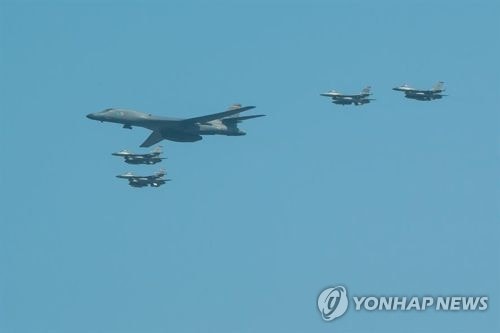 |
| The B-1B bomber and fighter jets are featured in this photo posted on the U.S. Air Force website. Photo: Yonhap |
According to the South Korean Joint Chiefs of Staff (JCS), the bombers originated from Guam and entered the South Korean Air Defense Identification Zone (KADIZ) at approximately 8:50 p.m. on October 10 (local time).
According to this source, they conducted simulated air-to-ground missile launch exercises with two F-15K fighter jets flying over the Sea of Japan and the Korean Peninsula.
The B-1B and F-15K aircraft subsequently participated in another exercise in the Yellow Sea. The JCS added that the bombers flew out of the KADIZ at approximately 11:30 p.m.
The U.S. military confirmed the nighttime operation, stating that its multirole, long-range supersonic bombers, also known as Lancers, had conducted similar exercises with the Japanese Air Force.
The U.S. Seventh Air Division described it as a “sequential bilateral mission” in the vicinity of South Korea.
The unit stated that this was the first time Lancer aircraft had conducted joint training exercises with South Korean and Japanese aircraft at night.
“Flying and training safely and effectively at night with allies is a critical capability shared between the United States, Japan, and North Korea, and enhances the tactical skills of each nation’s pilots. This is clear evidence that we are capable of conducting continuous operations with all allies anytime, anywhere,” said U.S. Air Force Major Patrick Applegate of the 613th Air Operations Center.
Ha asserted that the most recent B-1B flight was part of a “routine deployment training program” aimed at enhancing the ability to enforce “extended deterrence” against North Korea.
The U.S. military stated that this is a “continuous bomber presence mission” to demonstrate its combat readiness in the Indian Ocean, Asia, and Pacific regions, as allies commit to protecting security and stability in the area.
Late last month, the U.S. deployed B-1B bombers to fly over international waters near North Korea's east coast in a separate nighttime operation. South Korea's national intelligence agency said it appeared North Korea was unaware of the secret operation at the time.
Phu Binh
(According to Yonhap)
| RELATED NEWS |
|---|


