
Mother of an artist, mother of a hero
(Baonghean) - After the ceremony to receive the Certificate recognizing the To Ba Ngoc church, a martyr of the Can Vuong movement, as a historical relic, I went to the Cho Roc area in Trung Thanh commune (Yen Thanh district) to meet the artisans who participated in the once-famous "To Ba Ngoc" play. Of the more than 10 people who staged the "To Ba Ngoc" play, only artisan Hoang Thi Thin remains mentally sharp. Mother Thin's house is located next to Bau Roc. She is nearly 90 years old, slightly hard of hearing, but still has a sharp memory.
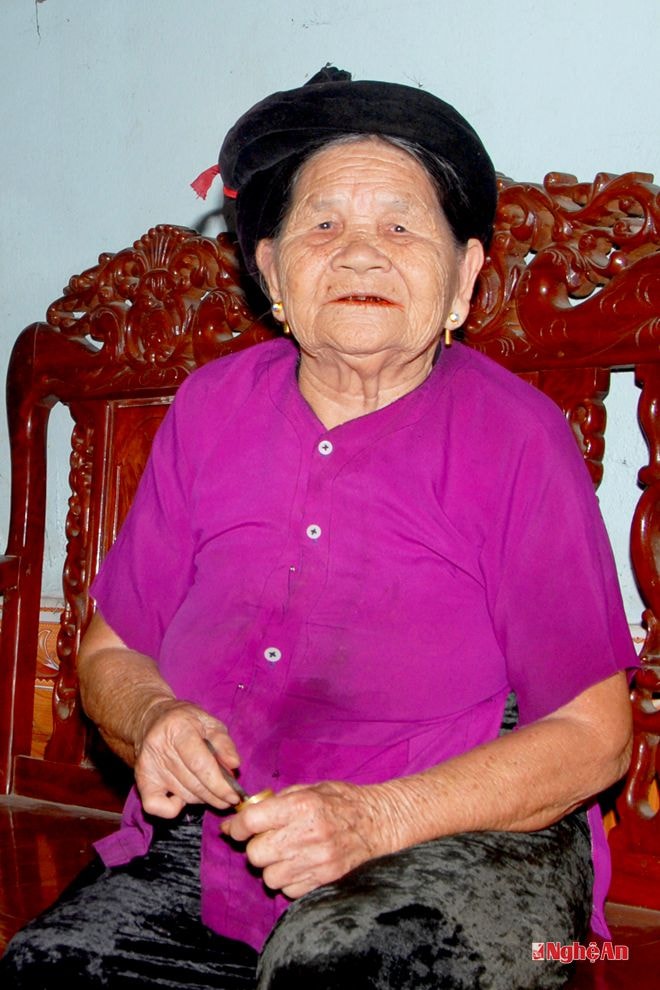 |
| Mother of Hoang Thi Thin. Photo: Ho Cac |
My mother recounted that she had seen the Rộc Market theatrical troupe growing up. Passionate about performing arts, and possessing both singing and dancing skills, she was given supporting roles by Teacher Cao Đình Hùng. Gradually, she was guided by the artists in the troupe, playing leading female roles. At that time, the Rộc Market troupe performed both traditional opera and folk opera. My mother and the other artists had the opportunity to attend festivals and performances in the district. The Trung Thành troupe was thriving when, unfortunately, Teacher Hùng's wife – the troupe's lead actor – passed away, leaving him to raise his two-year-old son alone. The Trung Thành troupe faced the risk of collapse due to the lack of a leader. Some fellow performers encouraged my mother to reconnect with Teacher Hùng. At first, she thought she was an unmarried woman and feared she couldn't handle the roles of mother and wife, but with the support of both families, she moved in with Teacher Hùng and his son, helping him raise his two-year-old child. With a leader, the Trung Thành troupe continued to stage performances for the community. My mother and her husband had nine children together, totaling ten children from previous relationships. During the subsidy period and through the war, the large family suffered from poverty year after year. Yet, my mother's entire family successively participated in the village's performing arts troupe. In some plays and operas, the parents played the main roles while the children played supporting roles; in some performances, my mother went on stage while the children stood behind the curtain prompting her.
During the collectivization period, the Trung Thanh commune's performing arts troupe gathered a large number of actors, received investment in kerosene lamps, and was provided with stage sets and costumes. All the children followed in their parents' footsteps, working in the fields, chopping firewood in the mountains, and participating in the performing arts movement. Then war broke out, and the children successively went to defend the country. The eldest son, Cao Dinh Huu, enlisted in 1971; the second son, Cao Dinh Cuu, went to the battlefield in Zone 5, joined the liberation performing arts troupe of Zone V, and died on May 29, 1971, while performing for the soldiers. Following him, Cao Thi Cuu joined the youth volunteer corps, serving in the Quang Tri battlefield. Cao Dinh Lien went to the South in 1974, also joining the liberation performing arts troupe of Zone V. After 1975, he stayed in Quang Nam to serve the Zone V theatrical troupe, becoming an Meritorious Artist. My daughter-in-law, People's Artist Nguyen Thi Thu Nhan, was also a former comrade of Cao Dinh Lien; now both she and her husband are leading actors in the Nguyen Hien Dinh Opera Troupe (Da Nang). My sixth son, Cao Dinh Loi, joined the army after 1975 and fought in the Central Highlands against the FULRO rebels, where he was seriously wounded. My seventh daughter, Cao Thi Ly, stayed in Nghe An and joined the Nghe An Performing Arts Troupe with her sister Song Thao, often playing the role of Mrs. Hoang Thi Loan. My ninth son, Cao Dinh Luong, was in 11th grade at the time and was selected to join the Nghe An Performing Arts Troupe. He was preparing to enlist when he received a conscription order. Luong joined the Navy and was deployed to protect Gac Ma Island. After a few months on the island, Luong sent his mother some photos, including one of him playing the guitar and singing for his comrades. All of his mother's hopes were placed on her youngest son, a talented singer, skilled musician, and handsome man. Little did she know that in the unequal battle against the invaders in 1978, Cao Dinh Luong would bravely sacrifice his life on the sacred island of Gac Ma.
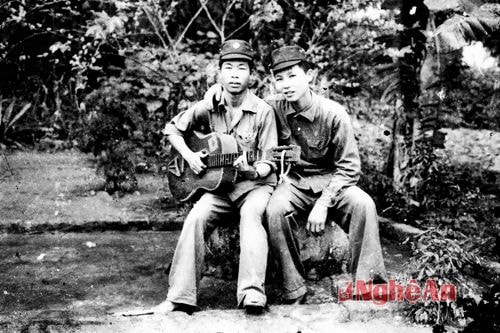 |
| Cao Dinh Luong (on the left) and his comrades at Gac Ma Island (Spratly Islands). |
My mother said that her life had been filled with both joy and sorrow. She sent seven sons to the front lines; two died in battle, and three were wounded. The pain was overwhelming, and there were times when she felt she couldn't recover. Thanks to the encouragement of her family and neighbors, she remained steadfast, raising her children and grandchildren to adulthood with her husband. The artistic blood in her veins always urged her back on stage, continuing to sing folk songs, perform traditional opera and Chèo. At 80, she no longer sings in crowded places, but when guests come to visit, mentioning her roles in plays like "Trung Nu Vuong," "Tong Tran Cuc Hoa," or Hoang Thi Thin, the woman who captivated so many audiences and stirred the hearts of the villagers, she enthusiastically sings a few lines from songs like "Looking at the trees, I remember her," and "Deep father-son love"... Her voice is hoarse, her hands tremble, but her eyes sparkle with joy.
On the last day of the year, I visited my mother. Looking at her graying hair, her kind and calm demeanor, and the wrinkles on her forehead, I thought of the image of Vietnamese mothers depicted in monuments across the country and in warm, simple homes. As I said goodbye, my heart still lingered on the lyrics she sang: "For every tree that grows in the forest, I am equally grateful to you."
Ngo Duc Tien


