
7-Level Spicy Noodles: What's Left After a Trend?
The spicy noodle dish that's taking the Vietnamese teen food scene by storm isn't actually anything special, and it could even be harmful.
Spicy flavors are indispensable in cuisine, stimulating the taste buds and making food more delicious. In cold climates like Korea, eating spicy food and preparing spicy dishes also helps warm the body and combat the freezing weather.
Korean spicy noodles have been infiltrating Vietnam for almost a year now and have quickly become a sensation among young people, first in Ho Chi Minh City, then in Hanoi and several other cities. Spicy noodle restaurants are springing up everywhere. Two popular spicy noodle brands in Vietnam are Sasin and Naga, named after two types of chili peppers advertised as "the world's spiciest." The chili pepper used in Sasin spicy noodles is the Carolina Reaper, a spice said to be spicier than US police pepper spray. According to the Scoville scale, this chili pepper has a spiciness level of 1.5 million to 2.2 million Scoville units, while pepper spray is at 2 million. The Naga Viper chili pepper used in Naga noodles is a hybrid of three extremely spicy chili peppers.
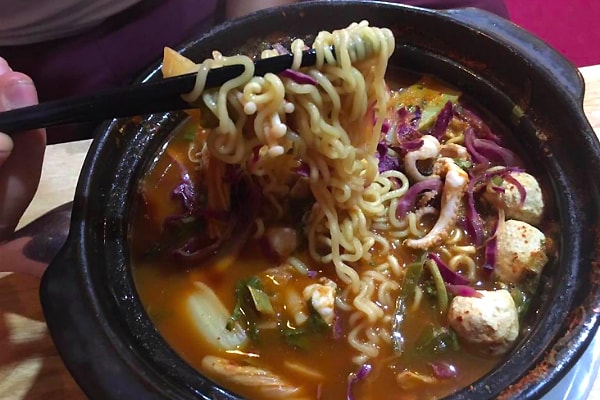 |
| A bowl of level 5 spicy octopus noodles. |
Aside from its unparalleled spiciness, this noodle dish has nothing special that would make people fall head over heels for it like kimbap, kimchi stew, or grilled octopus...
The noodles used to make spicy Korean noodles are simply thick, chewy instant noodles produced in Vietnam using Korean technology, easily available in supermarkets for about 60,000 VND for 10 packs. A bowl of Korean spicy noodles usually uses one pack of noodles.
The broth of Korean spicy noodles is completely flavorless, only boasting a sour and spicy taste similar to kimchi stew, but lacking the sweetness and richness. Compared to the broths of Chinese noodles, Japanese Udon or Ramen, or even the broths of our beef, offal, or chicken noodle soups, the broth of Korean spicy noodles falls far short in terms of preparation and flavor.
The ingredients for the noodle toppings, such as octopus, shrimp, squid, beef, sausage, beef meatballs, and fish balls, are quite ordinary. The freshness and quality vary depending on the restaurant's selection; however, it's difficult to distinguish whether they are high-quality or not because the diner's taste buds are overwhelmed by the spiciness.
Overall, a bowl of spicy Korean noodles isn't difficult to make because the recipe is very simple: a sour kimchi-flavored broth, thick instant noodles, toppings that can be bought ready-made, some purple cabbage, shredded carrots, and Saga or Sasin chili peppers in powder or whole dried form.
It's difficult to judge this as a delicious or appealing dish because you'll have to battle the incredible spiciness of the noodle bowl. All your senses will be focused on finishing it, on relieving the burning sensation on your tongue, throat, and stomach... Your face will flush, sweat will pour out, tears and snot will stream down your face, and your meal will be constantly interrupted by watering or trying to lessen the spiciness. How can you possibly enjoy the delicious taste of the chewy, crunchy noodles, the rich seafood, and the skillfully combined beef with the sourness of the kimchi…?
The spiciness of the noodle dish is divided into 7 levels: level 1 is equivalent to 3 times the spiciness of Chinsu chili sauce or 9 teaspoons of chili powder, with each level separated by 3 teaspoons of chili, up to level 7 which is 3 whole dried Sasin or Naga super-spicy chilies; this is what stimulates and attracts diners to Korean spicy noodles. There are also levels 0 and 0.5, and even those who can handle spicy food will still wince. The average price per dish ranges from about 40,000 to 70,000 VND.
When eating Korean spicy noodles, most diners want to test their spice tolerance, trying to overcome the restaurant's challenges to send the message: "It's nothing special." On the other hand, there's also a challenge among customers themselves, proving that they can handle spicier food than their friends...
The popularity of Korean spicy noodles can be explained by the influence of culinary trends stemming from the Korean film and K-Pop wave, coupled with its novelty and challenging nature. The shrewdness of those who brought Korean spicy noodles to Vietnam lies in understanding the Vietnamese people's preference for Korean food and the competitive spirit of young people. Thanks to this, they successfully promoted the unique aspects of Korean cuisine while still making good money.
However, there's a word of advice for Vietnamese diners: Don't risk trying Korean spicy noodles if you have stomach or digestive problems. Eating excessively spicy food can lead to digestive disorders or stomach issues. And be prepared with plenty of napkins when eating spicy noodles, because you'll likely cry more tears and snot from the chili than from a female actress's leukemia in a romantic Korean drama.
According to ngoisao.com
| RELATED NEWS |
|---|


