
The Mekong Delta during the historic autumn days.
(Baonghean) - As August arrives, the people of the ethnic groups in western Nghe An province once again feel a sense of pride in the revolutionary autumn of 1945. During those days, amidst the fervent atmosphere of the entire nation, barefooted farmers and workers rose up against colonial and feudal oppression, joining the whole country in regaining independence and freedom for Mother Vietnam.
Seventy years have passed, and the pioneers who participated in the August Revolution have passed away, but their deeds still shine brightly in history and in the hearts and minds of generations to come. Visiting Nghia Khanh (Nghia Dan district), I was fortunate to meet Mr. Phan Dinh Thanh, the grandson of Mr. Phan Dinh Lai, the first Party branch secretary of Nghia Dan district. The story of this man in his fifties took us back to the struggles of the people of Nghia Dan in the 1930s and 1940s, centered in Nghia Khanh commune, which at that time comprised three villages: Vinh Lai, Tho Loc, and Cu Lam. That was a time when Nghia Dan was suffering under the oppression and exploitation of the French colonialists. People from all directions flocked to work as laborers in plantations, road construction sites, and forest and land resource exploitation; combined with farmers, who made up 90% of the population, they became a large force in the revolution. They suffered severe oppression and exploitation, thus becoming a force ready to rise up and fight against imperialism and feudalism. Especially since the founding of the Communist Party of Vietnam, the revolutionary movement throughout the country has surged. At the end of September 1930, comrades Phan Đình Lại and Phạm Ngọc Liên, representatives of the Nghĩa Đàn Youth Branch, made contact with cadres of the Nghệ An Provincial Party Committee to build a movement in Nghĩa Đàn according to the Party's unified policy. “In early October 1930, a combined branch of party members from Thọ Lộc and Cự Lâm was established in Rú Ấm cave (now in Nghĩa Đức commune). The branch had 5 members, with my grandfather (Comrade Phan Đình Lại) as Secretary,” Mr. Thanh shared.
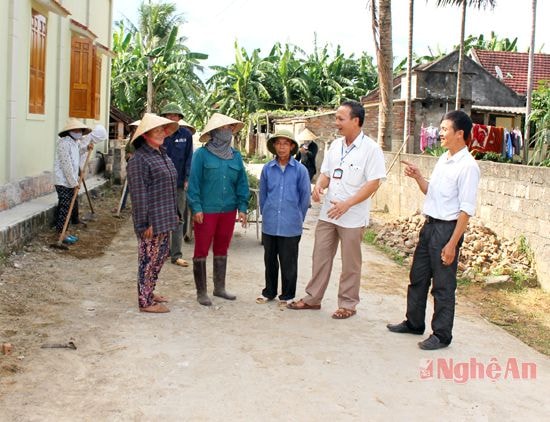 |
| Officials from Nghia Khanh commune (Nghia Dan district) discuss rural development with local residents. Photo: td |
Since the establishment of Party branches, the revolutionary movement in Nghia Dan developed strongly, even during times when the French colonialists brutally terrorized and suppressed revolutionary fighters. But no oppression could stop the fighting spirit for independence and freedom of the people of Nghia Dan. The peak was on the morning of August 22, 1945, under the leadership and organization of the District Uprising Committee, thousands of people from the communes of Cu Lam, Nghia Hung, Thach Khe, Ha Suu, Thai Thinh and hundreds of plantation workers in the Phu Quy area brought hunting rifles, spears, sticks, axes and machetes to gather at the banyan tree in Tru village, Nghia Khanh commune. The history of the Nghia Dan District Party Committee records the vibrant scene of those days: “Following the signal of the Uprising Committee's three rounds of nine drumbeats that resounded through the mountains and hills, the masses raised red flags with yellow stars, shouted revolutionary slogans, and marched noisily towards the district capital. Self-defense groups led the demonstrations into the district headquarters, arresting the district chief and his subordinates, confiscating seals, ledgers, and treasury funds; at the same time, they opened the prison doors and released prisoners. Before thousands of people participating in the uprising, the Provisional People's Committee and the Viet Minh Front Committee of the district introduced themselves to the public, declaring the permanent abolition of the imperialist, feudal regime and the puppet government apparatus of the Japanese fascists. Filled with the joy of victory, the masses cheered and caused a commotion throughout the area, and before the order to disperse to seize power in their localities, they shouted slogans: "Long live the successful revolution!", "Hail the revolutionary government!", "We resolutely support the Viet Minh!" "Long live independent Vietnam!" Yes! "Long live independent Vietnam" - the slogan that the farmers and workers of Nghia Dan chanted that day on the land of Nghia Dan still resonates with the mountains and rivers of the plateau, even though seven decades have passed.
Today, in Nghia Dan, one can still find the Ru Am cave, now located in Nghia Duc commune; and the century-old banyan tree at the beginning of the road leading to Nghia Khanh commune. Its tall, green canopy reaches towards the deep blue sky, a reminder to future generations to always uphold the revolutionary spirit of the August Revolution to build their homeland in a way that is worthy of the contributions of previous generations. The Nghia Khanh countryside has undergone many changes. In the midst of this August, the entire commune is focusing its efforts on beautifying village roads and alleys in preparation for the provincial delegation's assessment of the new rural development program. On each alley, despite the scorching sun and sweat-drenched shirts, the voices and laughter of the villagers resound throughout the hamlets. Comrade Tran Van Nhuong, Secretary of the Dong Dai hamlet Party branch, said: “The people in the hamlet are very enthusiastic. Every household contributes labor and resources to the new rural development. In particular, the Party members are always at the forefront, setting an example, and practicing what they preach so that the people can follow suit.” That's also what we felt during our time in Nghia Khanh commune. Despite being a purely agricultural commune, the new rural development program in this area is considered to have been implemented quickly and systematically. Just in the field improvement and irrigation projects alone, the people contributed 2.8 billion VND. Thanks to this, the commune has been able to increase rice cultivation by 100 hectares, which previously only produced one crop per year, now yielding two reliable crops per year. "The key to success is the high level of consensus and unity in thought and action among the entire Party committee and the people," shared Comrade Tran Dinh Hoi, Secretary of the Party Committee of Nghia Khanh commune, about the secret to Nghia Khanh becoming one of the top units in Nghia Dan district to complete all 19/19 criteria for new rural development.
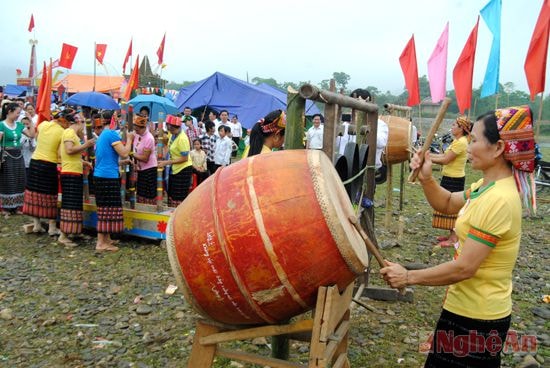 |
| Cultural and artistic exchange at the Mon Son - Luc Da Festival (Con Cuong). Photo: Ck |
Traveling through the western part of Nghe An province in August, we felt a surge of pride everywhere we went. For the August Revolution of 1945 had preceded many revolutionary movements, igniting the flames of patriotism and indomitable spirit. The story of the steadfast communist party member Vi Van Khang, the first Party branch secretary of the ethnic minority people in western Nghe An – the Mon Son branch, in Mon Son commune, Con Cuong district – lives on in the pride of every citizen in this southwestern part of Nghe An. Established in April 1931, the Mon Son branch led the revolutionary movement through many obstacles to victory. Even when the movement was brutally suppressed by colonial and feudal forces, and these pre-revolutionary communist fighters were imprisoned, the story continues to be a source of pride for everyone in this land. But once that flame of patriotism was ignited, it burned forever, a guiding light for the people of all ethnic groups in the dark night of slavery and suffering. It was on August 23, 1945, that the Viet Minh base in Mon Son commune, under the leadership of those steadfast party members, mobilized the masses to rise up and fight, declaring the establishment of a revolutionary government and opening a new life for the people of all ethnic groups along the Giang River.
The house of Mr. Vi Van Khang in Thai Hoa village, Mon Son commune, where the Mon Son Party branch was founded, remains intact. Every day, Mr. Vi Thanh Mao, Mr. Vi Van Khang's grandson, carefully waters each tree and cares for each memento with a sense of responsibility and reverence. "The house is a significant historical site visited by many delegations, from ethnic minority communities to Party and State leaders," Mr. Mao confided with a proud tone. Over the years, along with the country, Mon Son has changed dramatically. The lives of the people are increasingly prosperous and happy. Many sons and daughters of the homeland have excelled in their studies and now participate in Party and government work at all levels. But no matter where they go or what they do, the pride of being a son of Mon Son remains deeply ingrained in their hearts. And so, every year, in April, the Mon Son - Luc Da Festival is held, and people return to their hometowns to pay tribute to the revolutionary predecessors of the Mon Son Party Branch who, undeterred by danger, brought the light of independence and freedom to the highlands of Nghe An province; to refresh their souls in the flow of the revolutionary stream. From there, they strengthen their faith and ideals to continue the journey of building their homeland today under the light of the Party. Comrade Vi Van Nam, Secretary of the Mon Son Commune Party Committee, said: “The Party Committee and people of Mon Son always deeply understand the position and role of their revolutionary homeland. Therefore, many production and homeland construction movements have been launched, bringing high efficiency. In production, the people have changed the crop structure, and rice yields are among the highest in the district. The lives of the people are improving day by day.”
Seventy years have passed, yet the echoes of that historic August in the autumn still resonate throughout the nation's journey. It is a sacred emotion, instilling in every Vietnamese person an indomitable will to rise up and write more Augusts in the process of building the homeland and the nation.
Nhat Le


