
Opening the way to Thung But Valley
(Baonghean) - Returning to his hometown after the liberation of South Vietnam, war invalid Tran Xuan Ngoc (born in 1951 in Block 20, Quy Hop Town), a 2nd/4th degree disabled veteran, had to struggle with a difficult life. With the willpower and determination of a war invalid who is "disabled but not defeated," Mr. Ngoc has taken control of the Thung But area, transforming it into a renowned farm in the region...
Small but sturdy, with one eye affected by war on a sun-tanned face, when asked about his business, Mr. Tran Xuan Ngoc humbly said: "I didn't want to live in poverty, so I was determined to rise above it. I haven't accomplished much yet; my friends would laugh at me if I wrote about it." But when the topic of his farm came up, Mr. Ngoc enthusiastically told us about his connection to the Thung But area. Born in Hung Thang commune (Hung Nguyen district), in 1963, he moved with his family to settle in Dong Hop commune, Quy Hop district. In 1970, he enlisted in the army, serving in a unit under the General Department of Engineering.
In 1973, he participated in the war and was wounded in the battle at Long Binh General Warehouse. Returning home with numerous injuries, his family faced countless hardships, yet he remained optimistic and cheerful, working various jobs to make a living, never shying away from anything as long as it was legal. In 1976, Mr. Ngoc married Ms. Pham Thi Vien, a woman from the same village. Four children were born successively. With only about 1,000 square meters of land for farming, that amount of rice was not enough to feed six mouths, so Mr. Ngoc had to struggle to make a living through various jobs, even though his wounds always ached whenever the weather changed.
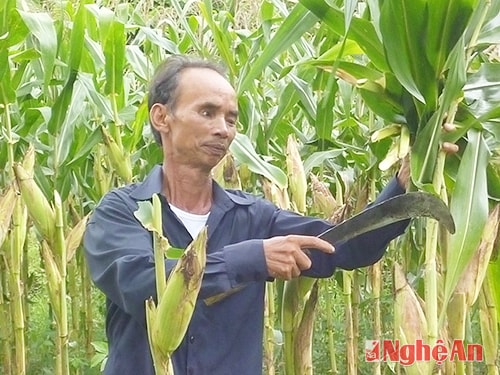 |
| Wounded soldier Tran Xuan Ngoc next to his cornfield... |
The Thung But area, located in Chau Dinh commune, is managed by the 3rd Youth Volunteer Brigade. The 3rd Youth Volunteer Brigade has repeatedly encouraged its members and local people to take over the Thung But area for land reclamation and settlement. After surveying the area, everyone shook their heads in disappointment due to its remoteness and isolation. At the end of 2006, Mr. Ngoc boldly discussed with his wife the idea of writing an application to lease Thung But, through the 3rd Youth Volunteer Brigade. Thung But is a barren land overgrown with sim and mua plants, surrounded by steep limestone mountains, with thousands of hectares of natural forest on top, and four towering peaks at each corner. Seen from afar, it resembles a pen nib, and the local people have known it as Thung But for generations.
Thanks to the forests and numerous caves, the Thung But basin always has streams full of water, creating favorable conditions for livestock farming and agriculture. Besides receiving 30 hectares of land, Mr. Ngoc also undertook the responsibility of managing and protecting 100 hectares of natural forest on the summit of Thung But. Facing a land fraught with difficulties, being more than ten kilometers from home and lacking roads, the only way to reach Thung But at that time was by following a narrow, winding path. However, with the enthusiastic support of his wife and the encouragement of friends, he was greatly motivated to stay. He pondered day and night how to conquer Thung But.
The first thing he determined was that to control Thung But, the first thing needed was a road for easy vehicle access, which would facilitate the sale of crops and livestock. However, building a road was no easy task, as Thung But had a complex terrain of steep rocky mountains, with only a single narrow path used by locals for gathering firewood. There was no other option but to hire machinery to cut through the mountains. In early 2007, he mobilized family funds, borrowed from friends, and hired an excavator. Nearly two months later, he spent cutting through the mountains to build the road. Over 2 kilometers of dirt road, connecting Cua Thung to the center of Thung But, was paved with large stones to prevent muddy conditions. With an investment of nearly 400 million dong, the project was completed, much to the astonishment of the local people.
This was also the only road leading to Thung But Valley, so managing the farm later would be easier in terms of security. After the road was built, Mr. Ngoc transported materials to construct a house to serve as his "headquarters." Some nights, lying in the cold house surrounded by rocky cliffs, he stayed awake to outline his ideas for land planning and what crops to plant. Initially, Mr. Ngoc's goal was to use the Thung But Valley area for cattle farming. This was because the land was surrounded by steep mountains, forming a basin, with vast grasslands and hills; once the gate on the only road closed, "no one could get in or out." Combining this with planting short-term crops and vegetables would ensure food security right on the spot...
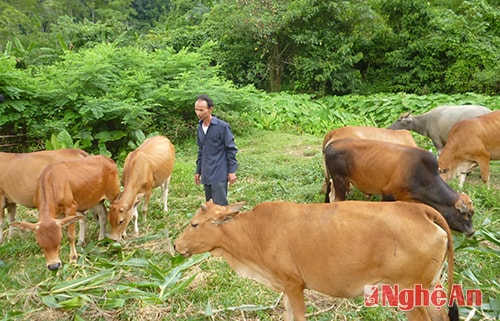 |
| ...and take care of the family's herd of cows. |
Sitting beside him, Mrs. Vien, his wife, smiled brightly and said, "I can't help him much, but I support and encourage him in everything he does. Even with acquiring the land in Thung But, it looked very difficult at first, and everyone tried to dissuade him, but seeing his determination, I encouraged him to go ahead. Despite being a war invalid, he always plans everything he does, so it's very effective. Before starting the farm, he worked as a truck driver for over a decade, saving up some capital, and with some loans from friends, he had the money for the initial investment. My wife and I have worked hard to provide for our four children's education; two of them have already graduated from university..."
With 30 hectares of land suitable for growing perennial and short-term crops, and ideal for grazing cattle, he initially invested in breeding cattle. After some time, he had a herd of dozens of cows. Previously, he hired people to raise them in other areas, but now he has the means to move them here for easier management. However, due to his lack of experience in disease prevention and control, the herd grew slowly, and at times, the number of cows decreased by as many as ten due to prolonged cold weather and disease outbreaks. With that much land, he hired machinery to prepare the soil, and with the help of idle laborers, he dug up each tree stump and removed each root, creating fertile, fresh soil. The largest area, nearly 10 hectares, he planned to plant only acacia trees for raw materials, followed by 7 hectares of sugarcane, and the lowest area with 7 hectares of corn and peanuts.
Mr. Ngoc proudly stated that perhaps it was due to the fertile land, replenished annually by rainwater runoff from the mountains, resulting in lush, high-yielding crops. Unable to manage the farm alone, Mr. Ngoc hired two local workers to live on-site. He not only paid each worker 3 million dong a month but also allocated land for them to work alongside him. Furthermore, they could utilize the forest land for cattle farming. He incurred a slight loss himself, but it motivated his workers to be more responsible for his property. Every harvest season, he hired dozens of workers – some harvesting, others loading the produce onto trucks… Thung But was bustling with activity on those days. With convenient access roads, allowing motorbikes and cars to reach the farm, the agricultural products could be sold immediately without being subjected to price manipulation.
Mr. Nguyen Thanh Binh, Chairman of the Veterans Association of Quy Hop Town, said: "The Veterans Association of Quy Hop Town has 554 members, some of whom have built exemplary family economic development models. Each exemplary case has a different approach, but they all share the same aspiration to rise up and become legitimately wealthy. War invalid Tran Xuan Ngoc is a prime example of escaping poverty and rising to wealth right on his homeland, truly worthy of respect! The respect and admiration lie in the fact that he has conquered and mastered the Thung But area. Recently, he was featured as an exemplary veteran excelling in economic activities in the area."
There's an old saying, "Wealth lies in the eyes, poverty in the hands," implying that sharp eyesight and foresight, combined with the diligence and hard work of one's hands, are the decisive factors in determining wealth or poverty. Starting from humble beginnings, after nearly eight years of toiling in the fields, despite losing one eye due to war, war veteran Tran Xuan Ngoc, through his courage, determination, and willpower, has risen to become the master of his own destiny. He now owns a farm with significant economic potential. "The land has not let him down." After years of struggling with the hilly terrain, Mr. Ngoc has transformed 30 hectares of barren land into acacia forests, cornfields, and sugarcane plantations. Each year, he harvests hundreds of tons of sugarcane and tens of tons of corn, not to mention his herd of nearly 100 buffaloes and cows. Mr. Ngoc confided: "Being alive is a blessing compared to so many of my comrades who sacrificed their lives. That's why, as soldiers of Uncle Ho, if we can return to our homeland, we should dedicate the rest of our lives to serving our country, no matter how difficult it may be!"
Text and photos:Xuan Hoang


