
Small model, big benefits
(Baonghean) - "In our profession, we don't underestimate anything, no matter how small, as long as it has the potential to improve the lives of farmers, especially ethnic minorities in mountainous areas..." - Mr. Phan Thanh Tam, Head of the Quy Hop Agricultural Extension Station, said this when he accompanied us to visit livestock farming families in Tho Hop and Nam Son communes. These are small-scale livestock farming models, but they have been and are proving to be economically effective and are enthusiastically received by the people...
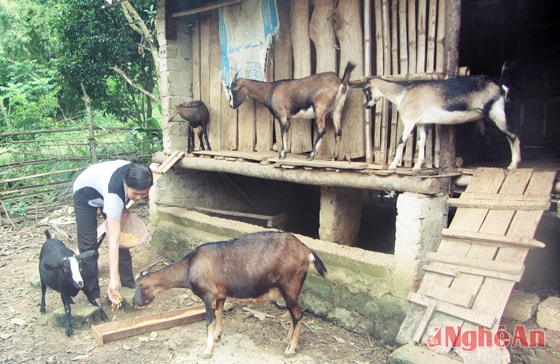 |
| Ms. Ho Thi Chau, from Lien Tan hamlet, Tho Hop commune (Quy Hop district), is taking care of her breeding goat herd. |
From the black pig of Nam Son…
In Nam Son commune, Quy Hop district, since 2013, 20 households have participated in a model of breeding local black pigs implemented by the District Agricultural Extension Center. Although not directly involved in the program, the Chairwoman of the Commune Farmers' Association, Luong Thi Hong, is intimately familiar with the families participating in the model. Therefore, she agreed to guide them.
Lo Van Hung's family lives in Khiet village, but they run a forest plantation and livestock farm in the border area of Binh Chuan commune (Con Cuong district). When we approached him to visit his farm, Mr. Hung said, "Oh, then I have to go call them. They've all gone out to play..." Seeing our unfamiliarity with the phrase "gone out to play," Luong Thi Hong explained, "Then we've come at the wrong time. Mr. Hung's pigs have gone into the forest to plant..." After about 15 minutes of searching, Mr. Hung brought back a pair of black breeding pigs. Pointing to the mother pig, weighing over 60 kg with a full belly, he said, "She's about to give birth to her third litter..." Lo Van Hung's family was given a breeding pair of pigs; they received guidance on breeding methods, technical training, disease prevention, and feed for six months. To date, they have had two litters, totaling 14 piglets. After caring for the piglets for a few months, he kept two female piglets for breeding and sold the rest to families in the commune who needed them for farming at a price of 70,000 - 80,000 VND/kg. He estimated that he earned nearly 7 million VND in profit from the two litters of piglets.
Leaving Lo Van Hung's farm, we visited Tang 2 village to see the herd of hybrid pigs (crossbred with wild boar) belonging to Vi Van Hung's family. A shrewd businessman, he carefully planned his livestock area and built the pens, even raising boars for breeding. Hung also received two black breeding pigs from the district's agricultural extension center. The story of his breeding pigs crossbred with wild boar is quite interesting. It happened when a pair of breeding pigs jumped out of their pen to "go out and play," accidentally encountering a wild boar from a neighboring farm. As a result, after two litters, he has a litter of piglets, including eight gray wild boar piglets with distinctive stripes...
According to Luong Thi Hong, Chairwoman of the Farmers' Association of Nam Son commune, the Thai people of Quy Hop are very attached to the local black pig breed, known as the "small-headed" pig. The traditional black pig is present in all their celebrations. From housewarming ceremonies and funerals to weddings, the offering tray must include a small pig's head and a small chicken. Furthermore, the meat of this breed is as delicious as wild boar meat, making it popular and easy to sell. The local black pig breed is closely associated with the lives of the people, and after more than a year of implementing the model, the economic benefits are evident, so the number of households participating in pig breeding in Nam Son has increased significantly. The total number of local black pigs raised for breeding has now exceeded 80...
...to Tho Hop goats
In Tho Hop commune, although the goat breeding model has only been underway for nearly two months and involves only four households, it has garnered significant interest from the local people. According to Ms. Nguyen Thi Thanh Tam, a land administration and agriculture official and agricultural extension officer in the commune, "everyone likes it and wants to participate." And indeed, they are truly enthusiastic after witnessing the goat breeding models of the households of Ho Thi Chau and Phan Thi Hang (Lien Tan hamlet); Phan Huu Hien (Tho Son); and Nguyen Van Hoat (Thung Khang). Ms. Ho Thi Chau's house is located right next to Provincial Road 532. She currently has a herd of nine goats, two of which she already owns, and the remaining seven were provided through the model. She proudly shared, "It took a long selection process to get chosen." Her family was selected because they own nearly 3 hectares of forest, providing ample fodder for the goats; and they had prior experience raising goats, including existing shelters and some experience... When asked about the differences between goat farming in the past and now, she replied... Feeding the goats corn kernels, she happily said, "Before, I raised them based on experience, but now I've been guided through a clear and systematic technical process, and with veterinary officers monitoring them, I feel much more at ease. Even the goat feed is different now, much better quality..." When she received the goats, each weighed an average of about 15 kg. After nearly two months of care, they are all plump, with some reaching over 20 kg. Ms. Chau anticipates that the goats will reach their breeding season by the end of this year.
At Ms. Phan Thi Hang's family farm, goat farming is practically a closed-loop process. Beside her plump, healthy goats, Ms. Hang excitedly shared that, due to lack of funds, she initially raised only a pair, and gradually expanded her herd. Now, with the addition of goats from her farming model, the total herd has increased from 12 to 20. Her family owns a vast area of hilly forest, so large that "you could walk until your legs ache and still not see the end," with many sections planted with local mahogany trees. She said, "The trunk of the neem tree is for timber, and the leaves are for the goats to eat. Goats really like neem leaves. Of all livestock, raising goats is the best; you get money whenever you need it. You call at night, and the next morning people come to pick them up. There's no haggling over the price; they'll take them for 150,000 dong per kilogram. Besides, goat manure is excellent for fertilizing fields and gardens. About 3 cubic meters of goat manure can fetch 2 million dong, but I never sell it. I use it to fertilize my two acres of corn and to care for my vegetable garden. Each corn harvest yields about 400 kilograms of kernels, which I use as feed for the goats..."
According to Station Chief Phan Thanh Tam, local livestock such as goats and black pigs have very good meat quality, but for a long time, livestock farming has been largely spontaneous, leading to inefficiency and disease outbreaks. Given this situation, the District Agricultural Extension Center has proposed that the District People's Committee consider allocating funds to build models for breeding pigs and goats. "In reality, these are small-scale models, with implementation costs not exceeding 100 million VND for each type. However, after implementation, they have all yielded very good results. Everyone is excited because they have found new ways to develop their economy, create jobs, and alleviate poverty. Seeing the people change their mindset and abandon traditional farming methods makes us very happy, because this ensures the success of these models..."
Nhat Lan - Dao Tuan


