
Open a bullfighting festival.
(Baonghean) - For the Hmong people, hobbies like archery and playing the Hmong flute are not reserved for holidays or special events. Simply put, they are everyday activities, and naturally, when something becomes a hobby, it never gets boring. Bullfighting is also one such everyday pastime...
On a bitterly cold winter day, the open field near the center of Na Ngoi commune (Kỳ Sơn district) was unusually bustling. In the village, under the wooden-roofed houses, people were also crowded together, calling out to each other as they headed to the open field. Tet (Lunar New Year) was still far away, and the harvest season had passed. There were no festivals or celebrations for the villagers at this time. So why was everyone in this small border village so excited and eager?
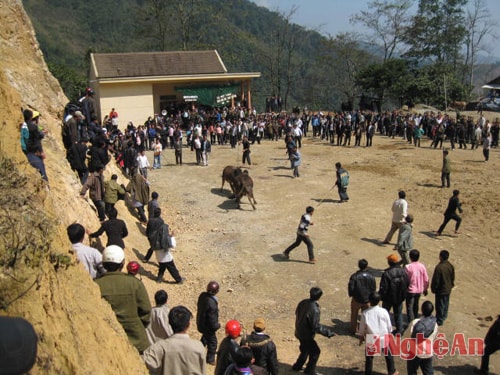 |
| Bullfighting festival in Ky Son district. Photo: Lang Luong |
Lo Van Thanh, a sixth-grade student from Huoi Thum village, was boarding at the commune center to attend school. We had just met when Thanh grabbed my hand and said, "Let's go see a bullfight, Uncle." It turned out there was a bullfight. It was strange; elsewhere, they only held large and small festivals during Tet (Lunar New Year), and only on Tet itself did they hold bullfights. The boy, Thanh, shared, "I've only been here a few months, and I've already witnessed several bullfights." For this Khmu boy, who was completely unfamiliar with bullfights, these competitions held a strange fascination. The field was right next to the school, and whenever there was a bullfight, the students would become restless, unable to concentrate on their lessons. They just wanted to jump into the field.
On the slope of the village, there were two more bulls, led down to the field. Both were eager to fight right from the slope, forcing the two strong men to sweat profusely to control them. A bull owner named Lau Va Denh, residing in Ka Duoi village, said: "Here, it's not just on festivals or holidays; whenever we have free time, there's usually a bullfighting competition."
The origins of bullfighting often stem from the men. After the rice has been stored and the harvest festival is over, the hardworking Hmong men reward themselves with a few days of rest at home. In conversations around the fire on winter days, they discuss village affairs, community matters, business, and even the raising of their buffaloes and cows. The strong, beautiful bulls in the village are brought out for evaluation. Everyone believes they have taken good care of their bulls, which is why they are healthy, strong, and skilled at plowing and pulling. Pride and self-respect are inherent traits of the Hmong people. Therefore, the evaluations easily lead to arguments. The arguments only end when the men decide to bring their bulls to the arena for a competition. That's why, during periods of agricultural inactivity, Hmong villages in Na Ngoi often hold bullfighting festivals.
The wide grassy field was bustling with spectators watching the bullfight. Today's match featured two pairs of bulls from the village of Ka Duoi. The first two "fighters" to enter the arena were quite cautious, observing their opponent for a long time before engaging. However, the match was quite quick, decided in just a few dozen seconds. The losing bull ran towards the fence of spectators seeking shelter. The spectators parted to make way, while the bull's owner frantically chased after it, trying to grab the rope. After the match, the owner of the winning bull was overjoyed. The owner of the losing bull, however, showed no sign of displeasure, a bright smile still on his face.
The first match had just ended when the second pair of bulls entered the arena. Unlike the previous match, the two bulls charged at each other without any introductions. The fierce battle sent dust flying everywhere. Both bulls appeared evenly matched, so the match lasted nearly five minutes. In the end, the bull belonging to Mr. Lầu Vả Dềnh emerged victorious. It eagerly chased its opponent out of the arena, while the two bull owners struggled to control them.
The match ended, and the spectators dispersed. The bulls returned to their grazing grounds. Leading his winning bull back home, Mr. Va Denh said, “It’s nice that my bull won. But the best part is that it still knows how to plow and pull logs.” For the locals here, bullfighting usually doesn’t involve prizes. It’s simply a pastime during leisure time in the fields. For the Hmong people in this border region, whenever they have free time, there’s a festival.
Mr. Mua Do Thai, Secretary of the Party Committee of Na Ngoi commune, said: Bullfighting has been a cultural activity in Na Ngoi for decades. The villagers organize the competitions without any "betting" like in buffalo fighting competitions in the lowlands; it's simply to add to the lively atmosphere of the village. Mr. Thai also shared that during Tet (Lunar New Year), the Mong villages all have bullfighting festivals, sometimes even buffalo fighting.
Huu Vi


