
Expanding livestock farming areas towards "clean" practices.
(Baonghean) - Taking advantage of the benefits of VietGAP-certified biosafety-compliant livestock farming, in many rural areas, small-scale livestock farmers have boldly adopted clean farming practices, initially yielding positive and more sustainable results.
Quynh Luu district currently has over 1,320 hectares of shrimp farms. Therefore, to ensure the sustainable development of shrimp farming, generate high income for the people, and especially to reach large markets such as Europe and the United States, shrimp farmers in Quynh Luu are actively approaching and implementing fundamental steps to build a VietGAP model. Since 2013, on an area of 5,000m2, Mr. Hoang Xuan Tin in Quynh Bang commune (Quynh Luu) has applied intensive shrimp farming according to the VietGAP process. To apply the clean farming process, he buys shrimp fry from a certified supplier, undergoes quarantine before stocking, and buys feed from reputable dealers. He carefully records each step in the farming process, from pond preparation to harvesting and post-harvest waste treatment. According to Mr. Tin, if the VietGAP process is followed correctly, the shrimp survival rate reaches over 90%, and the shrimp grow quickly. One hectare will yield 10-15 tons, generating a total income of over 1 billion VND. After deducting expenses, the profit will be 300-400 million VND. Raising 2-3 crops per year can also generate several billion VND in income. Not only does it improve economic efficiency, but shrimp farming according to VietGAP standards also contributes to environmental protection because wastewater and ponds are carefully treated, thus limiting disease outbreaks.
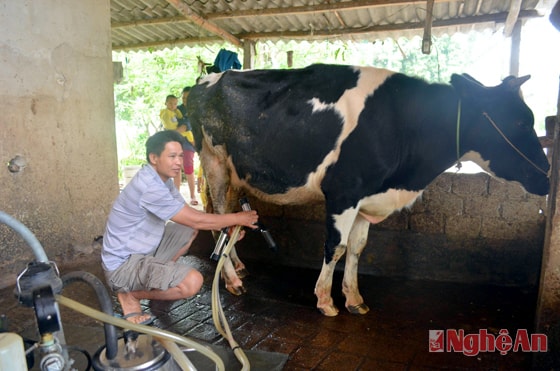 |
| This is the dairy farming model applying VietGAP standards by Mr. Tran Trung Huong in Hamlet 7, Quynh Thang Commune (Quynh Luu District). |
In Dien Chau, Mr. Ngo Xuan Dai's shrimp farming model in Hamlet 4, Dien Trung Commune (Dien Chau District) is considered the most effective and has been granted VietGAP certification. In early 2013, Mr. Dai received 50 million VND in support and borrowed an additional 2 billion VND to build the model. Regarding infrastructure, he built a separate water supply and drainage system, settling ponds, a warehouse for storing feed, and machinery. During the farming process, with technical guidance from experts, he developed a strict farming procedure with documented monitoring and data compilation on feed and shrimp health. Thanks to the strict application of these requirements, his shrimp pond thrived and remained disease-free. At the end of the season, from his 2.7-hectare pond, he harvested 45 tons of shrimp, achieving a yield of 17 tons/ha. After deducting all expenses, he earned a profit of over 4 billion VND. Mr. Dai said: “Previously, I only raised shrimp based on experience, but the weather is becoming increasingly unpredictable. Although I have a lot of experience, shrimp still die in some farming seasons, and some areas have poor growth, so the yield is not high. I think that if we don't change our mindset and apply science and technology to farming, it will be difficult to succeed. Therefore, I boldly applied to apply the VietGAP model with a focus on biosafety, and reality has proven that this is the right and effective direction.”
The VietGAP-compliant livestock farming process, funded by the World Bank's Agricultural Competitiveness Project (LIFSAP), was first implemented in Nghe An province in 2011. The initial models were implemented in four districts: Do Luong, Nam Dan, Nghi Loc, and Dien Chau, involving 439 livestock farming households across 10 communes, divided into 27 groups. These VietGAP-compliant farming groups received training, technical equipment for livestock farming, waste management, and branding for the livestock industry. After three years of implementation, the project has proven effective, with increased productivity and quality of livestock farming. Many households have established closed-system barns that ensure disease safety in livestock farming. 100% of households participating in the VietGAP group receive support in the form of supplies such as gloves, boots, protective clothing, and disinfectants for livestock pens; they also participate in short- and long-term training courses on technology transfer and the application of advanced techniques in livestock farming; and receive capital support for building biogas digesters and upgrading livestock pens.
In households participating in the Project, the vaccination rate for livestock reached over 95% of the total livestock and poultry population, and the livestock farming profits of households applying VietGAP increased by more than 7% compared to other households in the region… Mr. Nguyen Huu Dieu - Head of the Livestock Technical Team of the LIFSAP Project Management Board in Nghe An, said: “To date, 100% of households participating in the project have understood the content and meaning of “clean” livestock farming - especially awareness and ability to practice biosafety in livestock farming. In terms of economic efficiency, 100% of households are maintaining, developing, and tending to increase their herds despite the challenges facing the livestock sector; the livestock herds of these households have increased by about over 10% compared to before participating in the project. In parallel with direct support to households and groups practicing good livestock farming, to ensure clean livestock farming and food safety and environmental protection, the LIFSAP project also invests in localities in the project area.” projects, standardized livestock product markets, support for livestock farmers in building biogas digesters…
Nghe An province has a large livestock and poultry population, with over 750,000 cattle and buffaloes, 1.2 million pigs, and more than 15 million poultry. Livestock farming is gradually becoming a major sector in agricultural production. However, the livestock industry faces many challenges as the environment changes in a complex manner, and the trade, circulation, and transportation of animals lead to the spread and outbreak of diseases. In particular, diseases such as avian influenza, foot-and-mouth disease, swine fever, and swine cholera are becoming increasingly complex. Therefore, expanding livestock farming areas towards "clean" practices and forming a linked chain of livestock farming - slaughtering - food business is a continuous goal of the province's agricultural sector. The benefits from the VietGAP production model are not only economic but also have significant social implications, helping people use products that are safe for their health and environmentally friendly. However, currently, farm products are mainly sold in traditional markets at the same price as the market average. This is the main reason why many livestock farmers are hesitant to implement VietGAP. Therefore, finding markets and certifying products as meeting VietGAP standards should be considered the optimal solution to change consumer perceptions and contribute to the development of the local agricultural economy in the true sense of "clean agricultural practices".
VIETGAP standards (an abbreviation for Vietnamese Good Agricultural Practices) are a process for good agricultural production practices in Vietnam based on four criteria: • Standards for manufacturing techniques. • Food safety includes measures to ensure there are no chemical, bacterial, or physical contaminants during harvesting. • The working environment aims to prevent the exploitation of farmers' labor. • Product traceability. This standard allows for the identification of problems from the production stage to the consumption of the product. Specifically, VietGAP as applied in livestock farming is understood as follows: First, animal feed must not contain additives that could pose a food safety risk to consumers. The second stage (at the farm) involves protecting the animals by administering injections or veterinary medication to prevent food safety risks and ensure there are no chemical residues before they enter the slaughterhouses. The third step is to ensure that livestock and livestock products are transported in a way that protects consumers from food safety risks. The fourth stage (processing) is when livestock becomes food (such as meat), or animal products are processed into food (such as milk). The processing must be carried out under hygienic conditions. Throughout the fifth stage (marketing), food must be handled properly and not placed in uncontrolled environments. Finally, both suppliers and consumers must understand how to handle food safely. |
Ngoc Anh


