
A milestone in the relationship between Vietnam and Cambodia.
These days, looking at a bustling Phnom Penh with its shops, stores, and markets overflowing with goods, the endless stream of new cars on its clean and well-maintained boulevards, and especially the radiant faces of its people, it's hard to imagine that this was once the capital of a country once known as the "Killing Fields."
Thirty-four years ago, on January 7, 1979, when the revolutionary armed forces of the Cambodian National United Front for National Salvation, with the coordination and assistance of Vietnamese volunteer troops, entered Phnom Penh to liberate it, the city was truly a ghost city, both literally and figuratively. A city without people, without schools, hospitals, markets, money, banks, or post offices… only prisons and corpses. It was eerily silent!
Phnom Penh at that time was a "piece" of the "killing fields," with over 2 million people murdered – the horrific consequence of 3 years, 8 months, and 20 days under the brutal genocidal regime masquerading as "Democratic Cambodia" of the Pol Pot-Ieng Sary-Khieu Samphan clique.
Only those who were exiled to the "communes," which were essentially forced labor camps or prisons under "Democratic Cambodia," or who witnessed firsthand the crimes committed by the Pol Pot-Ieng Sary-Khieu Samphan genocidal regime against the Cambodian people, can fully understand the vital historical significance of January 7, 1979, for an entire nation.
Speaking at the 33rd anniversary celebration of this historic day, held on January 7, 2012, in Phnom Penh, the Chairman of the ruling Cambodian People's Party and President of the Senate of the Kingdom of Cambodia, Chea Sim, emphasized: "January 7, 1979, marks the rebirth of the nation, the second birth of every Cambodian citizen," and "without January 7, 1979, Cambodia would not have the achievements it has today."
Cambodia today began yesterday, on that historic day of January 7, 1979. That is a historical fact that no one can deny.
Over the past 34 years, from the "killing fields," Cambodia has revived, overcoming many difficulties and challenges and achieving great accomplishments in the cause of national construction and defense, truly becoming a peaceful, stable, and developed nation with friendly relations with countries in the region and around the world.
Looking at Cambodia's economic growth rate in recent years, one can see how much it has developed. With an average growth rate of 7.7% per year between 2001 and 2010, Cambodia ranked among the top 10 countries with the highest average annual growth rates in the world during the first decade of the 21st century. In 2011, this country of nearly 15 million people achieved a growth rate of 7.1%, bringing per capita income to nearly $1,000.
January 7, 1979 also marked a new chapter in the turbulent history of Vietnam-Cambodia relations.
Contrary to the traditional friendly relations between the two neighboring countries, the Pol Pot-Ieng Sary-Khieu Samphan clique, after seizing power (April 17, 1975), betrayed their friends, considered Vietnam their number one enemy, and launched an invasion along the entire southwestern border of Vietnam in 1977-1978.
Thus, Vietnam's defeat of the invading enemy on the southwestern border and its assistance to the revolutionary forces of the Cambodian National United Front for National Salvation to overthrow the Pol Pot regime not only saved itself and the Cambodian people from genocide, but also put an end to the darkest chapter in the history of Vietnam-Cambodia relations.
And from then on, the sincere and loyal friendship and solidarity between the Vietnamese and Cambodian peoples was not only restored but also grew stronger, becoming a crucial foundation for the two countries to cooperate and develop together.
During their 10 years of international service in Cambodia (1979-1989), with selfless and pure spirits, accepting all hardships and sacrifices, and wholeheartedly dedicating themselves to the revival of their neighboring country, Vietnamese experts and volunteer soldiers left unforgettable marks in the hearts of the Cambodian people.
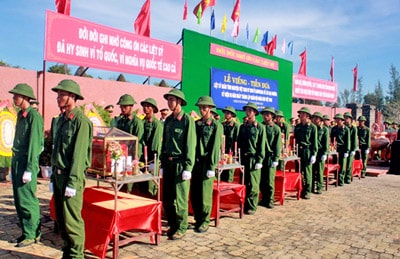
On January 7, 1989, during a meeting with Vietnamese experts preparing to return home, Chairman Heng Samrin said: "The Cambodian people and homeland have deeply engraved in their hearts, and the history of Cambodia will forever record in golden letters, the immense gratitude of the Vietnamese experts, cadres, and volunteer soldiers who successfully fulfilled their noble international duty in Cambodia."
The victory on January 7, 1979, laid the foundation and provided the confidence for the continuous development of the cooperative and friendly relationship between Vietnam and Cambodia. And January 7, 1979, will forever remain a milestone in the history of relations between the two countries.
According to (VNA) - LT


