
All citizens must abide by the law.
(Baonghean Newspaper) - As reported by Baonghean Newspaper, with the responsible involvement of the entire political system and the strong support of more than 4,000 households along National Highway 1A, many sections along the 73.8 km stretch from Hoang Mai Town to Vinh City have been basically completed. However, in Quynh Luu district, 410m/12.25km of the road remains unfinished due to some households re-encroaching on the land, hindering construction…
| RELATED NEWS |
|---|
As is known, although the Quỳnh Lưu district authorities have persistently propagated, mobilized, met with, and held direct dialogues with the people to understand and agree to the implementation of the National Highway 1A expansion and upgrade project, to date, 23 households in hamlets 11 and 12 of Quỳnh Giang commune and 8 households in Cầu Giát town are still deliberately obstructing construction. To ensure the progress of this key national project, on November 7, 2014, the Quỳnh Lưu District People's Committee sent Official Letter No. 2621/UBND-NV to Father Nguyễn Văn Đính - Dean of Thuận Nghĩa parish, requesting his cooperation in propagating and mobilizing Catholic households to support and implement the aforementioned project.
The official document stated: “The project to upgrade and expand National Highway 1A is a key national project, requiring urgent construction progress. The People's Committee of Quynh Luu District requests the priest to direct the Pastoral Council of Thuan Nghia Parish, the Pastoral Council of Tan Lap Sub-Parish, and Yen Luu Sub-Parish to encourage the remaining households not to obstruct construction, not to repeat activities such as ringing bells to gather and bringing large crowds to obstruct the project, and to create favorable conditions for the early completion of the project, ensuring traffic safety and order, contributing to socio-economic goals, and ensuring national defense and security in Quynh Giang commune and Cau Giat town in particular, and Quynh Luu district, Nghe An province in general.”
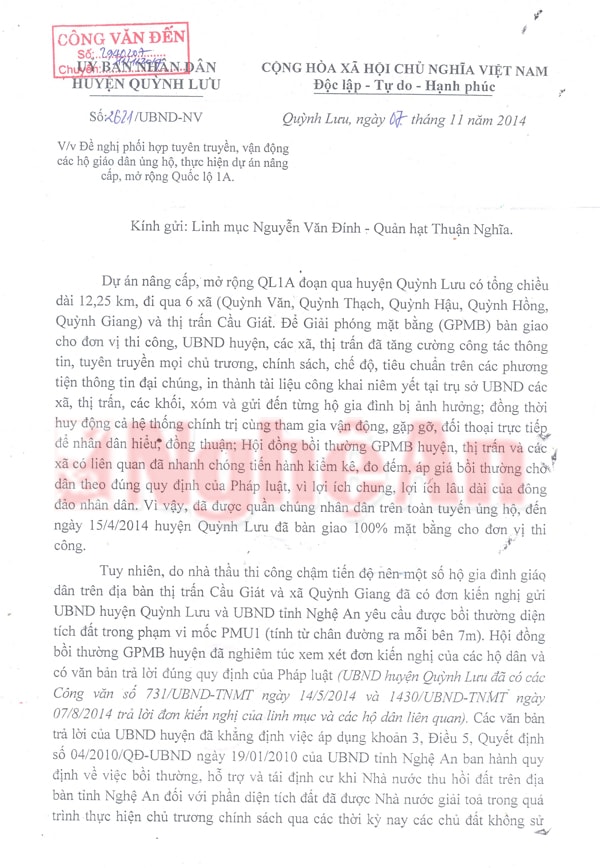 | 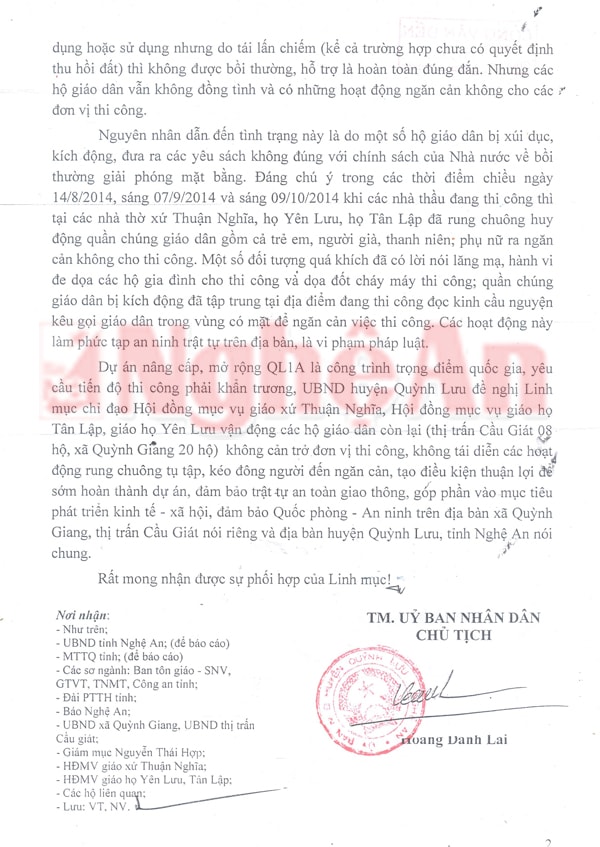 |
| Official document from the People's Committee of Quynh Luu District |
The reason the People's Committee of Quynh Luu District sent a document specifically addressed to Father Nguyen Van Dinh is because the households still obstructing construction on National Highway 1A, the section passing through hamlets 11 and 12, Quynh Giang and block 8, Cau Giat Town, are mainly Catholic households of Tan Lap and Yen Luu parishes, belonging to Thuan Nghia parish - where Father Nguyen Van Dinh serves as parish priest and dean. Furthermore, this is also because, despite exceeding his primary duty of caring for the religious affairs and spiritual guidance of his parishioners, this priest has repeatedly submitted petitions and requests to interfere in the work of the government.
Specifically, on April 21, 2014, Father Nguyen Van Dinh wrote a petition to the People's Committee of Quynh Luu District stating: “Recently, many households in Cau Giat Town and other communes in Quynh Luu District have informed me that their legally owned land has been encroached upon for the expansion of National Highway 1A, but they have not yet received compensation. The expansion of National Highway 1A is the desire of all citizens, as it facilitates travel, reduces accidents and traffic congestion… However, when clearing land related to the legally owned land of the people (with land titles and legitimate origins), the government needs to provide reasonable compensation. Doing so shows that the government respects itself (because the land titles were issued by the government); this is fair, creates trust, and ensures stability among the people. Because I desire stability in the area and for the legitimate rights and interests of the people, I am writing this petition to respectfully request the People's Committee of the district to consider protecting the legal rights and interests of the people.”
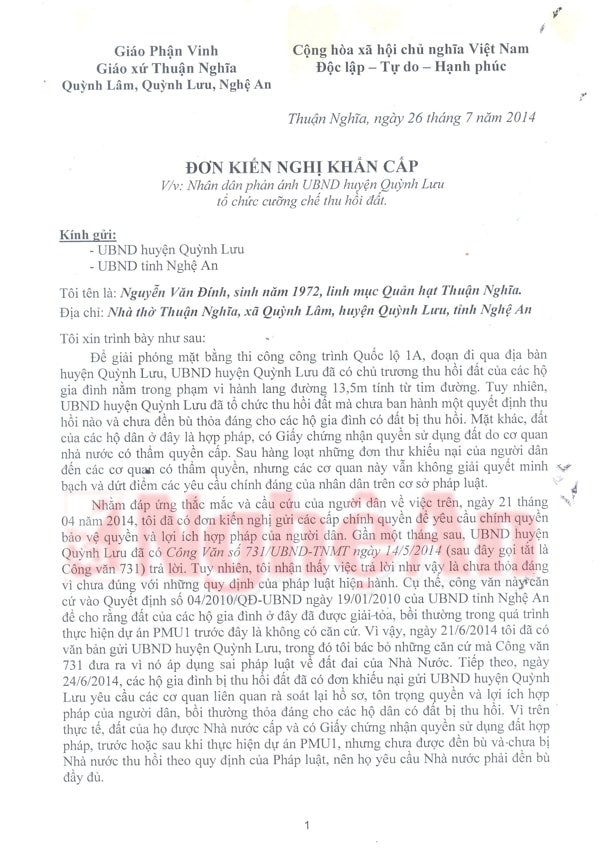 | 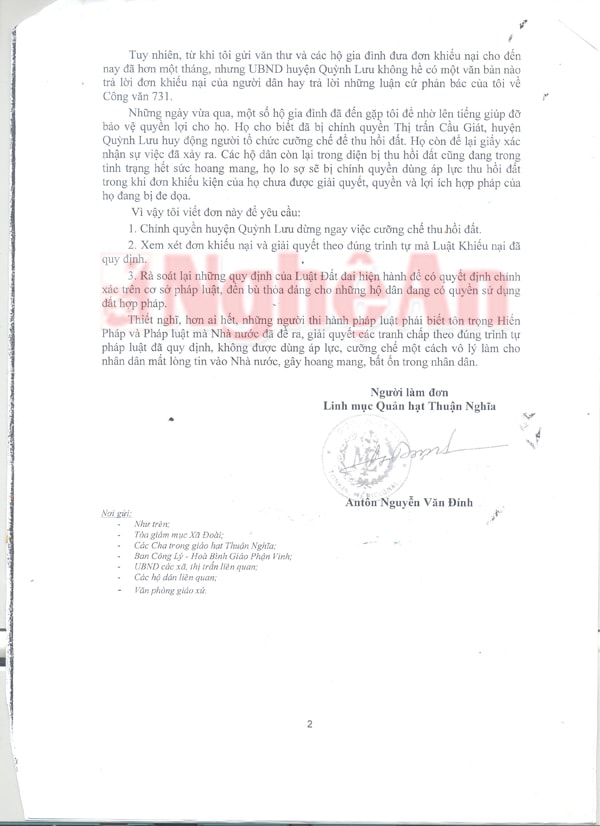 |
| Petition from Father Nguyen Van Dinh. |
Immediately after receiving the petition from Father Nguyen Van Dinh, on May 14, 2014, the People's Committee of Quynh Luu District issued Official Letter No. 731/UBND.TNMT, clarifying that the households in question had land within the 13.5m road corridor that had been cleared during the previous PMU1 Project, and therefore were not eligible for compensation. For cases where the affected land was outside the 13.5m road corridor, compensation and support would be considered based on the land use origin according to regulations. The letter also requested the priest to disseminate information and encourage residents to hand over the land to the construction unit to ensure the project progresses on schedule in accordance with the Government's policy.
Upon receiving Official Letter No. 731 from the People's Committee of Quynh Luu District, and after "discussing with the households involved in the dispute," on June 21, 2014, Father Nguyen Van Dinh continued to send a letter stating: "The government's solution is unsatisfactory; the people disagree because their legitimate rights have not been resolved." He also used the pretext of "for the practical interests of the people and for the prestige of the State government" to subjectively judge that "the People's Committee of Nghe An Province, the People's Committee of Quynh Luu District, especially the Land Clearance Board for the expansion of National Highway 1A through Nghe An Province, need to know that the previous regulations of the Government on traffic safety corridors are not a decision to reclaim land. Because even if it is a traffic safety corridor, that land still belongs to the people's land use rights, so when the State needs to reclaim it, it must issue a decision to reclaim and provide adequate compensation according to the law at the time of reclamation."
In fact, regulations on traffic safety corridors have been in place since 1982. Specifically, Decision No. 6-CT dated January 3, 1990, of the Council of Ministers on the implementation of Decree 203-HĐBT dated December 21, 1982, on the Regulations for Road Protection for National Highways, clearly states:
"1. According to the Road Regulations issued with Decree No. 203-HĐBT dated December 21, 1982, of the Council of Ministers, the scope of roads and road protection corridors is the open space, belonging to the road route for protection, ensuring traffic safety, and for future expansion. Land within the road protection corridor may only be used for growing food crops, flowers, and trees as directed by the Ministry of Transport;
2. On national highways, especially National Highway 1, from the date of promulgation of the Road Protection Regulations, all structures built within the road corridor, whether by land allocation by local authorities at the ward, commune, district, or provincial/city levels, or constructed without authorization, are in violation of the law. Within 6 months from the date of signing this decision, the violating agencies and individuals must remove the aforementioned structures from the road corridor (20 meters from the base of the embankment or the top of the excavation on each side). The State will waive fines and provide no compensation.
In 1993, when implementing the National Highway 1A upgrade and expansion project, with the PMU1 Management Board of the Ministry of Transport as the investor, this unit defined the traffic safety corridor as extending 7m from the edge of the road to each side along the entire route, equivalent to 13.5m from the centerline of the road to each side. In Official Letter No. 1268/PMU1-QLDA2 from Project Management Unit 1 (PMU1) - Ministry of Transport dated July 28, 2010, sent to the Steering Committee for Compensation, Support and Resettlement of the National Highway 1A Upgrade and Expansion Projects through Nghe An Province, it was confirmed: "After reviewing and checking the archived documents at PMU1 regarding the land clearance work for National Highway 1A of the WB1 Project from km 212+000 - km 463+000 (Cau Gie - Vinh City) in Nghe An Province, managed and implemented by PMU1 in the years 1993-1998, PMU1 would like to offer the following opinions: 1. Area where transportation infrastructure under the WB1 Project has been constructed: Procedures for permanent land acquisition up to the construction site have been completed; 2. Area from the construction site to the land clearance marker of the Project." WB1: Sections and routes passing through urban areas are measured 3m from the outer edge of the roadside ditch on each side; sections passing through rural areas are measured 7m from the base of the embankment slope and the top of the excavated embankment slope on each side; sections with adjacent railway lines only have land acquisition markers placed on one side. Within this area, the project has compensated for all structures, buildings on the land, and trees and crops."
Denying all the clear facts, on July 26, 2014, Father Nguyen Van Dinh continued to send a petition to the People's Committee of Quynh Luu District and the People's Committee of Nghe An Province. The petition stated: “In recent days, several families have come to me to ask for my help in protecting their rights. They said that the authorities of Cau Giat Town, Quynh Luu District, mobilized people to forcibly seize their land. They even left behind documents confirming the incident. The remaining households whose land is being seized are also in a state of extreme anxiety; they fear that the authorities will use pressure to seize their land, while their complaints have not been resolved, and their legitimate rights and interests are being threatened.” Father Dinh also made the following demands: “1. The Quynh Luu District government must immediately stop the forced land seizure. 2. Review the complaint and resolve it according to the procedures stipulated in the Law on Complaints. 3. Review the provisions of the current Land Law to make accurate decisions based on the law, and provide adequate compensation to households that have legal land use rights.” Here, Father Dinh needs to understand (or did he understand but still deliberately made unconstructive and legally incorrect suggestions and demands?):
Firstly, the land area within the 13.5m radius (which was cleared in 1993 by PMU1 as the investor) is within the road safety corridor managed by the State. When authorities at all levels have propagated, persuaded, and convinced some of the aforementioned households to continue resisting, the deployment of security measures to protect the construction on the cleared land area is in accordance with the law and cannot be called "forced land reclamation."
Secondly, in fact, during the land clearance process and handover to the construction unit, the government and the Land Clearance Council of Quynh Luu district directed local authorities to focus on disseminating information and publicizing all relevant policies and regulations through mass media and posting them at the headquarters of the People's Committees of communes and towns, and sending them to each block, hamlet, and household. At the same time, they mobilized the entire political system to participate in persuasion, direct dialogue, and written responses to address people's questions and requests in accordance with legal procedures. However, some households in Quynh Giang commune and Cau Giat town still refused to accept the situation, deliberately sending petitions repeatedly to many places with the main purpose of demanding compensation for land within the 13.5m radius. Clearly, considering both legal regulations and state management and the issue of equality and civic responsibility, they have absolutely no right to demand or receive any compensation.
Significantly, Father Nguyen Van Dinh's request to the Quynh Luu district authorities to "resolve disputes according to the legally prescribed procedures, without using unreasonable pressure or coercion that erodes public trust in the State and causes confusion and instability" is inaccurate, subjective, and short-sighted, essentially "adding fuel to the fire." Specifically, the land area belonging to the aforementioned households has been cleared over various periods and currently, naturally, the 13.5m² within the road safety corridor is under State management. Therefore, this area has never been and cannot be disputed land. Furthermore, the deployment of security measures to ensure the progress of this national key project is necessary at all times, in all places, and in accordance with the law. It absolutely cannot be called "using unreasonable pressure or coercion" as Father Dinh suggested.
One might think that in the construction of National Highway 1A – a key national project – it's not just "those enforcing the law must respect the Constitution and the laws of the State," as Father Dinh declared, but all citizens and organizations must respect and abide by the law. And if Father Nguyen Van Dinh truly "respects the Constitution and the law," and as he affirmed, "Expanding the National Highway is an important matter, and the people fully support it because of their responsibility as citizens towards the development of society," then why hasn't he actively cooperated with the authorities to persuade the aforementioned households to hand over the land as soon as possible, creating favorable conditions for the construction to proceed on schedule?
Why did he not question his own civic duty, without any concern for the reality that the modern, four-lane national highway we see today was formed thanks to the consensus, respect for the law, and adherence to state policies of over 4,000 households along the 73.8 km stretch from Hoang Mai Town to Vinh City? Could it be that the 23 households in hamlets 11 and 12 of Quynh Giang commune and block 8 of Cau Giat town are exceptions?
Reporters' Team


