
A bond of affection
(Baonghean)In Thai and Khmu communities, many people have the given name or middle name May. Some are given names like Xu or Hai. These names are related to a custom of giving and receiving children for adoption...
The custom of giving and receiving children for adoption also exists among the Kinh people and many other communities, though it is not very common. However, in many Thai villages in southwestern Nghe An, many children are adopted from a young age. Many families, due to infertility, have to adopt children, mostly only in name. Although considered adopted, the child still lives and eats in the home of their biological parents. This custom is related to the Thai people's belief about the child's birth date. The child's birth is considered a danger to the family; the parents must give the child away, otherwise the child or the parents will fall ill or even die...
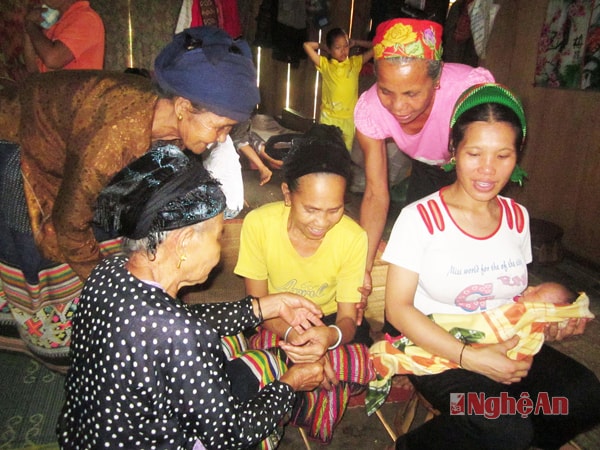 |
| The naming ceremony takes place on the day a child is given or received for adoption. |
In the Thai, Tay, and Muong ethnic groups of Con Cuong district, this custom is prevalent. When a child is born on a particular day and is considered incompatible with their parents, manifesting as frequent crying and illness, or possibly illness affecting the parents or another family member, the child is believed to have "gone to another land" and bring misfortune to the family. A specific day is chosen, and a family within the paternal or maternal lineage is selected to give the child away. Of course, before that, the parents will first go to the adoptive parents' house to ask for permission to "entrust" the child. On the appointed day, the family carries the child to the adoptive parents' home. The offerings usually consist of only two chickens; if the adoptive parents live in the village, boiled chickens may be included. Sticky rice and wine are also brought. At the adoptive parents' home, a ceremony is held to welcome the child. The adoptive family will also slaughter a pig or chicken to celebrate the arrival of the new member. In addition, the adoptive father will give a gift to his adopted child, usually a silver bracelet. Having an adopted child is also an honor for the family.
During the adoption ceremony, a new name is given to the child. This name becomes the common name until the child gets married. In some cases, this name is also used as the birth name. The most common names are "May" or "You," which in Thai also means adopted child, or "Hai" (to sell). After the ceremony, the adoptive mother will carry the adopted child back to her birth mother's home and say, "Please let my child breastfeed from you." From then on, the child will automatically remain at her birth mother's house.
The practice of adoption has certain taboos. In the complex family relationships within villages and communities, a newborn child is often considered "superior" to married members of the extended family. Therefore, they cannot adopt the child. Unmarried individuals, or those married but without children, are also not permitted to adopt.
According to the elders in the highlands, this custom is only intended to "deal with" evil spirits, even house spirits. Once the "evil-dealing" is over, that is, the ritual is complete, the child is now considered part of another family, and the spirits no longer have any reason to torment the child and the family. From then on, all family members will be healthy.
The matter is not yet settled. Once they become sworn siblings, the foster father has the obligation to educate the child as if they were biological parents, and to participate in important ceremonies such as the child's soul-calling ceremony and future wedding. On Tet (Lunar New Year), the child must visit their foster parents with a meal similar to the one offered to ancestors. The offerings include a pair of sticky rice cakes, pork, wine, etc. This bond of affection and responsibility of the child to their foster parents only ends when the foster parents return to their ancestors. Thus, it can be said that this custom of becoming sworn siblings is not only to "deceive" evil spirits, but it also creates a genuine bond between the foster "father" and "child," albeit in name.
Mrs. Vi Thi Chien, 88 years old (Trung Dinh village - Chi Khe - Con Cuong), recalls her childhood... Back then, this area was called Muong Chai. She was born sickly, and the shaman advised her to be given away to another family for adoption. Her maternal relatives at the time were led by a village chief called "Mr. Cham" Huyen. Mrs. Chien's family and the village chief were distant relatives, but they enthusiastically accepted her as their adopted daughter. Of course, only in name. In those days, the village chief and the villagers were very close. They held official positions but were very friendly to the people. She said that those who were given away to other families often recovered their health and were no longer sickly. Explaining this, she said it might be because the child's spirit had stabilized after becoming an "adopted child."
Like other communities, the Thai people also have the custom of adopting children, similar to the Kinh people and other communities. This is not a matter of "tricking" spirits as in the case mentioned above. Families who are genuinely infertile will adopt a child, usually a child from a relative. There are also cases of adoption similar to people in the lowlands, meaning that a familial relationship is not necessarily required. The child will live with the adoptive parents, not just in name as mentioned earlier.
Regarding procedures, on the day of adoption, in addition to the ritual to have the "house spirits" acknowledge the new member of the family, the adoptive parents must announce the event to relatives and the child's biological parents. Since the child will live with the family for life, the adoptive parents must also announce the amount of property they will give to the child. Furthermore, the child's future responsibilities to the new family are also clearly stated. During this adoption ceremony, the child is sometimes given a new name, a procedure similar to the Thai naming ceremony (or "óc khọ"). There was a name previously commonly used for adopted children called "Xự" (or "Sự" - meaning "bought child"). Later, due to the discriminatory connotations of this name between adopted and biological children, communities gradually abandoned it. In modern Thai communities, people use more elegant names with Chinese or even Korean elements for their children. Perhaps the names "Xự" (or "Sự") or "May" will gradually fade into the past?!
In the Khmu community, there are also names like May, Hai, Xu... similar to the Thai people. And the custom of giving and receiving children in this community also has similarities to that of the Thai. This is understandable, because both the Thai and Khmu people live in stilt houses and share many similar beliefs. In many villages, these two communities live interspersed with each other, so the mutual influence between their cultures is also understandable.
Huu Vi


