
Every day, Vietnam generates 13,000 tons of industrial solid waste.
Nationwide, the estimated volume of industrial solid waste generated daily exceeds 13,000 tons, a significant portion of which is hazardous solid waste, mainly concentrated in the two key economic regions of the North and South. Much of this waste originates from light industries, chemicals, and metallurgy, yet it remains largely unmanaged, uncollected, and untreated.
Nationwide, the estimated volume of industrial solid waste generated daily exceeds 13,000 tons, a significant portion of which is hazardous solid waste, mainly concentrated in the two key economic regions of the North and South. Much of this waste originates from light industries, chemicals, and metallurgy, yet it remains largely unmanaged, uncollected, and untreated.
In addition, the total amount of hazardous solid waste generated in craft villages nationwide is approximately 2,800 tons/day. Craft villages in the northern region generate the most solid waste, especially those involved in metal recycling and copper casting, with solid waste including metal shavings, dust, scraps, and rust ranging from 1-7 tons/day.
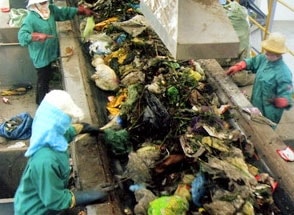
The waste conveyor system at the Trang Cat Waste Treatment Plant in Hai Phong. (Photo: Tran Tuan/VNA)
The amount of industrial solid waste generated from the illegal import of scrap materials such as old or damaged batteries, accumulators, and circuit boards into Vietnam, which must be disposed of, is also considerable.
According to statistics from the Environmental Crime Prevention Police Department of Hai Phong Public Security, in the three years from 2003 to 2006, the unit discovered nearly 2,300 containers containing almost 37,000 tons of waste lead-acid batteries imported into Hai Phong port.
Over the next two years (2008-2009), an additional 340 containers of scrap waste and dozens of containers of discarded lead-acid batteries and electronic circuits were discovered at the port. From 2010 to the present, Hai Phong port still holds more than 300 containers of waste that violate environmental protection laws.
The illegal import of scrap into our country stems from an inconsistent legal system, allowing some businesses to exploit loopholes by importing goods or scrap as raw materials for production. Furthermore, the collection and processing of industrial solid waste has not kept pace with demand, while the volume of waste continues to increase.
Furthermore, the collection and storage of industrial solid waste and hazardous waste have received little attention at small and medium-sized production facilities. Solid waste treatment technology still faces many pressing issues, such as the selection of landfills, transfer stations, and collection points lacking sufficient justification and practical basis; waste treatment technologies do not meet technical and environmental hygiene standards, thus failing to gain widespread support from local residents.
Solid waste treatment facilities are fragmented and scattered across administrative units. Therefore, management is inefficient, investment costs are high, utilization efficiency is low, and land is wasted. Many businesses have not yet invested in technology for waste recycling, as revenue from recycled products is currently quite low and unstable.
According to the General Department of Environment, investment in solid waste management remains severely lacking and unbalanced across different sectors. For example, funding from the Environmental Protection Fund faces significant difficulties in mobilizing additional capital annually; total revenue from various service fees for solid waste management in general, and industrial solid waste management in particular, only covers 60% of the total operating, maintenance, and upkeep costs of the management system. Meanwhile, the budget allocation structure dedicates over 90% to waste collection and transportation, leaving very little budget for solid waste treatment and disposal, insufficient to meet demand.
According to (Chinhphu.vn) - LC


