
The fragile lives of those who still practice 'spirit appeasement' to cure illnesses.
(Baonghean.vn) - We arrived at Tung Hoc village, Huu Khuong commune - one of the most remote and difficult villages in Tuong Duong district - on a hot day. From the upstream dock at Ban Ve hydroelectric reservoir, it takes an hour and a half by boat, then another 30 minutes by car to reach this poor village.
Huu Khuong commune is a particularly disadvantaged commune in Tuong Duong district due to its remote location. The road to Tung Hoc village is even more difficult; although it doesn't require a boat like other villages, the road is rough and full of rocks. Even riding on the back of a motorbike driven by a young commune official familiar with mountainous terrain, we couldn't help but sweat from the steep slopes. Several times I had to jump off because, even with first gear engaged, the motorbike couldn't climb the incline.
The village of Tủng Hốc is home to 84 households with 378 people of the Khơ mú ethnic group. 100% of the households here are poor or near-poor. Looking at the dilapidated, makeshift stilt houses perched on the mountainside, we couldn't help but feel saddened. On the way to the village, we encountered a group of people gathered around a shaman performing a ritual.
Around the shaman, a young Khmu mother was holding her child, whose face was flushed red from the heat. Upon inquiry, we learned that the child had been ill for almost a week and the family had asked the shaman to perform a ritual to ward off bad luck. We were truly worried about the child. Would the shaman's prayers be enough to drive away the "evil spirit" and cure the child's illness?!
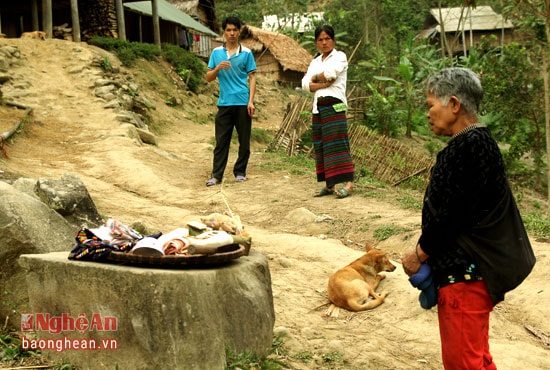 |
| In Tung Hoc, whenever children fall ill, their families always ask a shaman to come and perform rituals. |
The village head of Tủng Hốc, Mr. Lương Văn Nghệ, led us to the family of Cụt Văn Xuyên, whose child is disabled and mentally ill. Mr. Xuyên was away, but his wife, Ms. Moong Thị Xần, was home. Seeing us arrive, the woman quickly threw away the half-rolled cigarette she was holding and poured us some water.
The floor was paved with woven bamboo mats that creaked and groaned, making everyone hesitant to step heavily. It was the hot season, and the rice in the fields had just been sown, so the whole family had nothing to do. Occasionally, they would go into the forest to gather some bamboo shoots for their daily meals.
Speaking broken Vietnamese, Ms. Xần confided that she and Mr. Cụt Văn Xuyên (1982) had three children. Their eldest daughter, Cụt Thị Dương, is currently in 9th grade in Hữu Khuông; their second child, Cụt Văn Liễu (2004), has been disabled and mentally ill since childhood; and their youngest, Cụt Văn Phượng, is currently in kindergarten. Cụt Văn Liễu was a normal child at birth, but after an illness, his body became feverish, and the family didn't know how to treat him, causing convulsions and permanent disability. The young mother, having gone through such hardship, finally understood how difficult it was to care for her child and deeply regretted letting him suffer such a fate.
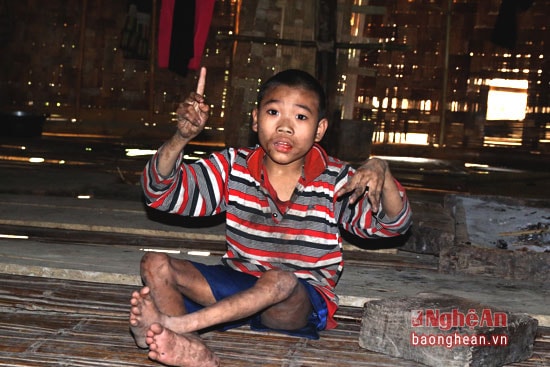 |
| Despite being covered in mud, Cụt Văn Liễu still raised his hand to signal to the camera. |
Indeed, although Lieu is over 12 years old, she looks no different from a three-year-old. Every day, everyone has to take turns looking after her. And she needs help with everything, from eating to drinking. The family receives a monthly allowance of 670,000 VND, which is not enough to cover the expenses for seven people. When we raised our cameras, Lieu stretched out her hand, held up two fingers, and mumbled, indicating she was ready to be photographed. Lieu smelled strongly of something from not having bathed in a long time. Mr. Luong Van Nghe said, "That's how it is for children here. Parents are busy working in the fields all day, just providing food; they don't have time to think about bathing their children."
Lieu's father, Cut Van Xuyen, seeing the family's dire circumstances, applied to work in Quy Hop mining. His monthly salary was over 3 million dong, and after deducting all expenses, he sent all the remaining money back to his family. However, difficulties piled up, and the family still frequently faced hunger.
We went to the house next door to meet Ms. Pit Thi Tien. She and her three children were living in a makeshift hut made of bamboo and leaves, resembling a rice storage shed of the Khmu people. The house's pillars were as thin as an adult's calf, and the thatched roof, covered in bamboo, had become dilapidated and gaping over time.
The mother and her two children didn't even have a bed to sleep on. We asked how they slept on rainy and cold days. Since we couldn't speak Vietnamese, we had to ask the village chief to translate for us. We learned that on those days, the three of them would huddle together inside the house, enduring immense hardship. Their most valuable possessions were a few old, tattered blankets piled up in a corner.
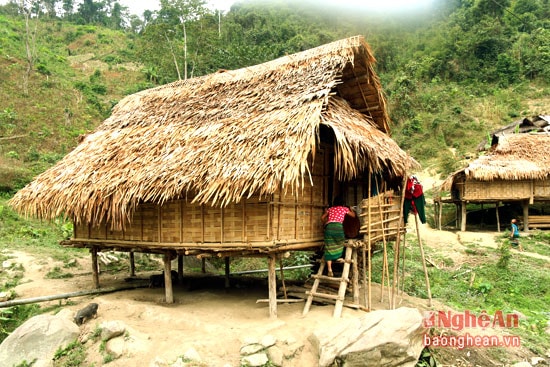 |
| This is the shack where Pit Thi Tien and her three children live. |
Through the words of village head Luong Van Nghe, we came to understand the pain of Ms. Tien's family: She and Mr. Moong Van Hoa, both born in 1976, married and had two children. Their eldest daughter, Moong Thi Tuyen (born in 2001), is growing up but, due to their family circumstances, has not received any education. Their second child, a son named Moong Van Cang (born in 2004), is also ill, with crippled limbs, and spends all day lying in bed.
When Cang was born, Hoa, her husband, inexplicably became involved with drugs, abandoning his family and children to cross the border into Laos in search of solace in the deadly white powder. While working as a laborer in Laos, Moong Van Hoa was arrested for drug offenses. Eight years have passed, and the family has received no news of Hoa. Everyone agrees that he must have died in Laos.
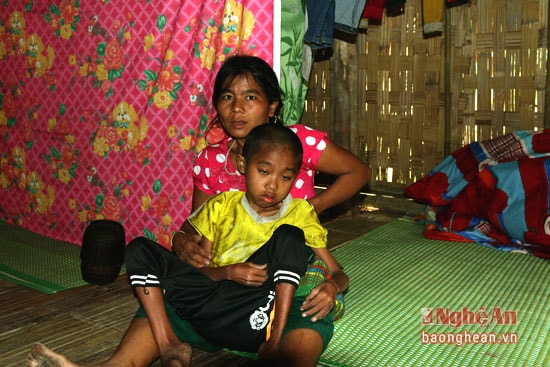 |
| Little Moong Van Cang in his mother's arms. |
Now, Ms. Tien's entire family relies on Cang's monthly allowance to survive. Without laborers, the rice fields yield inconsistent harvests, and they can't raise any livestock, so there are months when the whole family has to subsist on vegetables and rice porridge. Ms. Tien says she wants to go back to the fields to tend the rice plants and raise chickens and pigs, but she's afraid something might happen to her children at home. She says that for over 10 years, she hasn't found a single moment of joyful laughter; this pain remains etched in her heart.
Leaving the village of Tủng Hốc with its dilapidated houses and mud-stained children, we couldn't help but feel heartbroken. Somewhere, the sounds of ancestral worship still echoed. When will people like Ms. Xần and Ms. Tiền finally find peace from their hardships?
In this region, they desperately need help, both materially and in terms of life skills.
Dao Tho
| RELATED NEWS |
|---|


