
A taste of Luong land
(Baonghean) - “Because I love you so much, I discussed with my mother/We must prevent you from going on that trip to Luong.” I don't know why our ancestors...
(Baonghean) - “Because I love you so much, I discussed with my mother/That we must prevent you from going on that trip to Luong.” I don't know why our ancestors composed such a folk song. What was so terrible about Luong that the young wife had to “take it so seriously” that she still “had to discuss it with her mother” to prevent her husband from going? I didn't dare consult the materials of Associate Professor Ninh Viet Giao - a “Nghe An scholar” - who wrote about the origin of the place name Do Luong, for fear of easily getting carried away with citing it without feeling the charm and allure of the ancient Luong region, which is reflected in that folk song and the later proverb “Men of Cat Ngan, women of Do Luong.”
Actually, after some serious work unrelated to writing, at dusk, I stopped by the home of Mr. Vo Van Vinh – a member of the Nghe An Association of Literature and Arts. As the rare afternoon sunlight of winter caressed the banana grove, I conceived the idea of visiting the ancient ruins of a place called Luong. I recall that two years ago, after a trip to the Ban Ve hydroelectric reservoir area (Tuong Duong), I also visited Mr. Vo Van Vinh's house with journalist Tran Chien (the youngest son of Mr. Tran Huy Lieu). While waiting for the host to prepare some Do Luong dog meat to enjoy while chatting, Mr. Tran Chien invited me to explore the ancient ruins and the riverbank where the old Luong ferry landing used to be. With the keen eye of a renowned journalist and writer, he advised me: "You should have the opportunity to write about the 'negative' aspects of this land. You should choose the twilight moment, not follow the usual journalistic style, but explore barefoot; you'll have many interesting insights." Of course, I didn't fully grasp his meaning. And I was forced to switch roles, following him into every alleyway, stopping before each old, moss-covered house, and tracing the riverbank that had once been a muddy, clear stream formed by years of alluvial deposits.
Mr. Vinh's house is in Do Luong Town, a rural area with bustling waterways. From the vibrant commercial center of Do Luong Town, heading north to his house, spreading a woven mat on the brown brick steps of his quiet, old wooden house, and listening to him recount stories of rural life, one easily gets goosebumps and can't help but yearn to experience a land that has flourished early in the folk culture of Nghe An. Surely, he was born and raised there, and now, with his graying hair, he has absorbed the essence of the Luong River!
From what I've vaguely grasped, the name "Đô Lương" is a corrupted version of "Do Luong" (Luong Ferry) from the French colonial period. The Lam River, eroded and deposited over several centuries, has now been "decorated" along its right bank, near what is now Đô Lương, with a bustling ferry landing where locals traded with boatmen from Nam Định, the hometown of the scholar Lương Thế Vinh, who crossed the sea and traveled upstream. The ferry landing got its name from then on. I don't know how many boats from the North regularly came here back then; were those boats similar to the one the scholar Lương Thế Vinh used to weigh elephants? But it has shaped a charming and prosperous riverside market town! I'm from Thanh Chương, sharing the same "Lam River culture" as Vinh. Thanh Chương has men from Cát Ngạn with diverse personalities and early maturity, especially in matters of romance. I suspect that the proverb "Boys of Cat Ngan, girls of Do Luong" originated from the time when the Luong ferry crossing on the right bank was established, where the girls from the market were fair-skinned and well-dressed, making them beautiful and feisty; across the Lam River was Cat Ngan village, and the boys of Cat Ngan were infatuated with the beautiful girls of Luong market, so they would cross over on rafts and boats to tease them, also adopting the habits of the early market dwellers, becoming more cunning, quick-witted, and bold (?). And perhaps the girls of Luong market were so beautiful and feisty that the young wife "had to stop her husband from going on the trip to Luong"?
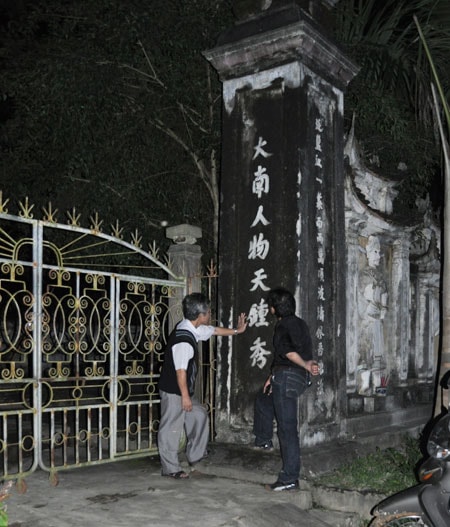
Beside the triple-arched gate of the temple dedicated to Thái phó Nguyễn Cảnh Chân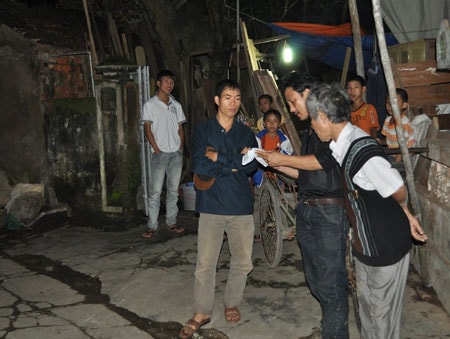
A corner of the alley at night in Phuc Dong village, where the old Luong market used to be.
According to Mr. Vo Van Vinh, Luong Market has moved locations four times, always along the banks of the Lam River. The current topography of the market is, of course, vastly different from the past. The area where Luong Market has moved several times is mainly located in Blocks 1 and 9 of Do Luong Town. The difference is that the roads are not flat like those in the other blocks, nor do they traverse steep hills like in other midland districts, but instead feature gentle, rhythmic slopes. Block 9 is considered the buffer zone around the old Luong ferry terminal. This block, the largest of the ten blocks in Do Luong Town, currently has 348 households with 1,700 inhabitants; of which 40 households are engaged in the production of rice crackers, vermicelli, sausages, and peanut candy; 100 households are relatively well-off; and the average income of the block reaches 30 million VND per household per year. The lingering charm of the old market remains in the small stalls selling local specialties and the occasional ancient, moss-covered little houses, untouched by the concrete paving of roads or new urban planning and construction; and within them reside generations with equally peculiar, secluded lives (I will return to this topic on another occasion - author)...
His injured legs led me along dimly lit alleyways, ancient paths with mud up to my ankles, where I could only discern the locations of the old Luong market. He reasoned that the auspicious land contained many origins, and that it shouldn't be called a coincidence. A little further up was the Do Luong Bara Dam, designed by Prince Souphanouvong (Laos). Did this Prince of the Land of a Million Elephants have a purpose in building this dam, which has stood for nearly a century, right on the old Luong ferry landing? Was it to avoid blocking the ancient waterway that served as a trade route for merchants on the Lam River to Luong (!). Nearly 30 years ago, when I was a child, I had the opportunity to go to Do Luong. The slope of National Highway 7 down to the ferry landing at the end of Do Luong district was enchanting, with rows of flamboyant trees in full bloom, their red blossoms scattered like spiderwebs, moss clinging to the yellow-painted walls of houses with architecture reminiscent of French style. Now, the Do Luong ferry terminal is gone, replaced by a sturdy bridge; the old charm of the town has faded into memory.
Vinh and I trudged through the mud along the riverside paths from the Bara Do Luong dam down to the old Luong ferry landing. The shimmering river at night, the dense shadows of trees, resembled the troops of King Ly Nhat Quang of old patrolling the border against invaders. But precisely, this old riverside path once bore the footprints of the Lam Son uprising army led by King Le Loi of Binh Dinh, who swiftly marched to achieve the "Thunderous Battle of Bo Dang / The Tra Lan region where bamboo was split and ashes flew." Not far from the old Luong ferry landing is the temple of Thai Pho Tan Quoc Cong Nguyen Canh Hoan (Later Le Dynasty), considered one of the founding figures of the Nguyen Canh family here, whose generations were blessed with academic achievements and contributions to their homeland. Further downstream is Lang Vinh Pagoda, now less solemn and spiritually serene… Even more interesting is the detail that the wife of Phan Boi Chau once visited the parents of the poet Vuong Trong in Dong Bich village. Was it a family visit between noble scholars, or the carefree, romantic adventure of Phan's youth that led him on his unstoppable journey to Luong? That's just my guess. For a talented scholar like Phan, Luong was probably just like any other well-known place in Nghe An province, a place where a scholar with a noble soul could leave his footprints.
Leaving the riverbank and returning to Block 9 - Phuc Dong village, Vinh led me along a small, now concreted, road lined with houses. This section of road runs through the old Luong market, which, during two periods of resistance, had two rows of stalls run by women in brown skirts and headscarves, their teeth stained black from chewing betel nut, their lips stained red, embodying the image of the women of the Luong ferry market. Passersby of all kinds and places, later often soldiers, laborers, and lumberjacks, with convoys of cars constantly crossing the Do Luong ferry… The old Luong market was held here on the ninth day of the lunar month, with men and women gathering in large numbers around stalls selling rice cakes and steamed rice rolls, eaten with beef stew and the pork sausage that still retained the flavor of the North, the homeland of the scholar Luong The Vinh. At night, the market square becomes the venue where villages stage theatrical performances featuring stories such as Trieu Thi Trinh, Romance of the Three Kingdoms, and Luu Binh - Duong Le… Each story evokes patriotic spirit and moral principles.
Mr. Vinh also subtly led me to an old location near the former Luong market where a Thanh Lau brothel used to be built, featuring singing and dancing girls in flowing dresses to cater to the romantic tastes of colonial officials and other dignitaries, as well as the ostentatious sons of wealthy families. Strangely, there is no trace of it anymore, and few people remember that Thanh Lau brothel, but on its former site, the imposing Tien Dat guesthouse with its flashing lights has sprung up.
Oh! The ancient Luong region, once a dreamlike place for all kinds of people, now so humble yet still captivating to those who travel and inquire; will there come a day not too far when those in charge will care enough to restore, to some extent, both tangible and intangible, the cultural space of Luong, creating a welcoming destination without fear of being deterred by visitors? Vinh invited me to stay overnight, lying on a bamboo bed with a woven mat, to immerse myself in the rustling sounds of banana leaves, the murmuring of the Luong market, of a Luong ferry landing, and to share stories of the vicissitudes of life and the fates of its people. No matter how much hardship and suffering there has been, the ancient Luong region has already seen encouraging improvements. I only share with him a little of the remaining nostalgia, to add another sense of Luong to my own memories for the future.
Dinh Sam



;)