
A milestone of the Revolution
Exactly 100 years ago, on June 5, 1911, the patriotic young man Nguyen Tat Thanh set out to find a way to save the country. After a long 30 years, on January 28, 1941, the patriotic citizen known as Nguyen Ai Quoc returned to Vietnam to directly lead the Vietnamese revolutionary movement. This day, 70 years ago, has become an unforgettable milestone!
Exactly 100 years ago, on June 5, 1911, the patriotic young man Nguyen Tat Thanh set out to find a way to save the country. After a long 30 years, on January 28, 1941, the patriotic citizen known as Nguyen Ai Quoc returned to Vietnam to directly lead the Vietnamese revolutionary movement. This day, 70 years ago, has become an unforgettable milestone!
Seventy years ago, around this time, President Ho Chi Minh returned to the border of his country. Before returning home, he was busy organizing a training course for Viet Minh cadres, which he personally supervised. This was the first training course, consisting of 40 students divided into two groups, who stayed and studied in the villages of Nam Quang and Ngam Tay (Tinh Tay, China). The training lasted about 7 to 10 days and concluded on January 26, 1941 (the 30th day of the 12th lunar month).
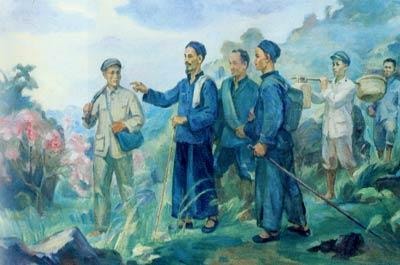 |
Uncle Ho returns to Vietnam (1941). Oil painting by artist Trinh Phong. |
The purpose of the training course was to equip the trainees with an understanding of the new situation and tasks of the Vietnamese revolution; to train them in methods of building and leading national salvation organizations, as well as methods of operation suitable to the new situation. At this training course, President Ho Chi Minh also advised the trainees on what to do and what to avoid in their relations with the people.
Regarding what should be done, the instructors taught the trainees to help the people with practical daily tasks; to learn about customs and traditions (paying attention to what the people avoid); to learn the local language, teach singing and literacy, and to build good relationships with the people; to appropriately propagate revolutionary ideas depending on the time and place; and to make the people see them as upright, diligent, and disciplined individuals so that the people would trust them.
Regarding things to avoid, he advised: Avoid anything that harms the people, soils or damages their houses and fields; avoid begging or borrowing anything from the people at all costs; avoid breaking promises; avoid violating the customs, traditions, and beliefs of the people; avoid revealing secrets. On the evening the training course ended, Uncle Ho and the trainees were celebrating Tet (Vietnamese New Year) at a villager's house in China when they heard that Chiang Kai-shek's army would be coming to the village. The villagers were very scared because Chiang Kai-shek's army was greedy and would loot anything they could find, so everyone was worried about hiding their possessions. Fearing exposure, Uncle Ho and the trainees prepared to return home.
On January 28, 1941 (the second day of the Lunar New Year), he crossed the border back into Vietnam. Upon reaching border marker 108 on the Vietnam-China border, in Truong Ha commune, Ha Quang district, Cao Bang province, he stood silently for a long time, then kissed the first handful of soil of his homeland, deeply moved and filled with emotion. Indeed, "After so many years of longing and waiting, today I finally set foot back in my own beautiful land" (While traveling, telling stories - TL).
Upon arriving in Pac Bo, President Ho Chi Minh moved into Coc Bo Cave. However, before that, he spent the night in a rocky hollow. Above was a rock arch, below was earth. His companions spread leaves for him to rest on. After confirming the route was clear and convenient, he asked, "What does 'Coc Bo' mean?" The guide explained, "It means 'Headwaters'." President Ho Chi Minh said, "That's good! Coc Bo Cave is close to the border, with a secret escape route. Standing at the cave entrance, you can clearly see strangers approaching from afar. This cave belongs to Pac Bo village; in the Nung language, it means 'Mouth of the Source'."
In Pac Bo, there is a long mountain range stretching across the Vietnam-China border. Upon entering the cave, seeing a stalactite shaped like an old man with a beard, President Ho Chi Minh decided to sculpt a statue of Karl Marx. From the 4th to the 13th day of the Lunar New Year of the Year of the Snake (1941), he completed the statue of Karl Marx and inscribed the date February 8, 1941, below it. This is the date he finished the statue, not the date he returned to Vietnam. When the situation was stable, he often went outside the cave and named the stream at its source Lenin Stream and the highest mountain Karl Marx Mountain.
In the early spring of that year, he composed the poem "Magnificent Pac Bo". It was also here that he, on behalf of the Communist International, convened and chaired the Eighth Conference of our Party, a strategically important meeting. The conference determined that the task of national liberation was urgent, organized the Viet Minh fronts, strengthened the armed forces, and moved towards a general uprising to seize power throughout the country. The significance of President Ho Chi Minh's return to the country 70 years ago is immense, yet the journey across the border back then was remarkably simple.
Twenty years after his return, in the spring of 1961, President Ho Chi Minh had the opportunity to visit Cao Bang again to revisit his old haunts. Although he was already at an age "rarely seen," as soon as he stepped off the plane, "He nimbly walked along the forest trails."
Upon arriving at Pac Bo, Uncle Ho climbed the stone steps into the cave where he had once stayed, gazing at the moss-covered stalactites and admiring the statue of Karl Marx that he had sculpted when he first returned. He sat by a rock where a clear stream flowed, seemingly lost in thought for a moment... When he left, seeing the villagers waiting, he cheerfully greeted them and gave the children a few bags of candy. He stopped by the house of Comrade Duong Dai Lam, visited the home of Kim Dong's mother, and went to the place where the statue of the brave young messenger boy who had sacrificed himself long ago was erected..." (Recalling a Time - To Huu).
Seventy years have passed, but the event of leader Nguyen Ai Quoc returning to Vietnam to directly lead the revolution in the spring of 1941 remains deeply etched in the hearts of millions of people and in the history of the Vietnamese revolution; it will forever be an unforgettable milestone, one that must never be forgotten!
Nguyen Viet Chinh


