
A "writer" in Phong village
(Baonghean) - Faced with such circumstances, many would undoubtedly be saddened and disappointed, but he remains cheerful and quite optimistic. Even more remarkably, his spirit is always open to embracing life's ups and downs, distilling them into poems, stories, and articles imbued with compassion. We are talking about Mr. Pham Dinh Tien, a citizen of Quynh Lap leprosy village.
The pain of "Han-sen"
Located near the road from the center of Hoang Mai town to the Dong Hoi Industrial Zone, the Quynh Lap leprosy village is no longer as desolate and deserted as before. We arrived at the beach at dawn. On the long sandy shore, a thin man walked slowly along the edge of the waves, occasionally stopping to take notes in a small notebook and pen. Startled to see us behind him, he looked slightly embarrassed and explained, "Sometimes, on beautiful days like this, it's good to come to the beach to enjoy nature and relax." Glancing at his notebook, a poem was taking shape, written in beautiful handwriting. "Excuse me, are you a literature teacher?" The man smiled, "No, I'm a leprosy patient in this Quynh Lap leprosy village." Our conversation with Mr. Pham Dinh Tien (born in 1950) – the "writer" of this small leprosy village – began like that.
At the age of 20, a time brimming with vitality and dreams, a young man from the coastal village of Cảnh Dương (Quảng Trạch district - Quảng Bình province) suddenly felt numbness and loss of sensation in his hands and feet. The symptoms worsened, to the point where even a burning ember wouldn't cause him pain, and his fingers began to curl up... Upon examination at the hospital, the doctor diagnosed him with leprosy. Phạm Đình Tiến was devastated, feeling as if his body was melting, everything around him spinning. At that time, leprosy sufferers were often ostracized and abandoned, forced to live lives of sorrow and hide their identities. His dreams of joining the army, fighting against the American invaders, and bringing peace to his homeland were shattered. His dreams of attending university, becoming a literature student, and writing poems filled with love and gratitude were also gone. Now, Tiến was enveloped in layers of fog...
Leaving his hometown of Quang Binh, Pham Dinh Tien went to Nghe An for treatment at Quynh Lap Leprosy Hospital. The leprosy village, home to those carrying the Hansen's disease bacteria, is isolated from the wider community, bordered by the sea and flanked by mountains and hills. Like many other patients, Mr. Tien arrived in this land with a sense of sorrow and despair about his fate, but also with hope and faith in a future where he would be cured and his body would be healthy again. Driven by this belief, he strived to integrate with everyone, especially those in similar circumstances. He wholeheartedly comforted, encouraged, and helped those with severe illnesses, instilling in them a flame of hope and rekindling aspirations that seemed buried deep in the ice.
Among the patients who received help, one person held a special affection for Pham Dinh Tien: Nguyen Thi Tuyen (born in 1956), a woman from Nam Sach (Hai Duong). Sharing the same plight, they easily empathized and shared experiences, their bond growing stronger. Even now, nearly 40 years later, Mr. and Mrs. Tien still cannot forget the joys, happiness, and sorrows of those days. The joy and happiness are understandable. But where did the sorrow and sorrow stem from? It all originated from illness and poverty. They got married without even a betel nut tray or a packet of candy; their only means was to travel to Quang Binh to register their marriage and introduce themselves to the groom's family.
That was something they wanted to keep buried deep in their hearts, never wanting to recall it. After having two sons in quick succession, Mr. Tien took his family back to his hometown in Quang Binh. He worked many jobs to make a living, from buying a boat to go fishing, pioneering new economic activities, working as a motorbike taxi driver, guarding parking lots at the market, to opening a barbershop – anything to earn an honest living to support his children. Then two daughters were born, making life even more difficult, but their home in the coastal village of Canh Duong was always filled with happiness. Old age came unexpectedly, health declined, and the symptoms of his old illness returned to torment him. So, after more than 20 years of returning to their hometown to work, make a living, and build a life for their children, Mr. Tien and his wife returned to the leprosy village of Quynh Lap.
Currently, Mr. Tien's children have stable lives; his youngest daughter has graduated from university and is working at the Military Bank. He and his wife live in a dormitory for leprosy patients, subsisting on a monthly allowance of 370,000 VND. They also raise chickens and pigs and work as barbers to make ends meet. While their lives aren't exactly luxurious, they can be considered reasonably comfortable.
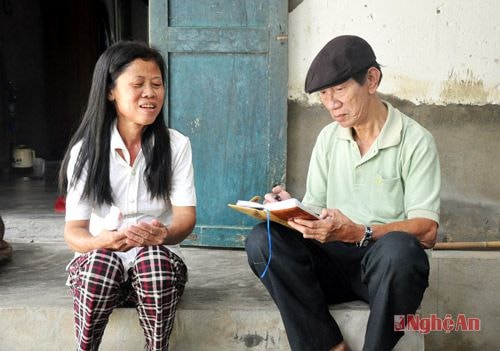 |
| Mr. Pham Dinh Tien is chatting with a resident of Quynh Lap leprosy village. |
Entrust your faith to the written page.
Over 40 years ago, the terrible disease of leprosy robbed young Pham Dinh Tien of his dreams of becoming a soldier and a writer. Occasionally, in his dreams, his youthful aspirations return to support him on his life's journey. It was this unfulfilled ambition, the years of struggling to make a living, and the battle against the disease that allowed Pham Dinh Tien to accumulate life experience, understand the nuances of emotion, and reflect on the meaning of life. These things are essential for a writer and poet. With a sensitive soul, a wealth of life experience, and a rich vocabulary, this man from the leprosy village decided to take up writing.
In fact, he began writing after bringing his wife and children back to Quang Binh to make a living, starting with short stories. He boldly submitted his works to newspapers and literary magazines, then patiently waited and continued writing. A pleasant surprise came when Nhat Le Magazine (Quang Binh) published his short story "The Purple Mua Flower Petal," which was later selected by the Voice of Vietnam Radio to be read in their "Late Night Storytelling" program. This gave Pham Dinh Tien renewed strength, helping him to continue his writing career and rekindle the dreams of his youth that seemed lost. Although he didn't receive formal education, life's lessons taught him many things, and he knew where he stood in this vast world.
More than anyone else, Pham Dinh Tien knows that many people with leprosy have overcome their fate, determined to take up writing and create miracles about their lives. One such person is Nguyen Duc Thin, a Hero of Labor and People's Teacher from Bac Ninh, who was treated at the Quynh Lap Leprosy Hospital and is an elder whom Tien always respects. Nguyen Duc Thin has published an autobiography, "The Story of My Life," recounting his life journey, including his years of treatment and activities at the Quynh Lap leprosy village. And for these "artists" carrying the Hansen bacteria, they always look to the life and career of the poet Han Mac Tu as a mirror, to gain more motivation to overcome adversity. Pham Dinh Tien is no different; he wholeheartedly praises his fellow countryman, the talented poet afflicted with the terrible disease of leprosy. That sentiment found its way into his poetry: “Han Mac Tu - You left behind countless memories / Han Mac Tu - You left behind a myriad of poetic thoughts / Was your departure real or a dream? / Leaving behind a bewildered expression etched deep in the hearts of so many young girls? / You gritted your teeth in pain, an endless, eternal pain / Your tears flowed like drops of poetry...” (Illusion of Love).
Pham Dinh Tien confided: “I fell ill at such a young age, before I could fulfill my dream of joining the army, of taking up arms and crossing the 17th parallel to fight the enemy. Most of my childhood friends, who herded buffalo and cut grass, went to war; some returned, others perished on the battlefield. Therefore, I often write about soldiers, writing to express my gratitude.” Reading his works, we easily encounter images of soldiers, both wartime and peacetime. And sometimes, the theme of soldiers is reflected in the title of his works, such as “The Fate of Soldiers,” “The Harmony of Soldiers,” “Island Soldiers – Hearts of Steel,” and “There Are Soldiers”… His dream is that, at some point, when he has the means, he will compile and publish a book about soldiers, to contribute another voice and perspective on the cause of building and defending the country.
Along with the theme of soldiers, Pham Dinh Tien also writes poems praising the beauty and renewal of his homeland. The beautiful images of Canh Duong village—his birthplace; of Nam Sach—his wife's hometown; and Quynh Lap—where he and his wife currently live—are ever-present in his poems. According to him, these are observations of life, reflections on existence, and an expression of his feelings on paper to seek empathy and understanding. Writing is a way to release emotions and anxieties, to gain more experience, and most importantly, to express the voice of his heart.
Besides writing poetry and short stories, Pham Dinh Tien also dedicates time to journalism. His themes revolve around life in leprosy villages, the struggles and aspirations of people seemingly drowned in sadness and despair. As someone who has experienced it firsthand, he understands the intricacies of life and the depths of the souls of the leprosy village residents. Therefore, his writing is always filled with love and compassion. He showed us his recently completed article, "After the Rain, the Sun Shines Again," about his neighbors, a couple suffering from leprosy, facing extremely difficult circumstances but still striving to overcome them. Their two children are now in university, facing many challenges ahead, but they maintain their faith in life. Mr. Tien expressed his concern that many newsrooms now accept articles via email, putting those who submit handwritten articles like him at a disadvantage in this era of information technology. He also wants to buy a computer to familiarize himself with technology and make his work easier, but his family's finances do not yet allow it. Therefore, every day, his disabled hands meticulously write each line on the page to express his hopes and thoughts about life.
The sun rose again over Quynh Lap beach, marking the beginning of another new day. Pham Dinh Tien's feet once more trod the beach, his eyes once more observed the scenery, and he once again pondered and poured his faith into the pages of his notebook...
Cong Kien


