
A witness to the revolutionary autumn.
(Baonghean) - Mr. Lo Van Xo, 88 years old, residing in Tam Bong village, Tam Quang commune (Tuong Duong district), was one of the militia soldiers who took over the government in Tuong Duong district in 1945. That autumn has passed 70 years ago, but the memory of the day he took up arms to seize power for the people remains vivid in his mind. In our conversation, he still radiated the fervent spirit of an 18-year-old participating in the seizure of power.
We met Mr. Lo Van Xo, one of the 12 militia soldiers who, armed with swords and spears, stormed into Tuong Duong Prefecture to take over power from the old regime. At that time, Tuong Duong Prefecture encompassed three districts: Tuong Duong, Con Cuong, and Ky Son today. The prefectural seat was located in Cua Rao village, Xa Luong commune.
Mr. Lo Van Xo, now 88 years old, lives with his son in Hoa Binh town, thirty kilometers from his old village. His health has deteriorated this year; when we arrived, his children had to help him greet us. Yet, when we mentioned the days of seizing power, he enthusiastically recounted the story with bright, proud eyes: “Back then, we only had spears and swords for the revolution. The whole team had only one gun…” – that’s how Mr. Xo began his story about those days 70 years ago.
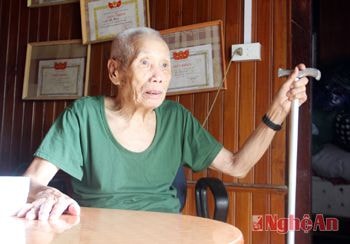 |
| Despite his advanced age, Mr. Lo Van Xo remains very sharp-minded. |
Mr. Lo Van Xo was born in 1927 in Tam Bong village, Tam Quang commune (Tuong Duong district). At that time, this area was called Muong Po. The entire village had only a dozen or so houses. In 1945, young Lo Van Xo had already lived through 18 farming seasons. At that time, following the Viet Minh's announcement, "The French have lost, the Japanese have surrendered. We must make a revolution and seize power," Lo Van Xo enthusiastically joined a 12-person militia. Mr. Pon Van from Chan village, Thach Giam commune, was the team leader. Xo, though younger, was literate and served as the deputy leader, responsible for recording information upon taking over power.
At that time, everyone knew that Governor Năng was renowned for his authority. However, upon entering the governor's gate, there were only two guards, and they laid down their weapons and surrendered. It seemed they understood the situation and were ready to hand over power to the revolution. Inside the governor's residence were only the admiral, the clerk, and the envoy. On the mountain on the right bank of the Lam River were two French military bunkers, normally garrisoned by around 30 soldiers. But they had all fled to Noọng Hét (Laos) since news of France's defeat across the Indochina battlefield. This was a once-in-a-thousand-years opportunity to seize power without firing a single shot, without even having to brandish a sword or spear.
About 20 days after seizing power, the self-defense militia squad disbanded. Returning to his village, Mr. Xo was appointed deputy squad leader, and later became the village militia commander. From 1950, he served as Vice Chairman and Chairman of the Resistance and Administrative Committee of Tam Quang commune. At that time, Ly Doan was the most dangerous opponent in the mountainous border region between Tuong Duong and Con Cuong districts. He sided with the French and was equipped by them to sabotage the revolution. The militia and guerrillas of the commune had almost no equipment, making it very difficult to counter Ly Doan's forces. At that time, the district military command sent a platoon to quell the rebellion. Ly Doan and his son, with the support of some relatives, always hid in the forest, making them very difficult to approach. When the army set up roadblocks to prevent people from crossing the border, he returned to Tung Huong village, only a few kilometers from National Highway 7, and hid in a field hut, a fact that few people suspected.
That time, the soldiers discovered Ly Doan's hiding place and planned to capture him alive. After establishing an outer encirclement, the local militia platoon leader and two other soldiers approached the target, but Ly Doan and his son woke up and fled into the deep forest. After several attempts to capture him, Ly Doan was killed while trying to escape to Laos. "In the period that followed, I suffered a serious illness and was bedridden for four months, so I resigned from my position as chairman of the commune," Mr. Xo continued the story. But after recovering, he participated in teaching literacy classes in the village, and then was appointed by the district to be the Secretary of the Tam Quang Commune Party Branch. At that time, each commune only had one party branch, not a party committee as it is now. The entire commune had more than 20 party members.
Around 1956, the Tuong Duong District Trading Cooperative was established, and Mr. Xo was assigned to be its chairman. At that time, he said, "I only know how to teach, how can I know how to trade?" His superiors advised him to just go ahead and do it, promising that the province and district would provide additional support. After some time, the Provincial Department of Trade transferred him to establish the Tuong Duong - Con Cuong Inter-District Trading Company. This new task was truly difficult for someone who had never experienced business before. The mountainous region's trade at that time was fragmented and small-scale. Goods from the lowlands mainly came through the trade department. In 1958, Mr. Xo participated in a short-term training course at the Central School of Trade. After the course, he was appointed Head of the Finance and Industry-Trade Department of the district. In the following years, until his retirement in 1982, he held many positions such as Deputy Secretary of the District Party Committee, Vice Chairman, Chairman of the People's Committee, and Secretary of the Tuong Duong District Party Committee. No matter what position he held, Lo Van Xo always strived to complete his tasks.
In the memory of this veteran official, who has lived through 88 autumns, many memories intertwine, but the most memorable and beautiful ones he always remembers are the days when he, along with the revolutionary forces and the people, took over the government in Tuong Duong district 70 autumns ago.
Huu Vi


