
A kind heart
(Baonghean)The poet Nguyen Bui Voi has a famous poem about the Nghe An dialect. He translated the poem from the Nghe An dialect into standard Vietnamese for his wife, Ms. Tu, who lives in Hanoi.
The bucket is called the drum.
When you go out to the yard, just say you're going outside to smile.
"Chộ" means "I see myself."
Blanching means dipping, don't laugh.
Listen to me
If you like something, just say you want it.
If you hear someone say "bring a bowl," then bring in a bowl.
Snakehead fish is also called catfish.
Vo trooc means shampooing, dear...
(Nghe An dialect)
Behind his simple words lies a deep love for his homeland. He is proud to be from Thanh Chuong. And, even though he lives in the capital and his wife is originally from Hanoi, he still retains his "Nghe An spirit." I often joke with Vo Thanh An that there are two Thanh Chuong brothers "precipitated" in the capital. When it comes to being stubborn and straightforward, Vo Thanh An and Nguyen Bui Voi are unmatched! In the old days, friendships between fellow countrymen were often considered parochial or regional. But that was in the public sphere. For artists and writers, it didn't matter. If they liked each other and respected each other, they'd be friends, regardless of the consequences!
I first met Nguyen Bui Voi at the third National Young Writers' Conference in Hanoi (December 1985). At that time, he was a famous poet, his poems already included in school textbooks, while I was just beginning my literary journey. Nguyen Bui Voi was tall and had a striking, thick head of long hair. He asked me to drive him from the Writers' Association headquarters to his office. After that initial meeting and conversation, he often paid attention to my works. I remember he was the first person to introduce my poetry collection in the Literature and Arts newspaper. I liked his introduction because he wrote it with great restraint and even pointed out the awkwardness I often encountered in my poetry. However, behind his purely professional words, I could still sense the affection he had for me.
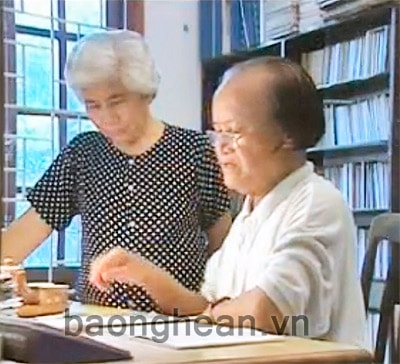
Poet Nguyen Bui Voi and his wife, Do Thi Tu. Photo: PV
Nguyen Bui Voi did not drink alcohol. Although a well-known poet and literary critic, he lived a very modest life. He was also a talkative person. Poet Tung Bach recounted that poet Vo Van Truc often visited Nguyen Bui Voi's house. Truc would sit there for hours without saying a word, silently listening to his friend. After Truc left, Mrs. Tu gently told him, "You should talk less; you should let Truc do the talking." The next time Truc came, he sat silently, waiting but Truc didn't say anything. After Truc left, Mrs. Tu asked, "What was going on between you two today?" He replied, "See? I didn't interrupt him. If he didn't speak, then I had to!"
I visited the poet Nguyen Bui Voi three times. Two of those visits were when he was already ill. His house in the West Lake area was very difficult to find. Even with the address he gave me, I struggled to find it. He said he acquired the house thanks to his children who worked abroad and brought back money to buy the land and build it. His only possessions were books, and he said none of his children had followed in his footsteps. He intended to donate all his books to the local community – his hometown, Cat Van commune – after his death. The last two visits were once in the hospital and once when he was recuperating at his daughter's house near the home of poet Hoang Cat. His wife, Ms. Tu, received me on both occasions.
Ms. Tu was a woman with a kind and benevolent face. I read his article and learned about his love affair with his beautiful student, who loved literature and was devoted to him, but was opposed by the organization because her family were landlords. Nguyen Bui Voi accepted disciplinary action to preserve his love for her. His life was full of ups and downs, from Hanoi to Phu Tho, and back to Hanoi. From a teacher and writer of literary criticism, to an official in the Culture and Information sector, and then an editor of the Arts and Culture program at the Voice of Vietnam Radio, wherever he worked, he left his mark and earned the respect of everyone.
Nguyen Bui Voi is a well-known anecdote writer in the literary world. Anecdotes are stories passed down through folklore, collected and compiled by writers. The writer's talent lies in selecting details of life, writing concisely yet encompassing both tragedy and comedy, sometimes even about a single person, yet conveying the poignant memories of a particular period in history. Many anecdotes told by Nguyen Bui Voi have a wide reach and endure through time. Writers, depending on their perspective, connect with readers and leave a lasting impression in their hearts in various ways.
Talent is something that cannot be treated equally to everyone because it is innate, beyond human control. However, if talent were only used for personal gain and enrichment, people wouldn't bother paying attention to it. Only when talent is used to serve the community and society will it be recognized. I have the feeling that Nguyen Bui Voi dedicated everything most valuable to his profession, the community, his homeland, and his country. He was passionate and sincere in everything he did. Ironically, he wasn't always recognized or treated fairly for his contributions. Even when treated unfairly, he remained optimistic, continued to create, and devoted himself wholeheartedly to the common good and to those he loved and respected.
Speaking of Nguyen Bui Voi's poetry, some argue that when his poems are compiled into a collection, they all sound similar and rather bland. It's true that his poetry lacks breakthroughs in language, form, innovation, and originality. His poetry is simple, a voice from his sensitive heart. Demanding from a writer something that doesn't belong to their writing style is utterly unreasonable. There are countless ways to connect with people's hearts. He has his own creative philosophy. A single poem like "Tieng Nghe," a single "Qua Tham Thinh," a single "Ben Cu"... is enough to paint a portrait of a poetic soul.
There's no competition here. Each work finds its own way to resonate with the public, without any conditions. Everyone experiences youth, but young people are far from having the same life experiences. Many people fear being quickly forgotten, so they hastily try to befriend the younger generation, lamenting their own era and their outdated literature. Yes, there's the inevitable law of historical selection, but suffering endures. Three hundred years after Nguyen Du, The Tale of Kieu still resonates with sorrow!
After Nguyen Bui Voi passed away, I intended to return to my hometown someday, to Cat Van, his birthplace, to hear stories about his childhood, to go to the riverbank where he used to let his buffalo wallow and bathe. He would bathe upstream, while I would bathe downstream, able to hear the playful laughter of children from both Tien Hoi (my hometown) and Cat Van (his hometown). To this day, I have yet to fulfill that dream.
A person may spend only the first ten or fifteen years of their life in their hometown, while the rest of their life is spent wandering and making a living in foreign lands. But nothing can erase the memories of childhood. Homeland is not just the place of birth, the place where one's umbilical cord was cut; it is deeply ingrained in each person's heart through its culture and profound childhood memories. This is the land of inspiration for many writers throughout their lives, including Nguyen Bui Voi. I believe he had the right perspective, lived rightly, and wrote rightly; nothing can replace sincerity, both in life and in writing. That is the philosophy I have learned from Nguyen Bui Voi – a fellow countryman whom I greatly admire!
Le Huy Mau


