
The season when bees return to the melaleuca forest.
(Baonghean)In April, when the rain showers arrive, the melaleuca forests are tinged with a bright green of young leaves. These young leaves daily secrete countless drops of sweet, glistening honey. At this time, itinerant beekeepers begin transporting their bees to the melaleuca forests, collecting this precious honey bestowed by nature...
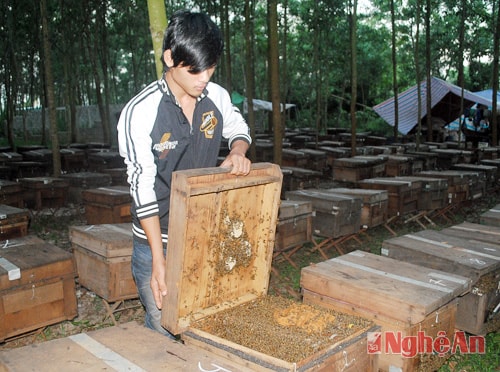 |
| Viên Đình Tuấn's mobile bee farm. |
One afternoon in late June, we followed District Road 22, connecting Tuan Market in Quynh Luu District to Yen Thanh Town, a distance of 43 km. On both sides of the road were vast melaleuca forests. Reaching a melaleuca forest about three years old, in the Trai hamlet of Tan Thanh commune, we saw a temporary shelter, covered with a white striped tarp, next to which were rows of neatly arranged beehives under the shade of the forest canopy. The owner of these beehives was a young man with a distinct Southern accent. He was Vien Dinh Tuan, born in 1989, from Buon Ho Town, Dak Lak Province.
Under the gentle breeze of the melaleuca forest, surrounded by the buzzing of bees, Viên Đình Tuấn candidly shared his experience of itinerant beekeeping: "This itinerant beekeeping job keeps me away from my family all the time. After Tet (Lunar New Year), I move the bees to Lâm Đồng to collect coffee flower nectar, then in February, I move them to Bắc Giang to collect lychee flower nectar. At the beginning of April, I move them to Nghệ An, Thanh Hóa, and Quảng Trị to collect melaleuca nectar until the end of September, then I return to Đắk Lắk to nurture the bees for two months." "The melaleuca trees aren't flowering this season, are they?" Tuấn smiled kindly. "Each tree has a different way of secreting nectar. Melaleuca trees secrete nectar from the axils of their young leaves. This season, with the rain showers, the melaleuca trees develop their foliage, and each young leaf daily secretes precious drops of nectar that only bees can collect. The value of melaleuca leaf nectar is that it's sweet and clear, so its quality is better than that of other flowers."
Therefore, honey harvested from melaleuca forests is always more expensive than honey harvested from lychee or coffee flowers... After saying this, Tuan led me to a melaleuca tree and gently pulled down a branch. Observing carefully, we saw drops of honey clinging to the young leaves. Gently wiping them with our fingers, we found the honey to be thick and viscous, with a pure, sweet taste. Tuan explained that melaleuca leaves usually secrete honey in the early morning and late evening, which is when the number of worker bees flying out to collect nectar is highest. Ideally, there should be a rain shower every 7 to 10 days, as this increases the amount of honey secreted. However, this doesn't mean the bees collect a lot of honey every day. During heavy rain and strong winds, the honey drops on the leaves fall to the ground, and the bees don't have a chance to collect it, resulting in very little honey being brought back to the hive that day. On favorable days, tens of thousands of worker bees bring back 3-4 ounces of honey to each hive. Therefore, honey can be harvested once every 10 days. With approximately 200 beehives, Mr. Tuan harvests around 500 kg of honey each time. The current selling price is 37,000 VND/kg, 5,000 VND/kg higher than last year. The harvested honey is immediately purchased on-site by Dong Nai Honey Company, which processes it into a high-value export product.
Harvesting three times a month yields 1.5 tons of honey, selling for nearly 60 million VND. Everyone says that it's a quick way to get rich from itinerant beekeeping. However, after deducting all expenses, there's not much left. Year-round, traveling from the South to the North and back again costs around 50 million VND just for transportation. Bees are finicky, so transporting beehives is different from other goods. The vehicle must travel slowly, and rest stops shouldn't exceed an hour; longer stops cause the temperature inside the hive to rise, affecting the bees' health. During the beekeeping process, you have to invest in supplementary feed (soybean meal), disease prevention medication, taxes, rent, and "networking" with local authorities... This profession means accepting the challenges of dealing with many different people. In a year with favorable weather, after deducting all expenses, Mr. Tuan still makes a profit of around 100 million VND.
The profession of itinerant beekeeping requires a significant investment to start. For Tuan, at the age of 15, he followed his relatives to beekeeping in various places, so his passion for the profession was deeply ingrained in him. It was deeply ingrained because every time he harvested honey, he was stung by hundreds of bees. Being stung year-round became a habit. At 19, he decided to strike out on his own, but his parents objected, fearing failure because he was young, unmarried, lacked capital and experience. Because he loved the profession, his parents invested 150 million dong in him for 100 beehives, along with another 100 million dong as working capital. During the beekeeping process, he divided his colonies, sometimes reaching 300 hives, but he couldn't manage them alone, so he sold some, leaving him with 200 hives.
To keep bees healthy, beekeepers must be familiar with their disease symptoms. The Italian bees that Mr. Tuan raises often suffer from diseases such as lice (lice infesting the wing stalks), larval rot, and abdominal pain. Therefore, during beekeeping, beekeepers must constantly monitor their bees. If they notice any unusual behavior, they can diagnose the disease and treat it promptly. They always carry medicine for common bee diseases in their travel bag. In addition, they must be aware of bee swarming. For Italian bees, swarming is usually caused by a lack of pollen, a lack of nectar, and attacks by hornets. Mr. Tuan's experience suggests that if there is a lack of pollen, beekeepers should promptly feed the bees soybean meal; if there is a lack of nectar, they should feed them pollen or sugar. Even the placement of the beehive requires skill. Firstly, bees are very sensitive to the environment, so the hives must be placed far away from agricultural production areas. Because during crop production, when humans spray pesticides, bees that come into contact with them while collecting nectar become contaminated with pesticides, affecting their health and the quality of the honey. Secondly, choose acacia forests that are 3-5 years old for planting. Acacia trees only start producing nectar at 2 years old, and the amount of nectar produced gradually decreases after 5-6 years.
The lives of itinerant beekeepers are very simple and makeshift. Inside their makeshift tents are a bed, a wooden chest for clothes, a few dented aluminum pots, plastic water containers, bowls and plates... But their possessions are immense: hundreds of beehives, each worth millions of dong. Facing such a large asset, living in a foreign land, without a home or relatives, how can they ensure the safety of their property and themselves? Ensuring they are not lost or exploited by criminals is no easy feat. "Every land has its guardian spirit," meaning that before arriving in any area, one must establish a close relationship with at least one local person. With the local authorities, one must apply for temporary residency and pay certain fees as required, and also sign a commitment not to disrupt public order or cause forest fires...
With the local people, we must be harmonious, open-minded, and understand their customs and traditions. We should even be willing to help them in any way we can. These are the first steps before placing bees in that area. Bees don't harm crops; they even help with pollination. Recognizing the benefits of bees, local authorities and people are always helpful and supportive. Those who work in mobile beekeeping are likened to "serving a hundred masters." Conversely, in some areas, after we've placed the bees for a short time, people come and demand that we move them elsewhere. They say the bees are destroying their crops, preventing corn from pollinating, and causing rice plants to lose their hairs. At that point, we calmly explain to them the benefits of bees for crops, and only then do they leave us alone. Upon investigation, we learned that during the beekeeping process, we sold honey to local residents at a low price, which made it difficult for other beekeepers in the area to sell their honey, so they tried to cause trouble. Since then, we have never sold honey to local residents again.
Speaking about the secret to success in the itinerant beekeeping business, Mr. Tuan confided: Besides capital, the most important thing is to be passionate about it, to consider the bees as close friends. As for beekeeping experience, books, and reference materials, practical experience is crucial. In the process of beekeeping, each person has their own experience, so beekeepers never hide their secrets or experiences; they readily share them with each other. Therefore, you must thoroughly understand the bee's growth process. From larva to adult bee takes about 20 days, and it takes a week to become a perfect worker bee. Bees have a very short lifespan, from 30 to 40 days; during the honey-gathering process, any old bee will fall to the ground and end its life.
Nghe An is a region with vast areas of melaleuca forests, each year yielding a valuable amount of natural honey. Many people who work as mobile beekeepers from Dak Lak, Lam Dong, and other provinces transport thousands of bee colonies here to collect honey. Each from a different region, they all share the same experience of "serving many masters," so they always strive to create a harmonious living environment. They sleep and wake alongside the bees, and in return, the bees bring them the precious honey bestowed upon them by nature.
Xuan Hoang


