
Muong Ai is both far and near...
(Baonghean) - I once heard that Muong Ai is a "senior village," steeped in age amidst the vast forests of the southern highlands of Ky Son; I thought it must be different from the "late villages" of Bac Ly and Keng Du in the North... But that's not the case; no matter how dear a village is, it remains the same...
Having never been to Muong Ai before, I was very excited when I heard that the Department of Science and Technology's working group was implementing the "Supporting Students to School" program there. After much pleading and persuasion, the officials from the Center for Applied Science and Technology finally agreed, but they warned that even though it was only 40 km from Muong Xen to the center of Muong Ai, it would be very difficult and take almost 3 hours. That's nothing. I've already traveled the remote and treacherous road to Keng Du.
 |
| Presenting gifts for the new school year to elementary school students in Muong Ai commune (Ky Son district). |
At 12:15 PM on September 15th, the delegation departed from Muong Xen town in three vehicles: one specialized pickup truck, two seven-seater vans (one 4x4 and one 4x4), all packed with people. I was in the pickup truck with the delegation; besides officials from the Center for Applied Science and Technology, there were also representatives from the Nghe An Agricultural Materials Corporation and Vinh Hoa Science and Technology Company Limited. After only about five kilometers, the gravel road, precariously balanced with a cliff on one side and the Nam Mo River gorge on the other, had already transformed. The road surface was muddy and uneven, with long ridges and trenches interspersed with deep pits and jagged rocks. The entire convoy stopped. The head of the delegation, Director of the Department of Science and Technology Tran Quoc Thanh, drawing on his experience from working in the mountainous district of Que Phong, decided: "This road is only accessible to four-wheel drive vehicles. So, the single-wheel drive vehicle must turn back and find someone to help swap vehicles... If we can't swap vehicles, we'll just load the goods onto the truck..." Then he "transferred" the personnel from the Nghe An Agricultural Materials Corporation and Vinh Hoa Science and Technology Company Limited to the Pajero, while he and another official went ahead in a pickup truck because they needed to work with the commune.
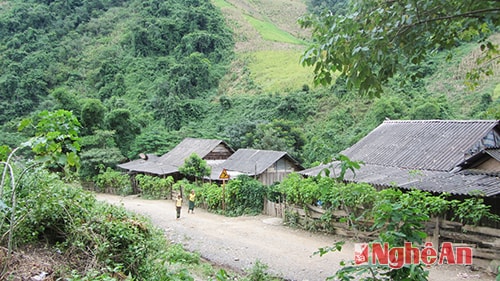 |
| A view of Xop Lau 2 village, in the center of Muong Ai commune, Ky Son district. |
The road from Muong Xen town to Muong Ai is a border ring road, known as Road 7b. Across the Nam Mo River, neighboring Laos is also constructing a road. Road 7b was built about 10 years ago, but only up to the compaction and laying of crushed stone. After a period of use, many sections have seriously deteriorated. Passing through Ta Ca and Muong Tip communes, there are many vulnerable areas, including sharp bends, sections with deep ravines, and areas nestled between mountain passes where water from the high streams causes significant erosion. In such locations, the roadbed is very weak, while trees and boulders on the mountainside protrude as if ready to roll down. In many sections, despite the muddy conditions, people have to get out of their vehicles for safety and to signal for the vehicle to pass. Despite reassuring everyone, "Nothing is as difficult as the road from Chau Thon to Quang Phong and Cam Muon (communes in Que Phong district - PV)," the team leader Tran Quoc Thanh still exclaimed: "These places need drainage culverts and embankments with gabions; leaving them like this is too dangerous..."
After a grueling, bumpy, and bumpy ride in our pickup truck through the communes of Ta Ca and Muong Tip, we finally arrived at the center of Muong Ai after nearly three hours. Before we could even greet the local officials, Mr. Phan Van Hoa, Director of Vinh Hoa Science and Technology Co., Ltd., rushed up on a motorbike, breathless: "Our 4x4 truck broke down in Muong Tip... The brakes failed... Luckily, we were on a flat section of road; if we had gone downhill, it would have been over. Now that we're here, we finally have phone signal to call a mechanic from Muong Xen town to help fix it...!" The fact that we were worried about our vehicle became a hindrance... I indulged my excitement for this "new land" with my eyes. The first impression of the center of Muong Ai was the towering power poles with cables running along the mountainside, xuyên through the villages. However, despite the poles and cables, there was no electricity. "It's been like this for three years," said Mr. Hoa Pho Nganh, Secretary of the Party Committee of Muong Ai commune.
In Muong Ai, the local government had to install a solar power system, while the villagers built embankments along the Nam Tip River and bought turbines to generate electricity for lighting. The young Deputy Chief of Police of Muong Ai commune, Moong Ba Huan, took me to see the commune's electricity system and said that the solar power was usable on sunny days, but in this gloomy weather, it was very poor. It was barely enough for lighting; you couldn't even watch TV, let alone use a computer, printer, or photocopier. Then he sighed: "Oh dear. The government's electricity still hasn't arrived. The power poles have been up for years already..."
We went to visit Lu Pho Kien, who lives in Xop Lau 2 village. Kien is 30 years old, and his wife, as Kien says, "her name is also Lu Pho Kien," is 32. They have four children. The eldest is in 5th grade, then in 3rd grade, 1st grade, and the fourth is just over three months old. Will they have more children? Kien laughed: "It's very difficult, officer. We work on hillside fields, not rice paddies. Raising buffalo and cows is also very difficult because of the frequent diseases." When asked about electricity, she smiled and pointed to her husband. Kien's house is right next to the Nam Tip River. They bought a small turbine for 1.9 million dong to build a dam and generate electricity for lighting. Kien enthusiastically led me down to see the "small hydroelectric plant," and said, "It's fine when things are peaceful, but if there's a drought or a flood, we're doomed." "The flood washed away two of our generators. It's such a shame, but without them to power the lights, we'll have to sell our corn and pigs to buy new ones. We just hope the government will bring electricity back..."
Neither the Party Secretary of Hoa Pho Nganh nor the Chairman of Cut Pho Chien commune knew exactly which unit was the investor responsible for constructing the power line to Muong Ai. They only knew that the power line ran from Na Ngoi and Nam Can, and that the construction unit, upon arrival, had come to the commune to request assistance with land clearance. Party Secretary Hoa Pho Nganh said: "They came to request the commune to calculate compensation for the people, because it affects many households. In Muong Ai, there are 4 villages including Pung, Nha Nang - Huoi Khe, Xop Xang and Xop Lau 2 where low-voltage transformer stations are installed. After compiling the list and installing the power lines, they disappeared. At the beginning of June, the District Finance Department came to check if the compensation was accurate. However, no one has paid compensation yet. The people came to ask, but the commune didn't know how to answer. After the commune signed the documents, they took them away, not handing any copies back to the commune... According to the Chairman of Cut Pho Chien commune, Muong Ai has 389 households and 2,248 people. The majority are Khmu people, with a small number of Mong and Thai people. He said: "It's still very difficult; our whole commune only has about 50 hectares of rice paddies." "The roads are difficult to access, there's no electricity, there are many things we want to do, but we can't..."
More than an hour later, the delegation finally assembled and, along with local officials, went to deliver gifts to the students of Muong Ai Primary School. Around 5 PM, due to a scheduled meeting in Chi Khe (Con Cuong), the delegation had to return to Muong Xen. The journey there was difficult, but the return trip was even harder in the dark. Navigating through the night, at the border between Muong Tip and Ta Ca, the vehicle carrying the Director of the Department of Science and Technology, Tran Quoc Thanh, fell into a pothole. The entire delegation shoveled rocks, used wooden planks to wedge the hole, and even took off their shoes to push, but to no avail. Finally, they had to rely on border guards to help find a cable. It took more than an hour and a half before the convoy could continue its journey. They arrived in Muong Xen at 9:30 PM.
The next morning, by chance, I "luckily" met the Chairman of the People's Committee of Ky Son District and the former Secretary of the District Party Committee, Mr. Bui Tram and Mr. Vi Hai Thanh, in a small roadside shop. I recounted the hardships of the roads and the people's longing for "state-provided electricity." According to them, Road 7b (the Muong Xen - Muong Ai road) was once considered the "Lang - Hoa Lac" of Ky Son, but it was damaged by trucks carrying timber from Laos. As for the power lines and poles, the 4th Regiment was the investor, pulling them from Na Ngoi and Nam Can. The progress and when the electricity would be connected depended entirely on them. I asked if Ky Son could do something about the current state of the roads and electricity, given the condition of the roads and poles. According to former District Party Secretary Vi Hai Thanh, as long as there are trucks carrying timber, the roads will remain damaged. And of course, there will be more trucks carrying timber. Only when there's no more wood to transport will the trucks stop moving... District Chairman Bui Tram didn't say much, only stating, "There are still many places in Ky Son that are struggling. We would like to help, but it's very difficult at this time..."
Listening to the two men share their stories, I was reminded of the Party Secretary of Muong Ai, Hoa Pho Nganh, when he bid farewell to the delegation. He briefly spoke on behalf of the commune, then recited a poem. To be honest, it wasn't very clear through the microphone. I only remember that in the short poem, adapted from the song "Who Goes to Nghe An," he choked up and repeated the line "Whoever passes through here, please stop... Muong Ai" several times. I think that electricity and roads are the most important issues for economic and social development, closely related to the lives of the people. Lacking electricity and roads, along with low-quality officials and limited awareness among the people, Muong Ai still faces many difficulties in changing more quickly!
The journey to Muong Ai was long and arduous, yet I found myself facing the same worries as many other "villages." But I still hope to return to Muong Ai soon, to discover many new things and find joy in this land of "brother and sister villages"!
Nhat Lan


