
Muong Qua this Autumn
(Baonghean)This August, when visiting Muong Qua, the people of the Thai and Dan Lai villages proudly introduce to visitors their homeland, rich in revolutionary traditions, how it has now been transformed...
Sad memories
Traveling over 150 kilometers from Vinh City to the countryside famous for the proverb "Muong Qua rice, Giang River fish," in Mon Son commune, Con Cuong district, the road is no longer rough and bumpy. Turning off National Highway 7 towards the center of the commune, after nearly 20 km, the road has been paved. The treacherous slopes with names like "Mu, Ong" that once terrified drivers have now been eased. From Vinh bus station, a 24-seat passenger bus takes less than 3 hours to reach the area.
Mr. Vi Van Nam, from Thai Son village (Mon Son commune), will never forget the story his ancestors told him about the humiliating days under the rule of the local chieftains and colonialists before the revolution. Even now, hearing the story brings tears to everyone's eyes: His grandfather, Mo Que, had no fields, no house, and not even a piece of cloth to cover himself; the whole family only had one piece of coarse cloth to share. Those on land used the cloth to cover themselves while digging for wild yams and gathering firewood in the forest, while those at home, in both the hot summer and the freezing winter, had to immerse themselves in water and take shelter under a raft made of bamboo.
The family of Mr. Lo Van Thieu still hasn't forgotten the story of the days before the revolution, when they didn't own a single plot of land. Back then, whenever they ventured into the forest to clear land for planting or cultivated fields, they were chased away, assuring them that the land belonged to the village headman. Destitute and hungry, they would sneak out at night to set eel traps in the fields, only to be caught and beaten within an inch of their lives by the headman's family. Like many other Thai people in the villages of Mon Son commune, the families of Mr. Nam, Mr. Thieu, and others now own forest land, buffaloes, cows, fields, ponds, and have built large stilt houses with tiled roofs. Their children are educated and successful.
Visiting the resettled Dan Lai people in Tan Son village, one finds that every family has a spacious home, roads, electricity, schools... a prosperous and civilized life. No longer do they have to endure the hardships of "Following deer footprints to plant rice grains / Following tiger footprints to plant corn kernels / Wandering on mountaintops / Wandering aimlessly on mountain passes..." as in the past. To have reached this point, they surely haven't forgotten the sad legend from the past, from Hoa Quan region in what is now Thanh Chuong district, where they had to flee to the "ends of the mountains and rivers" to escape the deadly beatings of a cruel "village chief" who forced them to find "a boat with oars and a hundred golden bamboo poles."
In the past, the family of Mr. La Van May lived in poverty, subsisting on salt and only eating wild yams and other tubers. Thanks to the revolution that liberated them from colonial and feudal oppression, they escaped a life of misery and darkness. Now, Mr. La Van May's descendants have received an education, with some becoming drivers, officials, teachers, and medical professionals—a typical example of the Dan Lai family.
Transforming the villages
This August, in Muong Qua, the people of the Thai and Dan Lai villages proudly introduce to visitors their homeland rich in revolutionary traditions: In April 1931, the Mon Son Party Branch was established with 5 members, also the first Party branch in the western region of Nghe An province. This is a brilliant milestone in the history of the Con Cuong District Party Committee, and a source of pride for the people of the ethnic groups in western Nghe An. After the establishment of the Mon Son Party Branch, mass organizations such as the Red Peasant Association, the Women's Union, and the Red Self-Defense Force were successively formed and operated effectively. The revolutionary movement spread among the people. The demonstration of the revolutionary masses on the night of August 9, 1931, demonstrated the unwavering solidarity of the ethnic minorities in the struggle for national liberation under the leadership of the Party.
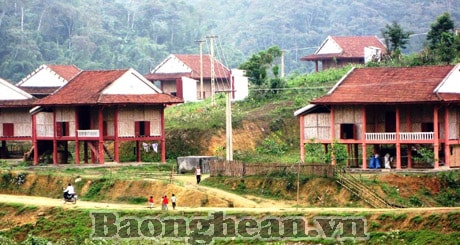
The new version by the Dan Lai people.
In August 1945, from Mon Son commune, the Party branch led the people in seizing power, then marched to the district to participate in the seizure of power for the people. Regarding the development of Mon Son commune, Party Secretary Vi Van Nam said: Over 82 years, since its establishment, from a Party branch with only 5 members, the Mon Son commune Party Committee now has 22 branches with more than 289 members. From a remote, border area, after 78 years of power being in the hands of the people, the face of the mountainous rural area has changed significantly and flourished.
For many years, upholding the tradition of "Muong Qua rice," Mon Son has successfully restructured its farming practices to include three rice crops per year on double-cropped land, applying new varieties and introducing new science and technology into production to achieve rice yields of 54-55 quintals/hectare, with an average food production of nearly 500 kg/person/year. After more than 20 years of reform, 20 km of asphalt road from National Highway 7 has connected to Mon Son, creating convenient transportation for tourism to Pu Mat National Park; the Pha Lai dam, with a total cost of 26 billion VND, has controlled the Giang River, preventing water from irrigating 300 hectares of rice and other crops, creating an attractive lakeside tourist area. The school system and health station in Mon Son commune have been upgraded and modernized...
On September 5, 2012, the Party Committee and people of Mon Son commune had the honor of welcoming General Secretary Nguyen Phu Trong and the Central Delegation to visit and work. This once again demonstrated the profound concern of the Party and State for the ethnic minorities in Mon Son commune and Con Cuong district. During his visit to Mon Son commune, the General Secretary happily acknowledged the achievements and results that the Party Committee, government, and people of Mon Son commune had attained.
The Party Committee and people of Mon Son commune will remember and be determined to implement the General Secretary's instructions, which is to further promote the heroic revolutionary tradition, develop the potential and strengths of the locality, effectively implement the resolutions of the Central and local authorities, strive to reduce poverty, achieve sustainable poverty eradication, further increase the percentage of wealthy households, form specialized production areas, and resolutely build a new rural area.
Furthermore, Mon Son needs to pay close attention to consolidating and maintaining national defense and security, contributing to the development of foreign relations, combating social evils, constantly caring for the lives of ethnic minorities, policy beneficiaries, meritorious individuals, and ensuring social security...; it must do a really good job of Party building, linking it with mass work, people's mobilization work, ethnic and religious affairs, thoroughly assessing the actual role, functions, and tasks of Party organizations, especially at the grassroots level, and implementing practical and effective measures to continuously improve the leadership capacity and fighting strength of Party organizations and Party members...
Minh Thu


